
The Manes arise in Roman religious thought as a cultic category for the divine dead. Classified among the di inferi ('those who dwell below'), they represent the numinous aspect of deceased persons within household and local religion. As a collective designation rather than a single mythic figure, the Manes reflect Roman practices of deifying or ritually honoring ancestors and the broader undifferentiated dead, forming part of the domestic and communal religious economy alongside Lares, Genii, Di Penates, and Lemures.
No consistent anthropomorphic description of individual Manes survives in the sources; they are principally attested through cultic markers. Material and epigraphic signs associated with them include tombstones and memorial inscriptions bearing the abbreviation D.M. (Dis Manibus) and civic/domiciliary markers such as the lapis manalis used in foundation rites. Sources emphasize their role as the spirits of the deceased rather than a visible, standardized form.
As a collective category of the dead, the Manes receive offerings, sacrifices, and ritual address; Latin spells and magical invocations were often directed to them. They are integrated into household and civic religion (alongside Lares, Genii, and Penates) and are propitiated at funerary festivals such as the Parentalia and Feralia. Literary sources record that Manes could be ritually summoned from liminal subterranean sites (for example, Cicero reports they could be called forth from caves near Lake Avernus), but otherwise surviving evidence limits their 'abilities' to receiving cult, being invoked in spells, and occupying the category of chthonic divine dead.
Weaknesses
- conditionplacation by proper cult and offerings
- otherneglect leading to restless or malevolent dead (literary sources link neglected dead with Lemures/Larvae in later accounts)
Wards
- ritualongoing household and familial cult (honor of Lares, Penates, Genii and Manes)
- ritualfoundation deposit of lapis manalis (gate-stone to the underworld) in town foundations
- ritualannual funerary observances: Parentalia and Feralia (commemorative rites and offerings to the dead)
- symbolepigraphic dedication D.M. (Dis Manibus) on tombs as formal dedication to the Manes

Penates (Di Penates)
The Penates are Roman household deities (dii familiares) who inhabit the domestic sphere of the domus. They are cultic presences maintained by routine family ritual—most notably the practice of casting a morsel into the hearth fire at meals—and are associated with Vesta, the Lares, and the Genius of the pater familias.
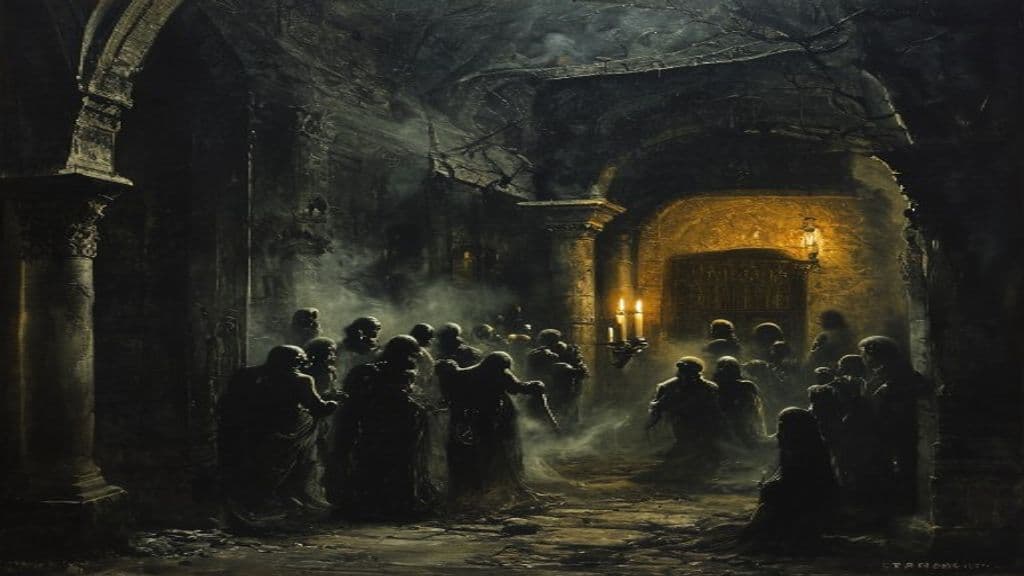
Lemures
The malevolent restless dead of Roman religion — spirits of those who died without proper burial or with unresolved grievances, haunting their former homes until appeased.

Di inferi
A ritual-technical collective in Roman religion denoting the gods and powers 'below' (the underworld), the di inferi comprise chthonic deities, ancestral forces (often overlapping with the Manes), and other underworld entities who receive burnt offerings and are propitiated outside Rome's sacred boundary.

Preta (Hungry Ghost)
A post-mortem supernatural being associated with extreme, unremitting hunger and thirst. In Hindu usage the Sanskrit term can mean a deceased person, while Buddhist traditions develop the category into a distinct realm of hungry spirits whose condition illustrates karmic consequences for demeritorious action.
Pitṛ (Pitris)
In Hindu religious tradition the pitṛs (Sanskrit: पितृ, pl. pitṛs or pitris) are the departed ancestors regarded as a class of beings whose welfare depends on ritual duties performed by living descendants. They occupy Pitrloka (and in some accounts Devaloka or other lokas), are sustained by offerings such as piṇḍa and śrāddha, and—when properly propitiated—are believed to confer blessings and social-religious benefits on the living.
Community Record
- [1]Manes - Wikipedia. Wikipedia, 'Manes'wiki
- [2]Manes - Wikidata. Wikidata entry for Manesother
- [3]Manes - NovaRoma. NovaRoma summary on Manes and Roman cultother