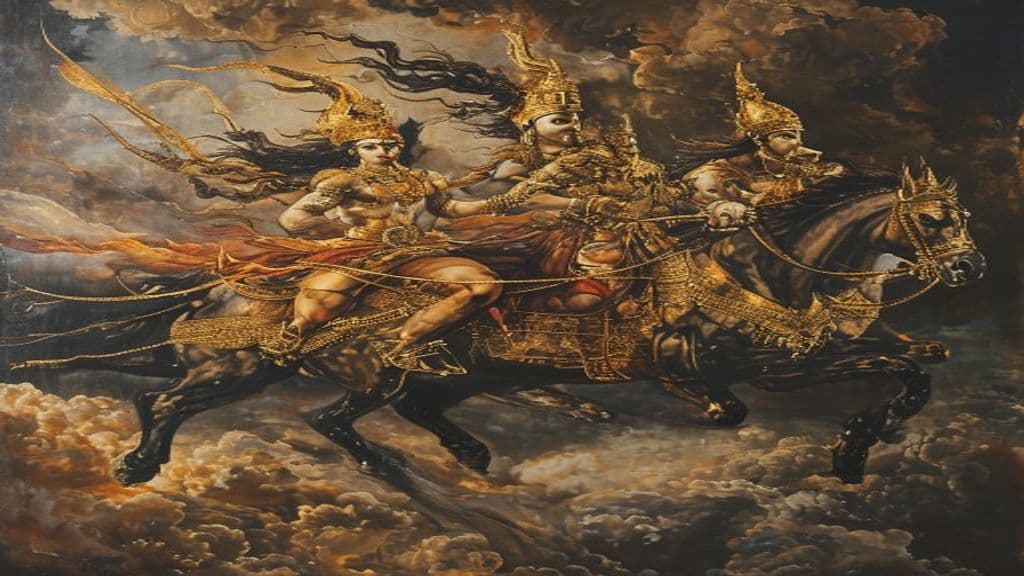
Vedic sources describe the Maruts as a company of storm-gods sometimes called Marutagana and in at least some accounts as sons of Rudra and Prisni. Rigvedic hymns present them as a martial troop whose number varies in hymnic contexts (scholarly summaries note variant counts attested in the tradition). Later Puranic tradition offers an alternate origin in which the Maruts are born from the broken womb of the goddess Diti after an action of Indra (the thunderbolt hurled to prevent a powerful son), producing a different mythic genealogy. They are also at times identified with the Rudras, reflecting genealogical and interpretive variability across Vedic and post-Vedic texts.
Rigvedic hymns and summaries depict the Maruts as young, armed warriors: wearing golden helmets and ornamented armour, riding in golden chariots drawn by ruddy horses, and accompanied by the female figure Rodasi who rides with them on the clouds. They are described with striking physical imagery—having iron teeth and roaring like lions—and armed with golden weapons (lightning and thunderbolts) and axes used in hymn imagery to split the clouds. Rodasi is variably portrayed in sources as mother, consort, or collective beloved and is associated symbolically with lightning.
The Maruts are personified forces of storms: they wield lightning and thunderbolts, split clouds with axes to bring rain, and can make mountains tremble. Characterized as very violent and aggressive, they serve as Indra's companions and assist him in battle against cosmic foes such as Vritra. In the ritual and hymnic sphere they participate in the sacrificial economy—Rigvedic narratives record disputes between Indra and the Maruts over sacrificial shares (including a mythic dispute involving the sage Agastya)—so their role spans natural phenomena and cultic/social relations between gods.
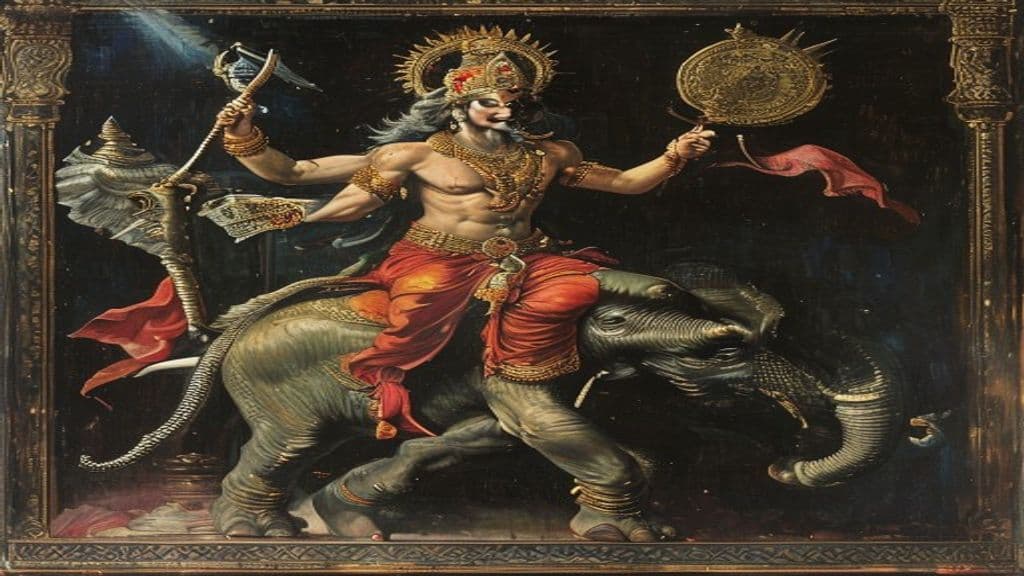
Indra
Indra is a major Vedic deity, king of the devas and lord of Svarga (heaven), associated primarily with the sky, storms, lightning, rain, rivers and martial heroism; he is central in the Rigveda and later appears across Hindu, Buddhist and Jain cosmologies with varying status.
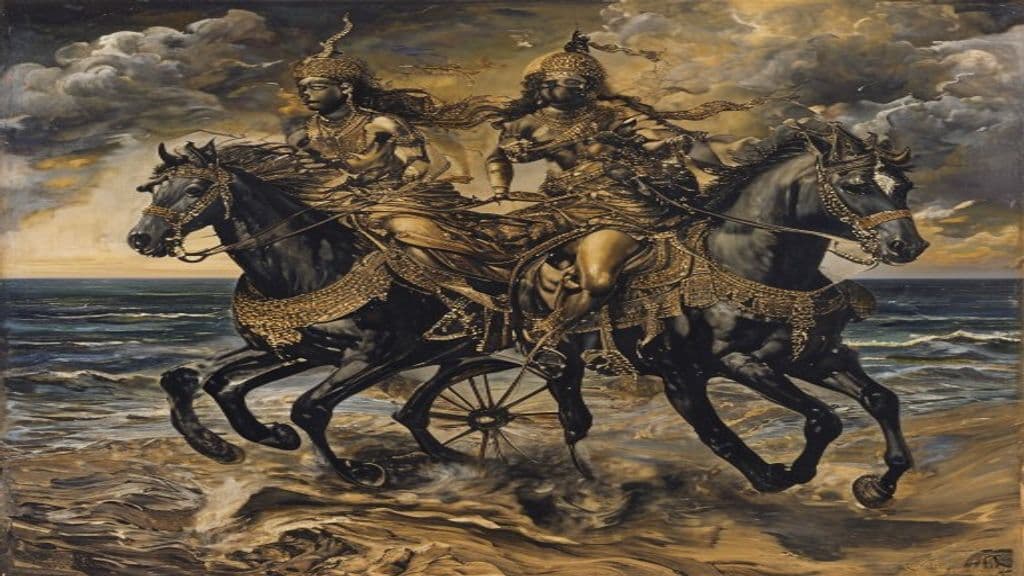
Ashvins
The Aśvin (Ashvins) are Vedic twin divine horsemen invoked in the Rigveda as youthful rescuers and restorers who travel in a swift chariot; they are closely associated with dawn/twilight, healing, and medicine and are repeatedly called upon to save, restore, or bring home those in peril.
Araṇyānī
Araṇyānī is the Vedic forest goddess/personified presence of the wild in early Hindu literature, best known from the Aranyani Suktam (Rigveda 10.146). She embodies the autonomous, productive character of untamed woodlands—elusive, a provider of sustenance, and perceptible by the tinkling of anklets rather than by sight.
Bhikshatana
An aspect of the Hindu god Shiva manifested as the 'Supreme mendicant' — a naked, wandering ascetic who begs for alms as a penitential and pedagogical form. Presented in Puranic narratives and South Indian iconography, Bhikshatana enacts a Kapali vow of expiation and provokes sages and householders as part of a revelatory drama.
Hindu deities
Hindu deities (Deva/Devi) are the diverse gods and goddesses recognized across Hindu traditions, ranging from Vedic forces of nature to later personalized major gods and goddesses. They function as patrons of rites, embodiments of moral and cosmic principles, and focal points for temple cults, festivals, and devotional traditions while often also being interpreted as aspects of a single Ultimate Reality (Brahman).
Prajapati
Prajapati (Sanskrit: प्रजापति) is a Vedic-Brahmana creator figure whose name means "lord of creatures." In Vedic and Brahmana texts he functions as a primordial creative principle and progenitor; in later Puranic layers the term becomes a flexible title applied to multiple creator‑figures (including Brahma and others).
Tvashtr
Tvashtr (also Tvashta, Tvashṭṛ, Tvastr) is the Vedic artisan or fashioner-deity attested in early Vedic hymns and Brāhmaṇa narratives. He functions as the divine craftsman who fashions implements, weapons and sometimes beings for the gods, and in later tradition his role is closely associated or assimilated with the craftsman deity Vishvakarma.
Marraco (Gegants del Clot)
The Marraco is a dragon or frightening creature in Catalan myth associated with the city of Lleida, described in sources as possessing a mouth wide enough to swallow a human whole and commonly invoked in tales told to frighten children.
Mars
Mars is the ancient Roman god of war who also functions as an agricultural guardian; a chief civic deity of early Rome, he is described as the son of Jupiter and Juno and is commonly equated with the Greek Ares while retaining distinct Roman agrarian aspects.
Marsyas
Marsyas is a satyr/silenus of Phrygian myth celebrated as an expert aulos-player who challenges Apollo and is ultimately punished (flayed) for that contest. He is associated with springs and rivers around Celaenae/Kelainai and with older chthonic/Mother-Goddess cultic strands (Rhea/Cybele) in Greek tradition.
Marukos
Marukos is an Ilocano legendary place-bound spirit associated with river crossings and dried riverbed shrublands; tales portray it as a stern, often disembodied old-man voice that waylays large traveling groups, causing disorientation and eventual drowning by flash floods. Stories function as cautionary narratives about observing local norms and the hazards of crossing rivers.
Marzanna
Marzanna (Polish form of Morana/Morė/Mara) is a pre-Christian Slavic seasonal goddess/personification representing winter, decay, and the death-aspect of the vegetation cycle. Her ritual 'death'—commonly enacted by destroying a humanlike effigy—marks the communal transition from winter to spring and is paired in tradition with separate spring figures (e.g., Vesna, Lada, Kostroma).
María (Mariang) Makiling
A diwata — a place‑bound mountain spirit or lambana in Tagalog/Philippine tradition associated with Mount Makiling (Laguna). Portrayed as a beautiful, ageless woman who protects the mountain and aids or punishes people according to local moral rules; colonial contact Hispanicized her name to "María" while older honorifics such as Dayang link her to pre‑colonial veneration.
María Lionza
María Lionza is the central sacred figure of a Venezuelan syncretic popular religion centered on Sorte mountain; venerated as a queen/goddess of nature, love, and healing, she functions as a focal point for mediumship, spirit courts, and pilgrimage.
Community Record
- [1]Maruts - Wikipedia. Wikipedia contributors, 'Maruts', Wikipedia, The Free Encyclopedia.wiki
- [2]Maruts - Wikidata entry Q1906028. Wikidata entry for Maruts (Q1906028).other
- [3]Mythological Studies in the Rigveda (Macdonell). Macdonell, 'Mythological Studies in the Rigveda' (archive).academic
- [4]Vedic hymns (archival collection). Archive: collection of Vedic hymns (references to hymns to the Maruts, e.g., RV Mandala VI).literary
- [5]Vedische Mythologie (Hill, archive). H.H. Wilson / Hill, 'Vedische Mythologie' (archival reference).academic