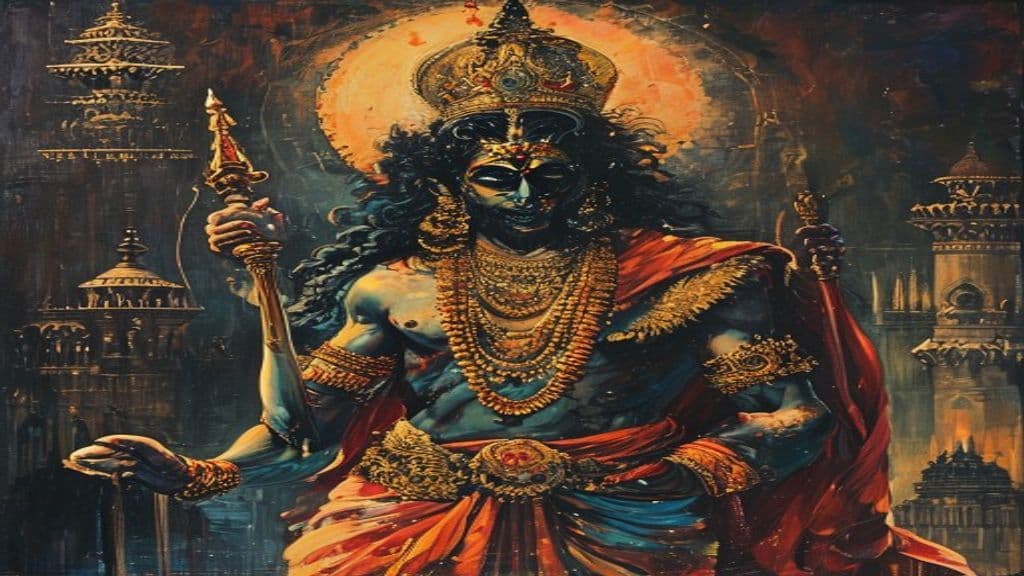
In the genealogical framework of the Sūryavaṃśa, Nimi is placed as a direct descendant of the prime progenitors: he is recorded as a son of Ikṣvāku and a grandson of Manu. Within this mytho-historical ordering he functions as the founding monarch of the Videha polity: tradition names him the first king of the Videha kingdom and presents him as the ancestor from whom the Janaka line of Mithila descends. The Vāyu Purāṇa further situates his activity geographically by stating that King Nimi established a city called Jayantapura near the Gautam Aśram, linking his dynastic role to territorial and sacred geography.
The provided sources supply no physical description or iconography for Nimi. He is presented in texts and genealogies as a Vedic-era king and ancestral figure rather than as a character with described physical features; extant summaries emphasize his place in lineage and rulership. Thus, any specific visual portrayal, dress, or iconographic attributes are not attested in the cited material and remain absent from the sources.
The sources do not attribute supernatural powers, magical abilities, or extraordinary feats to Nimi. His primary 'abilities' as recorded are political and genealogical: he establishes rulership as the first king of Videha, founds a city (Jayantapura, per the Vāyu Purāṇa), and functions as a progenitor whose lineage legitimizes later rulers such as the Janakas of Mithila. The tradition frames his significance in terms of foundational kingship and dynastic continuity rather than miraculous or divine action; no magical or hostile attributes are recorded in the cited excerpt.
Alaka (Hindu tradition)
Mythical city in Hindu cosmology, dwelling place of Kubera and ruler of the yakshas. (Note: - Power tier: Primordial (Alaka's splendor rivals Amaravati, which is a capital of a cosmic deity; thus, it should be categorized as Primordial) - Abilities: The text states Alaka has grandeur and maj)
Asuras
In Vedic mythology, the Asuras are a group of beings described as the 'enemies' or 'opponents' of the Devas (gods), often associated with chaos and disorder. (Note: 1. Power tier should be Ancient (or Deity-level), as they are described as eternal enemies of the gods. 2. Sensory cues and wards/weaknesses sections should be filled in, as there's no information to )
Atharvan
A legendary Vedic sage and creator of sacred texts, associated with the institution of fire sacrifices. (Note: - Power tier: Not Primordial (Atharvan's abilities are more in line with a Greater or Ancient power tier, given his association with the creation of sacred texts and institution of fire sacrifices). -)
Bakasura (Hindu Tradition)
A malevolent rakshasa from Hindu mythology with supernatural strength and ferocity. (Note: - Power tier: Primordial (due to its cosmic and epic-scale impact in Hindu mythology) - Abilities: Remove "at will" as it's not present in the source material - Weaknesses: Not specified in the source)
Brahmahatya (Hindu tradition)
A grave sin and entity in Hindu tradition, representing the act of killing a Brahmin. (Note: 1. Power tier should be Primordial (cosmic) instead of Ancient (deity-level), as Brahmahatya represents a grave sin and not a deity. 2. The article lacks an appearance description, which needs to be a)
Cynocephalics
In Egyptian tradition, cynocephalics are human beings with dog's heads. (Note: 1. The power tier should be Primordial, given the fact that cynocephalics are described as a widely attested mythical phenomenon existing in many different forms and contexts. 2. Add an origin story b)
Daksha yajna
A significant mythological event in Hindu tradition, the Daksha yajna is a ritual-sacrifice organized by Daksha that has far-reaching spiritual and mythological implications. (Note: - Power tier should be Ancient (deity-level) instead of Primordial, as the Daksha yajna is a significant mythological event caused by the wrath of a deity (Shiva), rather than a cosmic power. - Appear)
Durgamasura
An asura king in Hindu mythology, often depicted as powerful and malevolent, who engages in struggles against the gods. (Note: - Summary: accurate - Power tier: Greater (as a powerful regional being, lower than Primordial) - Abilities: too vague; needs more specific details on what abilities are associated with Durgamasura in)
Durukti
In Hindu mythology, Durukti is the sister and wife of the asura Kali, associated with the complexities of human society. (Note: * The power tier is likely incorrect, considering Durukti's association with an asura (a type of demonic being) but not explicitly described as cosmic or deity-level. * Appearance and abilities are mi)
Epic-Puranic Royal Genealogies (Hindu tradition)
Historical accounts of ancient Indian dynasties as recorded in the Epic-Puranic narratives. (Note: - Power tier: Should be Primordial=cosmic (given the historical and genealogical significance), not Minor Spirit. - Summary: Should mention that these are considered historical events by Indian tradit)
Ghoshayatra Parva
Episode from the Hindu epic Mahabharata where Kauravas are captured by gandharvas and released by the Pandavas. (Note: - Power tier: Ancient (deity-level abilities would fit better with the described events in the source material) - Appearance: Should be added as per source material does not describe but one can infer)
Harana (Elopement)
In Hindu tradition, a 'Harana' is an act of elopement or abduction, often against the will of the person being taken. (Note: - Power tier: Primordial (this seems too high given the description; consider Lesser or Minor Spirit) - Abilities: Consider adding that Harana's "powers" are more related to social and cultural influe)
Community Record
- [1]