
Primary sources do not preserve a single, extended origin narrative for Ningishzida. He is attested in the god-list/cultic tradition as the son of the god Ninazu and the goddess Ningirida in the prosopography of Mesopotamian deities; however, surviving hymns, temple inscriptions, and mythic fragments emphasize his roles (vegetation, snakes, underworld, occasional martial functions) rather than a detailed birth or origin tale. The parentage is an attested relational fact in the corpus but full mythic genealogy narratives are limited in the supplied materials.
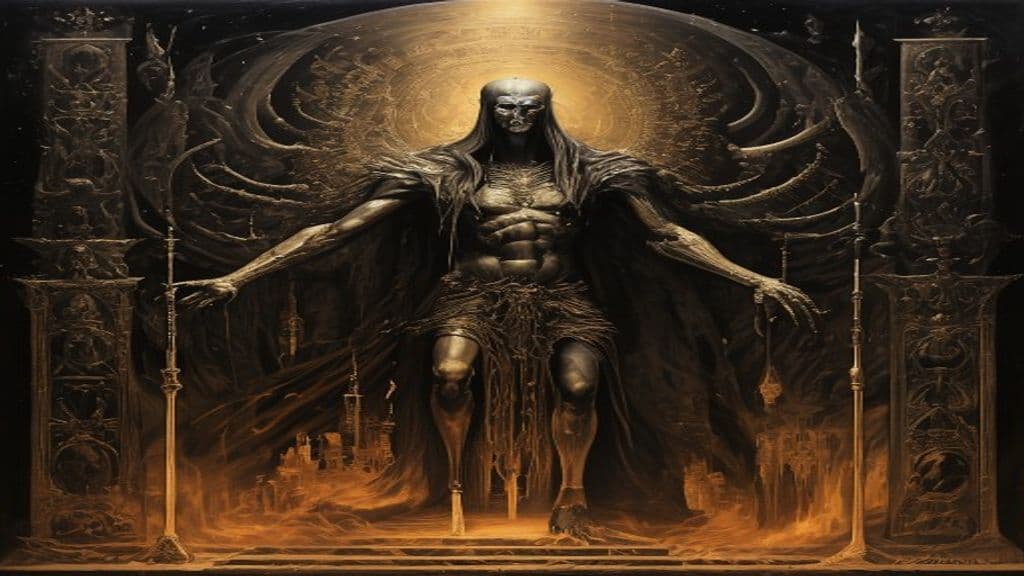
Textual sources repeatedly associate Ningishzida with snakes and serpent motifs (named serpent-types include mušḫuššu, ushumgal, bashmu, and in one attestation Nirah). Hymnic language gives fierce, martial imagery (e.g., 'hero, falcon preying on the gods... fully equipped with arrows and quiver, impetuous leo'), but the supplied corpus does not provide a single fixed anthropomorphic portrait (clothing, color, exact posture) in the excerpts given. Astral associations sometimes link him with the constellation Hydra.
Ningishzida functions as a vegetation deity who provides grass for domestic animals and whose 'annual travel to the underworld' is tied to seasonal decline of plants. He is also repeatedly attested as an underworld figure, holding the title rendered as 'chair bearer' or 'chamberlain' of the underworld in some texts. In some compositions he shares martial and victory-related functions (linked with the victory-goddess Irnina) and is praised in hymns for savage awesomeness and martial prowess. In one tradition (the myth of Adapa) he appears as a doorkeeper to the sky god Anu, showing occasional non-chthonic roles. Modern scholarship groups him typologically with other Mesopotamian snake-chthonic deities.
Weaknesses
- otherNo specific weaknesses recorded in the supplied sources
Wards
- otherNo explicit anti-Ningishzida wards recorded in the provided materials; sources document cultic propitiation (offerings, temple maintenance) rather than repellents

Ninazu
Ninazu is a Mesopotamian chthonic deity associated with the underworld, healing, snakes, and vegetation; his cult originated in Enegi and Eshnunna and appears in hymns, god lists, and incantations from the Early Dynastic through first-millennium traditions.
Nergal
Nergal is a major Mesopotamian deity associated with war, disease, inflicted death, and rulership of the underworld. Principal cult center at Kutha (temple E‑Meslam), he appears in hymns and myths (e.g., the Epic of Erra, "Nergal and Ereshkigal") and is sometimes equated with or called Erra or Meslamtaea.
Community Record
- [1]Ningishzida — Wikipedia. Wikipedia contributors, 'Ningishzida,' Wikipedia, The Free Encyclopedia.wiki
- [2]A balbale to Ningishzida (Ningishzida B) — ETCSL translation. ETCSL, 'A balbale to Ningishzida (Ningishzida B),' translated text.academic
- [3]A hymn to Ningishzida (Ningishzida C) — ETCSL translation. ETCSL, 'A hymn to Ningishzida (Ningishzida C),' translated text.academic
- [4]Wikidata: Ningishzida. Wikidata entry Q1753026.other
- [5]Samim: Ningishzida is a Mesopotamian deity of vegetation and the underworld. Samim blog post summarizing attestations.other
- [6]Archive: caduceus comparative materials (modern discussion referencing Mesopotamian imagery). Modern comparative discussion linking Mesopotamian snake-staff imagery to later caduceus symbolism (secondary interpretive source).other
- [7]WordWeb definition: NINGISHZIDA. WordWeb dictionary entry summarizing the deity.other
- [8]Miscellaneous reference — bibleorigins.net Ningishzida. Online summary linking ancient Near Eastern deity references.other