
In Delian cult tradition the Hyperborean Maidens are virginal female groups said to have travelled from Hyperborea to Delos. Their voyage functions as an etiological myth: it explains the origin of the Hyperborean Offerings that are brought to Delos each year and provides a sacred provenance linking the island's rites to the distant, semi-mythical land of Hyperborea. The phenomenon is presented not as a single individual but as several named small groups (for example Opis, Loxo, and Arge; Hyperoche and Laodice; Achaeia) whose travel and gifts establish recurring ritual practice on Delos. Some ancient sources credit these maidens with bringing the worship of Artemis and Apollo to Delos, but this specific attribution is disputed among authors and traditions.
Primary literary and summarizing sources do not supply physical descriptions of the Maidens; they are identified by origin (Hyperborea), virginal cult status, and by group names rather than by bodily features. Their presence in Delian sacred landscape is also materialized in local topography: excavations on Delos uncovered two tombs that were attributed in the tradition to the Hyperborean Maidens, indicating a cultic anchoring in visible memorials rather than descriptive iconography.
The Maidens' activity in the sources is cultic and etiological rather than overtly supernatural in the sense of hostile or prodigious powers. They are credited with conveying the Hyperborean Offerings to Delos and with participating in hymn-singing associated with those offerings; hymns for the various groups are often attributed to the early poet Olen. Beyond acting as ritual patrons and origin-figures for recurring offerings and rites, the sources do not ascribe aggressive or magical powers to them. Their role is beneficent and commemorative within Delian religious practice.
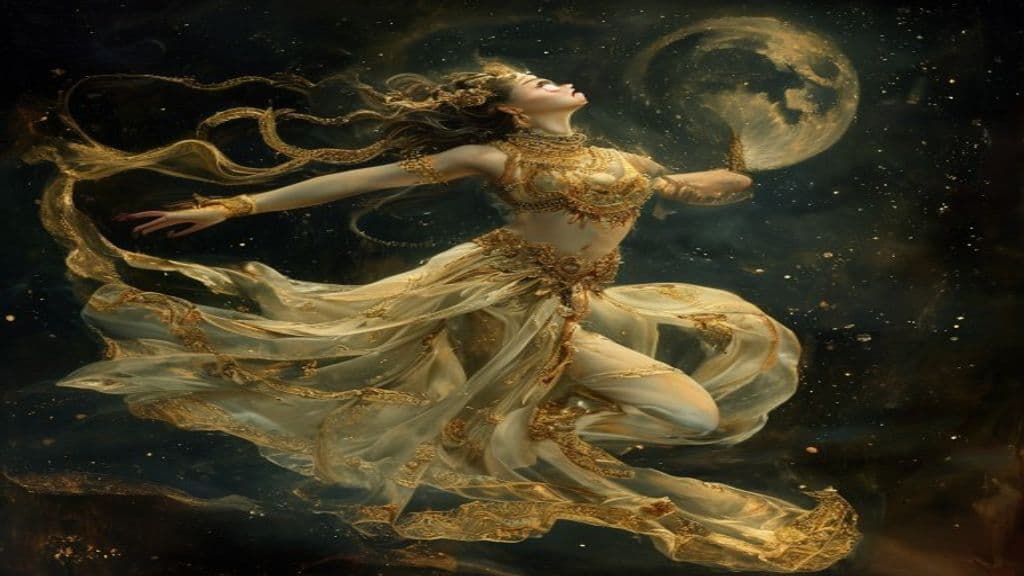
Apsara
Celestial dancers and water nymphs of Hindu cosmology — beautiful semi-divine beings who dance at the court of Indra and, by his command, descend to earth to distract sages from excessive asceticism.
Apsara
Celestial dancers and water nymphs of Hindu cosmology — beautiful semi-divine beings who dance at the court of Indra and, by his command, descend to earth to distract sages from excessive asceticism.
Hylaeus
Hylaeus is a name attested across unrelated referents in classical myth, biological taxonomy, and popular culture rather than a single supernatural being: brief mythic proper names (a centaur and one of Actaeon’s dogs), a cosmopolitan genus of bees (yellow‑face or masked bees), and a named pet dog in the videogame Caves of Qud.
Hylas
Hylas is a mortal youth in classical Greek myth, famed as the beloved companion and arms-bearer of Heracles and (in some accounts) an Argonaut. His myth centers on his disappearance at the freshwater spring of Pegae in Mysia, where naiads either abduct, entice, or transform him, a story remembered in local festivals and widely alluded to in later literature and art.
Hylonome
Hylonome (Ancient Greek: Ὑλονόμη) is a female centaur from Greek mythology known primarily from Ovid's Metamorphoses (Book 12) as one half of a pair of centaur lovers; after her husband Cyllarus is killed in the battle between the Centaurs and the Lapiths she kills herself from grief.
Hyottoko
Hyottoko is a comical masked character in Japanese folk performance, symbolically tied to fire and the household hearth. Primarily a stock clown in dengaku and festival dances, in some regional traditions he is also regarded as a local fire-deity or household talisman associated with luck and productive fire (ironworking).
Hypate
Hypate (Greek Ὑπάτη) is a Muse-figure in Greek tradition identified with the lowest (first) note of the first tetrachord and the tallest string of the lyre. She is attested as one member of a Delphic triad of lyre-Muses (Hypate, Nete, Mese) and is placed in some ancient harmonic cosmologies as custodian of the fixed stars.
Hyperbius
Hyperbius (Ancient Greek: Ὑπέρβιος, Hupérbios, "of overwhelming strength") is a recurring personal name in Greek myth attached to several distinct human or heroic figures—founders, inventors, and warriors—rather than a single supernatural being. The name appears in traditions crediting individuals with inventions (brick-building, the potter's wheel), roles in legendary genealogies (son of Aegyptus), and martial service (defender at Thebes).
Hyperenor
Hyperenor (Ancient Greek: Ὺπερήνωρ, Upērēnōr) is not a single supernatural being but an anthroponym applied to several mortal personages in Greek heroic-age traditions. Figures named Hyperenor appear as a Spartus of Thebes (one of Cadmus' sown men and reportedly worshipped as a hero at Thebes), a son of Poseidon in genealogical lists, a warrior in the Seven against Thebes cycle, a Trojan warrior (son of Panthous and Phrontis) killed in the Iliad-cycle, and one of the suitors of Penelope slain in the Odyssey-cycle.
Hyperion
Hyperion is a polysemous proper name attested in ancient Greek myth as both a Titan (one of the twelve Titans) and as a byname of the Sun-god Helios, and reused widely in modern scientific, literary, and commercial contexts. The available sources treat 'Hyperion' primarily as a name applied to multiple distinct referents rather than as a single, describable folkloric being.
Hypermnestra
Hypermnestra is a mythological mortal from ancient Greek tradition, a daughter of Danaus who alone refused her father's command that the Danaids kill their husbands. By sparing Lynceus she becomes ancestress of the Abantiad line and an exemplar of individual moral refusal within the Danaid narrative.
Hypnos
Hypnos is the ancient Greek personification and god of sleep who induces slumber in mortals and gods. Son of Night (Nyx) and twin brother of Thanatos (Death), he dwells in liminal places associated with dreams and the underworld and appears in myth as a gentle, intervening deity.
Hypsenor
Hypsenor (Ancient Greek: Ὑψήνωρ) is a personal name borne by multiple human figures in the Homeric and related Greek genealogical tradition. The attested bearers are identified by parentage and social role — a Trojan priest, a warrior under Antilochus, and a son of Neleus and Chloris — and are recorded mainly by their fates in battle.
Hypsistos (Theos Hypsistos)
Hypsistos (Θεός Ὑψιστος) is an ancient divine epithet and cultic designation meaning "God Most High" attested in inscriptions, votive altars, and occasional temple dedications in Asia Minor, the Black Sea region, and the eastern Mediterranean from the Hellenistic period into late antiquity. It functions as a titulary focus of worship — sometimes attached to established gods (e.g., Zeus Hypsistos) and sometimes invoked more abstractly by groups later called Hypsistarians in fourth‑century Christian writings.
Community Record
- [1]Hyperborean maidens. Wikipedia: Hyperborean maidenswiki