
The English/French term ogre has a literary and linguistic history rooted in medieval and early modern European sources. The word appears in Old French literature (earliest attestation in Chrétien de Troyes, late 12th century) and later in popular fairy‑tale collections by authors such as Charles Perrault (1696) and Mme d'Aulnoy (late 17th century). Etymological treatments link ogre to Italian medieval forms like orco and Neapolitan uerco, and to classical/Italic figures such as the Etruscan/Roman Orcus; Old English orcnēas (Beowulf) is noted as a related lexical and morphological parallel. Comparative scholarship and encyclopedic summaries place the ogre within a longstanding cultural slot for a large, man‑eating humanoid that recurs across literary and folk traditions rather than as a single origin myth.
Ogres are typically described as inhumanly large, tall humanoids with coarse or hideous features: disproportionately large heads, abundant body hair, unusually colored or rough skin, and a strongly built body. Literary and folktale accounts frequently associate them visually with giants or cyclopean figures (e.g., Polyphemus) and allow variation by culture and author, but the common motifs are great size, a repellent or monstrous visage, and physical bulk.
Folkloric ogres are primarily monstrous, corporeal beings: their defining behaviors are great physical strength, voracious appetite, and a tendency in stories to eat humans—especially infants and children. Sources emphasize their role as predatory antagonists rather than as beings with consistent supernatural powers; some modern fictional systems (e.g., tabletop gaming) later codify attributes such as low intelligence or specific combat stats, but the folkloric record centers on size, strength, aggression, and cannibalistic predation.
Weaknesses
- otherNarrative defeat by cunning, trickery, or force
Wards
None recorded.
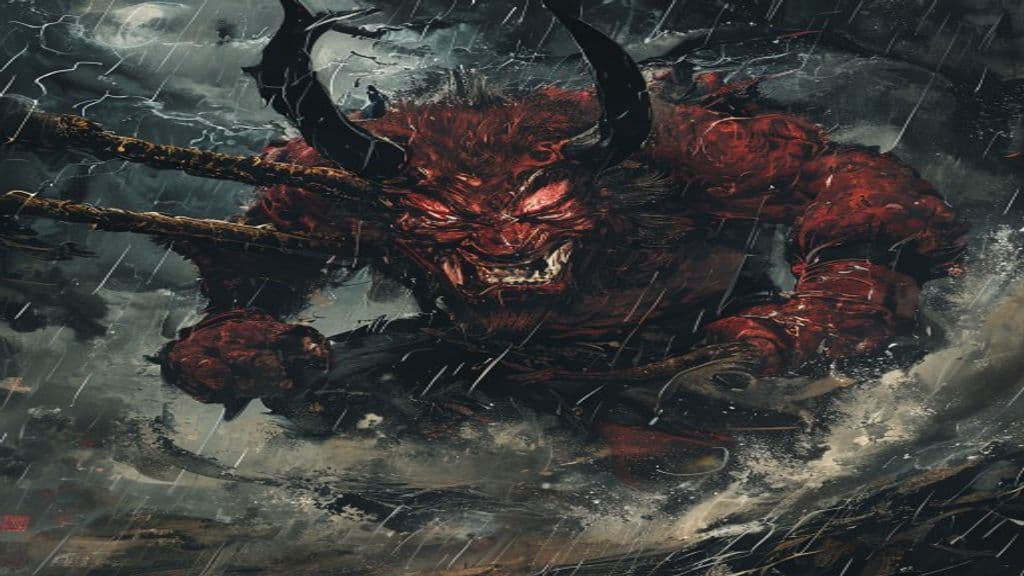
Oni
Powerful supernatural beings of Japanese folklore — associated with misfortune, disease, and the punishment of sinners in hell. Fearsome, often depicted as guardians of the underworld.
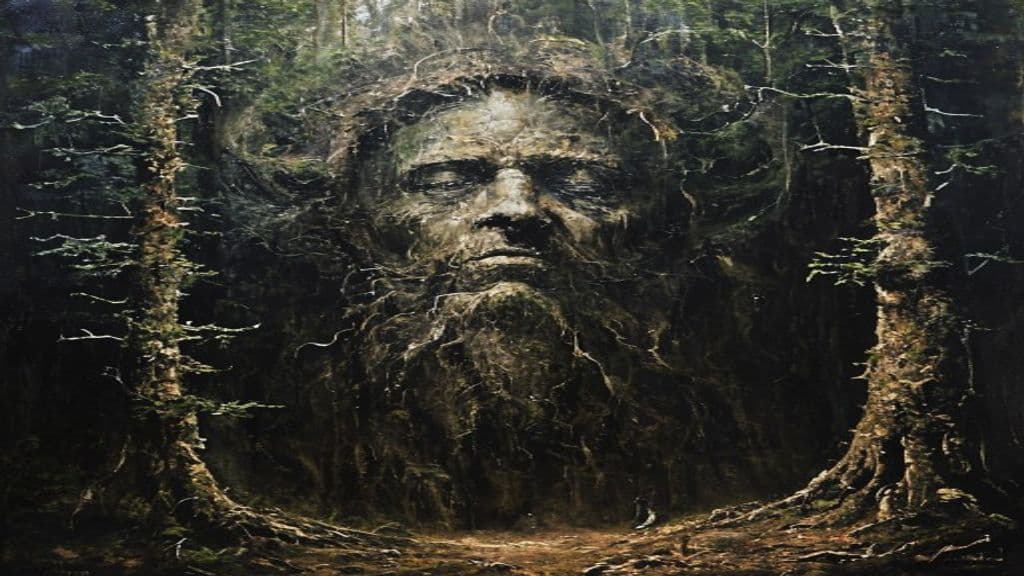
Humbaba
The divine guardian of the Cedar Forest appointed by Enlil, a terrifying giant whose roar was the flood, whose breath was fire, and whose gaze was death — slain by Gilgamesh and Enkidu.
Oenotrus
Oenotrus (Ancient Greek: Οἴνωτρος, Oínōtros) is a mythic human figure in Greek tradition, the youngest son of Lycaon of Arcadia, credited—along with his brother Peucetius—with an early migration from Arcadia to the Italian peninsula and as the eponymous founder of Oenotria (southern Italy/Calabria). Classical sources present him as an ancestral/colonizing founder rather than a supernatural being.
Ofinran
16th-century king of the Oyo Empire, known for his leadership and interactions with other communities in pre-colonial West Africa. (Note: 1. Power tier is likely Greater (regional power) based on the description, but it's worth noting that the sources don't explicitly mention any supernatural or magical abilities. 2. Add specific sensor)
Ogbanje (West African malevolent spirit)
A malevolent entity that intentionally causes misfortune for a specific family in Odinani cosmology. (Note: - Power tier should be "Lesser" or possibly "Minor Spirit", given its described abilities and lack of specific powers. - The summary mentions "Odinani cosmology", but the source refers to it simply as)
Oghene
Oghene is attested in the supplied sources as a modern personal or family name appearing across Nigerian and wider African contexts (music credits, journalism, politics, academia, fashion). The provided corpus contains no evidence treating Oghene as a supernatural, mythological, or folkloric entity.
Oghuz Khagan
Oghuz Khagan (Oğuz Khan/Oğuz Han) is the legendary founding khan and eponymous ancestor of the Oghuz Turks whose miraculous birth, heroic deeds, divine encounters, and final division of lands and symbols for his sons constitute the charter myth of Oghuz tribal identity preserved in the Oguz‑nāme tradition.
Ogopogo (Naitaka / n̓x̌ax̌aitkʷ)
A powerful lake spirit of Okanagan Lake in British Columbia recorded in Syilx/Okanagan and Secwepemc oral traditions and reworked in colonial and popular culture as a lake 'monster' called Ogopogo. Indigenous accounts present the being as a place-tied sacred water spirit that enforces ritual obligations (sacrifice before crossing) and can drown those who refuse; settler/popular accounts emphasize serpentine, hump-backed sightings and wakes.
Ogun-yan
No attested supernatural entity named "Ogun-yan" appears in the supplied sources. The materials provided are an administrative list of settlements in Ogun State, an unrelated Wikidata item about the Battle of Yangxia, and a Yoruba-language excerpt from a speculative fiction/war-gaming archive; none describe a forest or warrior spirit called Ogun-yan.
Ogunlabi (river spirit variant)
No reliable information about an entity called "Ogunlabi" (as a river-spirit variant) is present in the supplied source materials. The available sources discuss an Arsenal fan channel (AFTV) and the city and rulership of Ogbomosho in Oyo State, Nigeria, and do not document any spirit named Ogunlabi.
Ogyges
Ogyges is a primeval mythic ruler in Greek tradition, conventionally linked to Boeotia/Thebes (with an alternative tradition making him first king of Attica) and eponymous for the prehistoric age and the so‑called Ogygian deluge. His name (Ogygian) functions adjectivally to mark the very earliest, primordial times in Greek chronology and myth.
Ohomairangi
An important ancestral figure in Māori mythology, guardian of Taputapuatea marae in Rangiatea. (Note: - Power tier should be Ancient, not Greater, given that Ohomairangi lived six generations before the migration to Aotearoa. - Origin story should mention Hawaiki, not Rangiatea (Raiatea) for his place)
Ohr
Ohr (Hebrew: אור, ʾor, 'Light') is a central technical term in Kabbalah denoting divine light or emanation. It functions as a metaphysical model for how divine influence flows into and relates to the created world, rather than a personified being.
Ohthere (Vendelcrow)
Ohthere (Old Norse Óttarr vendilkráka; modern Swedish Ottar Vendelkråka) is a semi-legendary Swedish king of the Scylfing house, placed by sources in the Germanic Heroic Age, possibly early 6th century (fl. c. 515–c. 530). Literary traditions present him as a warrior-king involved in Swedish–Geatish and Swedish–Danish conflicts; a burial mound in Vendel parish (Ottarshögen) has long been associated with his name. Some narrative details (notably a Danish death in the Limfjord and the story of a wooden "Vendelcrow" of humiliation) are attested only in Snorri's later Ynglinga saga and may represent literary elaboration.
Community Record
- [1]Ogre — Wikipedia. Ogre. Wikipedia. Retrieved from https://en.wikipedia.org/wiki/Ogrewiki
- [2]Wikidata: Ogre (Q731915). Ogre (Wikidata Q731915). Retrieved from http://www.wikidata.org/entity/Q731915other
- [3]Archive and assorted references (name attestations and usage examples). Archive material referencing 'ogre' (contextual links). Retrieved from https://archive.org/details/ie3ogre-byTPS0other