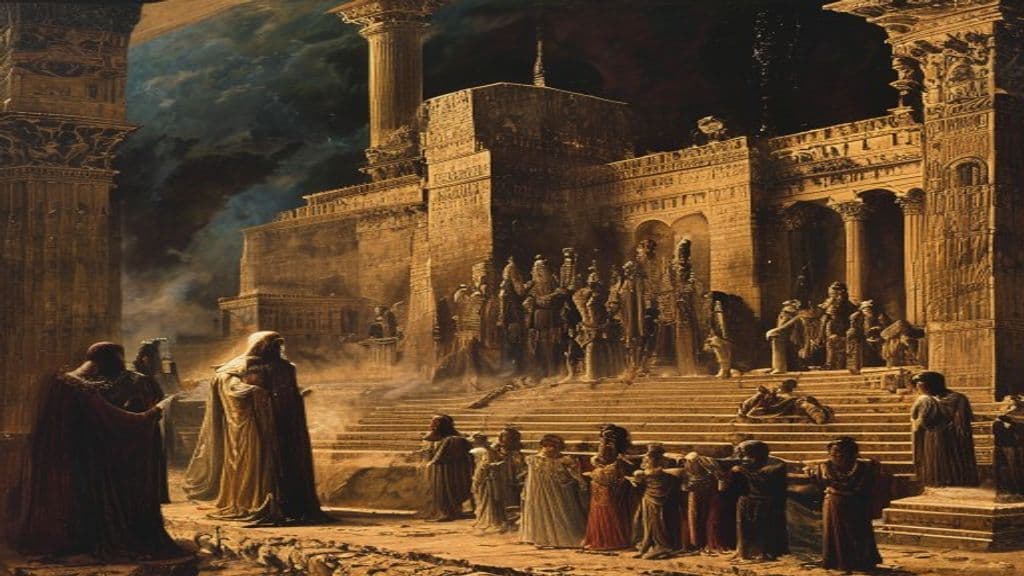
Panbabylonism emerged in Europe among Assyriologists and theologians during the 19th and early 20th centuries.
Panbabylonism is characterized by its ability to explain cultural and religious heritage through Babylonian mythology-based approach, without possessing any supernatural powers or abilities.
Pamisus (Pamisos)
Pamisus (also rendered Pamisos) is primarily attested in the provided sources as the largest river of the Messenia regional unit in the southern Peloponnese, Greece. A separate short catalogue entry (Wikidata) labels Pamisus as a "river god of Messenia," but the geographic sources give no supporting mythic detail; therefore the evidence for personification or cult is minimal and secondary to the river's hydrological description.
Pan
Pan is identified in the provided sources as a Greek deity who is, in those sources, noted to be often depicted with goat features. The available material is limited to a disambiguation listing and does not supply further mythic narrative, functions, or rituals.
Pan's Assistant
The phrase "Pan's Assistant" appears only in modern, fragmentary sources (a 2025 film title referencing Peter Pan and a terse Wikidata label) and is not attested as a traditional folkloric supernatural entity. No reliable descriptions, origin, abilities, rituals, or warding practices for a being by this name are present in the provided sources.
Pana
Pana (also attested as Panna or Pavna) is an Inuit female supernatural figure described in brief ethnographic and encyclopedic sources as a sky‑dwelling custodian who cares for souls transported from the Middle World while they await reincarnation.
Panagia Agiosoritissa (Maria Advocata)
The Panagia Agiosoritissa, known in Latin as Maria Advocata, is an iconographic type of the Virgin Mary in Byzantine and related Christian devotional art. It depicts the Theotokos alone, shown slightly in three-quarter view with both hands raised in a gesture of prayer or intercession, and functions as an image of Mary the intercessor rather than as an autonomous supernatural being.
Panakawan
A class of supernatural entities serving as clown servants to heroes in Javanese wayang, personifying qualities of humility and loyalty. (Note: - Power tier should be Ancient (deity-level) not Primordial (cosmic) - Summary could be more specific about the entity's role in Javanese wayang, e.g., "serve as clown servants to heroes" - Sensory cu)
Panchamukha
A Hindu deity or manifestation with five faces, representing the multifaceted nature and attributes of various divine beings. (Note: 1. Power tier should be Ancient (deity-level) to match the description of representing various divine beings. 2. Add sensory cues for detecting Panchamukha's presence, such as unusual iconography or m)
Pancratis
Pancratis (Ancient Greek Παγκρατίς / Παγκρατώ) is a woman in Greek myth, daughter of Aloeus and Iphimedeia and sister of Otus and Ephialtes. In surviving traditions she is captured by Thracian raiders during a Dionysian celebration; her beauty provokes rivalry among captors and her fate differs between accounts (marriage and later rescue in one version; the mutual killing of rival captors in another).
Pandareus
Pandareus is a mortal figure in Greek mythic tradition, son of Merops and a nymph, variously placed in Miletus, Ephesus or associated with Crete. He is best known in surviving accounts for stealing a sacred/golden dog that guarded the infant Zeus and for familial tragedies that in some variants end in divine punishment or metamorphosis (including transformation into a sea-eagle).
Pandava
The Pandavas are five legendary royal brothers who are central protagonists of the Indian epic the Mahabharata. They are mortal princes of the Kuru line whose births are supernaturally sanctioned by different gods and whose lives (education, exile, war, and rule) illustrate dilemmas of dharma, kinship, and kingship.
Pandion (hero)
Pandion is the eponymous Athenian hero of the Attic tribe Pandionis, venerated at a heroon in Athens and usually identified in ancient tradition with one or the other legendary kings called Pandion. He functions as a civic ancestor whose name anchors tribal identity and local cultic commemoration rather than as an actively described supernatural agent.
Pandion I
Pandion I is a legendary early king of Athens in Greek mythic-historical tradition, presented as a grandson of Hephaestus and a node in Athenian genealogies that link royal houses, priesthoods, and tribal eponyms to a mythic past.
Community Record
- [1]Wikipediawiki