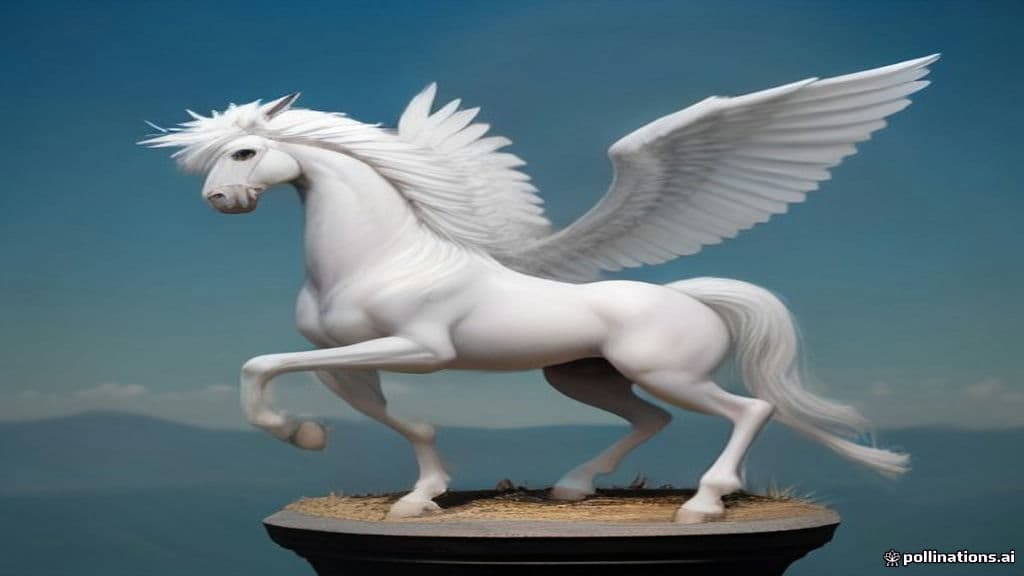
In Hesiodic and later Greek tradition Pegasus is born at the moment of Medusa's decapitation by Perseus; Hesiod places his birth at the 'springs of Oceanus' (the world-margin). Variants hold that Pegasus and his brother Chrysaor sprang from the blood issuing from Medusa's neck, or from Medusa's blood falling upon the Earth, or from a mingling of Medusa's blood, sea-foam and pain (a variant implying Poseidon's involvement). These different accounts are preserved across the mythic corpus rather than unified in a single canonical narrative.
Literary and artistic sources usually present Pegasus as a winged horse, commonly a white stallion. Iconography on pottery and later art depicts an equine body with avian wings; literary tradition emphasizes the whiteness and stallion form but allows for variation in specific scenes and representations.
Pegasus is credited with striking the earth to produce inspiring springs (most famously the Hippocrene on Mount Helicon and a spring at Troezen). Hesiod and later tradition describe Pegasus as connected to Zeus's thunder—carrying thunderbolts for Zeus or serving among Zeus's storm-attendants—and able to move between earth and Olympus by flight. Mythic narrative also records that Pegasus can be tamed and ridden by a human hero: in the common Bellerophon variant Athena grants a golden bridle (via dream/incubation), enabling Bellerophon to catch and ride Pegasus for heroic exploits. After Bellerophon's fall Pegasus is taken to Olympus, serves Zeus, and is later transformed into a northern-hemisphere constellation.

Medusa (the Gorgon)
Medusa, also called Gorgo or the Gorgon, is one of the three Gorgons in ancient Greek mythology. She is described as a mortal woman whose hair is composed of living snakes and whose gaze turns onlookers to stone; she is usually named as a daughter of the sea-associated figures Phorcys and Ceto and sister to Euryale and Stheno.

Zeus
Zeus (Ancient Greek: Ζεύς) is the supreme deity of the classical Greek pantheon, a sky-and-thunder god who rules as king of the gods on Mount Olympus and functions as a sky‑father who assigns roles among the immortals.
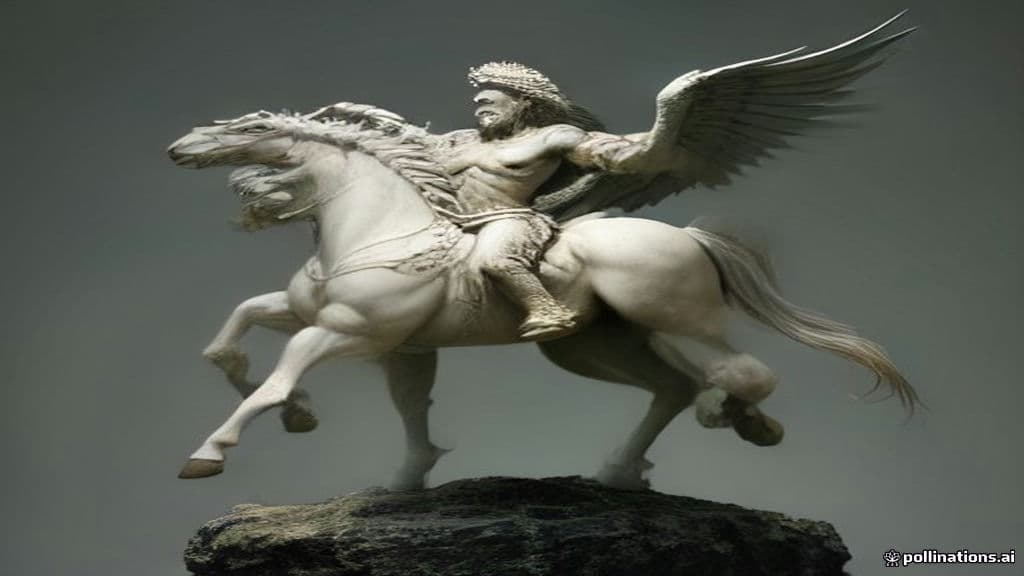
Bellerophon
Bellerophon is a heroic figure of ancient Greek tradition, famed as a slayer of monsters and the tamer of Pegasus. Various accounts present him as of mixed divine and mortal lineage and as an exemplar of heroic achievement enabled by divine aid and constrained by social-ritual norms.

Athena
Athena is a major ancient Greek goddess associated with wisdom, handicraft (notably weaving), and warfare; she serves as a tutelary protector of cities—most prominently Athens—and is central to myth, cult, and civic identity in the Greek world.

Chrysaor
Chrysaor is a figure from Greek myth born from the beheading of the Gorgon Medusa; traditionally presented as the brother of Pegasus and the father of Geryon, he functions chiefly as a genealogical and etiological link within Hesiodic and related traditions.
Community Record
- [1]Pegasus — Wikipedia. Wikipedia: Pegasuswiki
- [2]Pegasus — Wikidata Q8864. Wikidata entry for Pegasus (Q8864)other