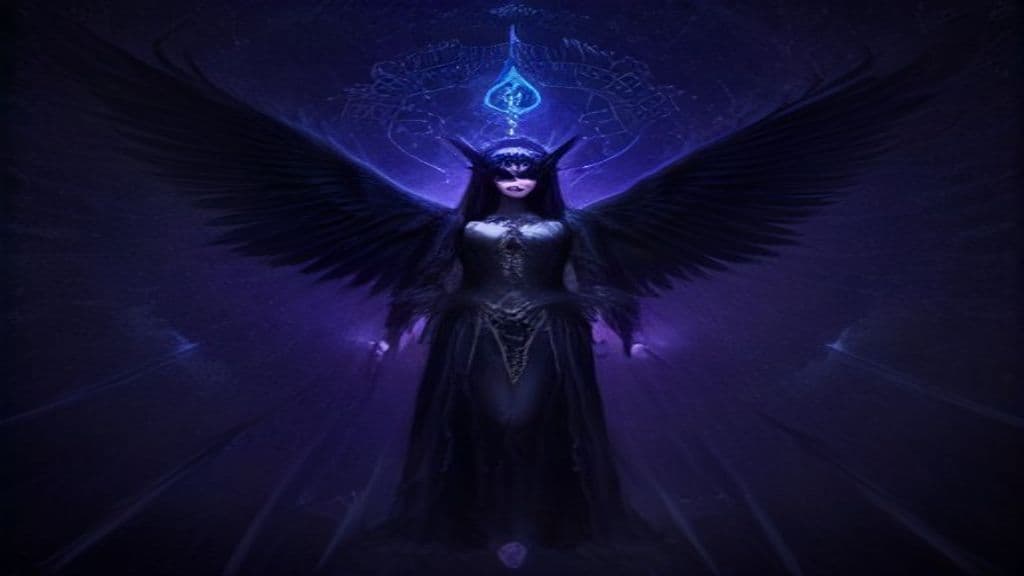
Phenex appears in the corpus of Renaissance/early modern grimoire material consolidated in The Lesser Key of Solomon (the Goetia). The Goetic entry presents him as a fallen spirit whose appearance resembles the classical phoenix and who 'hopeth to return to the seventh throne after a thousand two hundredth years.' Beyond this Goetic listing there is no extended origin narrative in the cited sources; the grimoire entry functions as a classificatory catalog entry rather than a fuller mythic biography.
The Goetia describes Phenex as 'appearing like the bird Phoenix' and having 'a child's voice.' Before standing still before the conjuror he 'singeth many sweet notes.' The grimoire instructs the conjuror to bid him 'put on humane shape,' after which he takes human form and speaks. No further physical details of the humane shape (clothing, gender, specific features) are provided in the cited text.
According to the Goetic listing, Phenex 'will speak marvelously of all wonderful sciences' and is 'an excellent poet.' He governs 'twenty legions' of spirits, and once compelled into human shape he is described as obedient to the conjuror. The text also ascribes to him an aspiration within its cosmology — a hope to return to the seventh throne after 1,200 years. These descriptions are presented in the grimoire as the spirit's attributed faculties within that ritual tradition.
Weaknesses
- conditionDo not listen to his song (conjuror and companions must beware to give no ear to the melody)
- ritualImmediate command to 'put on humane shape' (compel him into human form to secure obedience)
Wards
- conditionConjuror control and refusal of attention to the song (procedural ward specified in the Goetic text)
Barbatos
Barbatos is a named spirit in European grimoire tradition, listed among the Seventy-Two spirits of The Lesser Key of Solomon and also appearing in the Grand Grimoire. He is given a ducal rank, commands legions of spirits, and is invoked in ceremonial contexts for knowledge, revelation of hidden things, and reconciliation.
Phaethon
Phaethon (Ancient Greek: Φαέθων, "radiant") is a mythic youth of Greek tradition, usually described as the son of the sun‑god Helios and the Oceanid Clymene, who borrows his father's sun‑chariot for a single day, loses control, produces cosmic disorder (scorching and freezing of the earth), and is killed by Zeus' thunderbolt; his death and his sisters' mourning supply etiologies for amber and other natural phenomena.
Phantes
Phantes (Ancient Greek Φάντης, 'visible') is a named figure in Greek mythic genealogies, identified as a son of King Aegyptus who married the Danaid Theano and was slain on his wedding night. He appears in classical lists of the Aegyptid princes and is otherwise absent from cultic or ritual records.
Phantom kangaroo
A modern folkloric and cryptozoological label applied to reports of kangaroos, wallabies, or their tracks appearing in places outside their native range. Accounts range from documented feral/introduced populations and escaped captive animals to sensational, apparitional, or misidentified sightings discussed in urban‑legend and Fortean contexts.
Phartis
Phartis is a named daughter of Danaus in Greek mythic genealogies, attested as one of the Danaids and recorded as the wife of an Aegyptid named Eurydamas. One source specifies her mother as an Ethiopian woman. Sources provide only brief genealogical notice and no narrative detail about her actions.
Phaya Naga
A regional form of the nāga in Lao and Thai Mekong riverine culture: large serpent/dragon-like semi-divine water beings associated with the Mekong, implicated in local ritual calendars and popular explanations for luminous river phenomena (the 'Naga fireballs').
Phellus
Phellus is an ancient Lycian hilltop town known from classical sources and archaeology rather than a supernatural being. The site, called Φέλλος (Phellos) in Ancient Greek and recorded in Lycian as Wehnti/Vehinda, preserves substantial funerary architecture, sarcophagi, and city walls and served as a regional inland centre in classical and Byzantine periods.
Pheres
Pheres is a mythic genealogical figure in ancient Greek tradition, named as the son of Cretheus and Tyro, brother of Aeson and Amythaon, founder of the city Pherae in Thessaly, and father of Admetus and Lycurgus. He functions as an eponymous ancestral founder whose placement in genealogies links local ruling houses to wider heroic cycles such as the Argonauts and the Alcestis/Admetus narratives.
Phersipnai
Phersipnai (also attested as Persipnei) was the Etruscan queen of the underworld, described in the sources as the consort of the underworld ruler Aita and functionally equivalent to the Greek Persephone and Roman Proserpina. The available references state that the Etruscan name was borrowed from Greek and place her among the ruling figures of the Etruscan chthonic realm.
Phi Am
A vernacular Thai spirit invoked to explain the experience of sleep paralysis: a conscious sleeper who perceives an oppressive presence and is temporarily unable to move. The label links a brief, often frightening nocturnal episode to an unseen agent pressing on the sleeper.
Phi Hua Khat (Rice-Field Ghost)
Phi Hua Khat is presented here as a named rice-field ghost in Thai folkloric terminology supplied by the user; however, the provided source set does not contain any specific attested information about this entity. General statements about Thai ghost beliefs are drawn only from Source 1; no direct descriptions, stories, rituals, or attributes for Phi Hua Khat itself appear in the supplied materials.
Phi Krasue
Phi Krasue is a nocturnal female spirit in Thai/Isan popular belief, depicted as a floating disembodied woman's head with trailing internal organs. Situated within Buddhist-syncretic and local animist worldviews, it functions as a visceral, boundary-enforcing specter in village and regional folklore and continues to appear in contemporary media.
Community Record
- [1]Phenex — Wikipedia. Wikipedia entry summarizing The Lesser Key of Solomon / Goetia entry for Phenex (includes direct quote from the grimoire as reproduced on the page).wiki
- [2]Wikidata: Phenex. Wikidata item classifying Phenex within Goetic demon entries.other
- [3]THE LOST PHENEX : THE BLACK FIRE (archive examples of modern adaptations). Archive examples indicating modern fictional/adapted uses of the name 'Phenex'; cited to note contemporary adaptations rather than traditional attributes.other