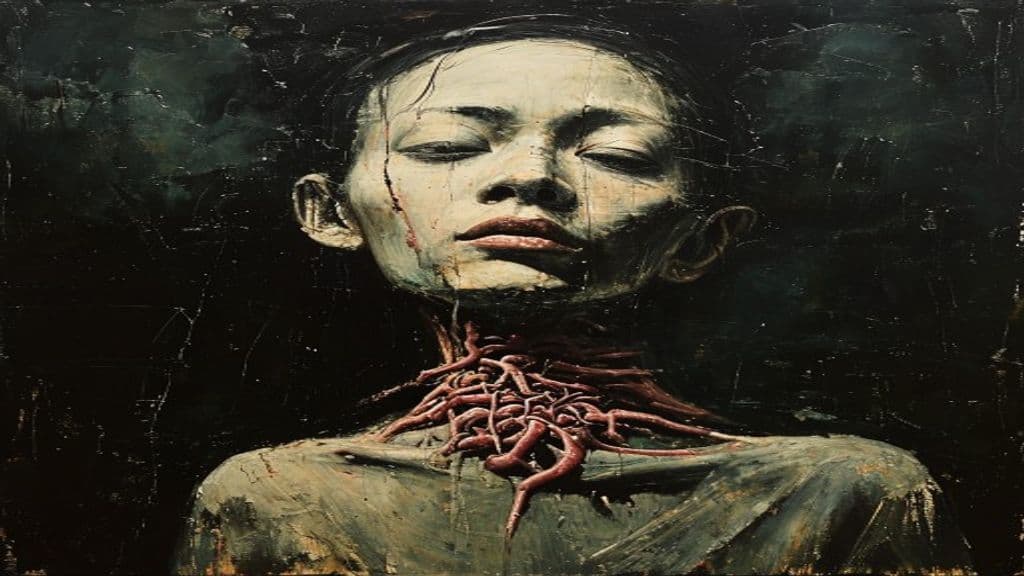
The provided sources do not record a single, consistent origin narrative for Phi Krasue in the excerpts supplied. Scholarship and cultural commentary frame Krasue as a tamnan (traditional narrative) figure whose specific origin motifs vary in oral and textual traditions; such motifs in wider scholarship often include tamnan forms, moral transgression, curse or sorcery, or other local explanatory frameworks, but those specific causal accounts are not documented in the supplied notes. The Kyoto Review commentary emphasizes that Krasue legends are narrated and reworked in tamnan and film contexts, indicating multiple narrative lines rather than a single canonical origin.
Across the cited sources Phi Krasue is consistently described as a nocturnal female apparition appearing as the floating, disembodied head of a woman—often described as young and beautiful—whose internal organs (commonly intestines) hang and trail from the neck. Accounts emphasize vivid corporeal detail such as blood-stained mouth or teeth. Popular-media references reproduce and sometimes stylize this core visual: a woman's head hovering above the ground with viscera trailing beneath.
Sources describe Krasue as active at night and as hovering through rural or remote village spaces. The spirit's visceral appearance (head with trailing organs and blood-stained teeth) implies predatory or sanguinary associations in popular descriptions, though the supplied excerpts do not specify precise feeding mechanisms or victims. Analyses position Krasue within a taxonomy of terrifying spirits as a boundary-enforcing, corporealizing specter—its threat is expressed as bodily violation and contamination. Contemporary scholarship and media note that Krasue motifs are adapted for urban contexts in film and other cultural production.
Weaknesses
- otherNot specified in provided sources
Wards
- otherSpecific warding rituals or methods against Phi Krasue are not documented in the supplied excerpts; protection would be expected to fall within local ritual frameworks such as Isan's Heet Sib Song, but no concrete rites are given.
Mae Nak Phra Khanong
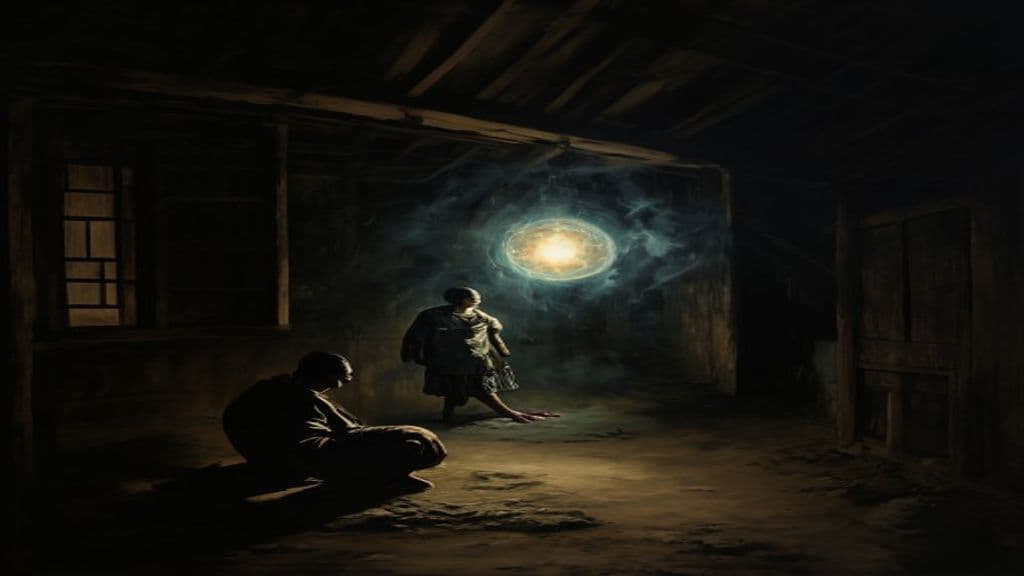
Mae Nak Phra Khanong is a well-known Thai folktale spirit of a woman named Nak who died in childbirth and remained attached to the living world out of devotion to her husband Mak. The legend places her at Phra Khanong (along Khlong Phra Khanong) and presents her both as a terrifying haunting figure and as an object of local devotion at the Wat Mahabut shrine.
Phi Hua Khat (Rice-Field Ghost)
Phi Hua Khat is presented here as a named rice-field ghost in Thai folkloric terminology supplied by the user; however, the provided source set does not contain any specific attested information about this entity. General statements about Thai ghost beliefs are drawn only from Source 1; no direct descriptions, stories, rituals, or attributes for Phi Hua Khat itself appear in the supplied materials.
Phellus
Phellus is an ancient Lycian hilltop town known from classical sources and archaeology rather than a supernatural being. The site, called Φέλλος (Phellos) in Ancient Greek and recorded in Lycian as Wehnti/Vehinda, preserves substantial funerary architecture, sarcophagi, and city walls and served as a regional inland centre in classical and Byzantine periods.
Phenex
Phenex is a Goetic spirit listed in The Lesser Key of Solomon as a Great Marquis of Hell who appears like the mythical phoenix, sings with a child's voice, governs twenty legions, and is said to teach sciences and poetry when compelled into human form. The primary practical caution in the Goetic text is that conjurors must not listen to his singing and must promptly command him to assume humane shape.
Pheres
Pheres is a mythic genealogical figure in ancient Greek tradition, named as the son of Cretheus and Tyro, brother of Aeson and Amythaon, founder of the city Pherae in Thessaly, and father of Admetus and Lycurgus. He functions as an eponymous ancestral founder whose placement in genealogies links local ruling houses to wider heroic cycles such as the Argonauts and the Alcestis/Admetus narratives.
Phersipnai
Phersipnai (also attested as Persipnei) was the Etruscan queen of the underworld, described in the sources as the consort of the underworld ruler Aita and functionally equivalent to the Greek Persephone and Roman Proserpina. The available references state that the Etruscan name was borrowed from Greek and place her among the ruling figures of the Etruscan chthonic realm.
Phi Am
A vernacular Thai spirit invoked to explain the experience of sleep paralysis: a conscious sleeper who perceives an oppressive presence and is temporarily unable to move. The label links a brief, often frightening nocturnal episode to an unseen agent pressing on the sleeper.
Phi Phong
A ghostly spirit of northern Thai folklore described as the result of black magic gone awry; in modern media a related variant is depicted as a blood‑feeding nocturnal entity. It is framed in sources as arising from failed dark sorcery and appears in contemporary regional horror films.
Phi Pop
A Thai possessing spirit that inhabits a living person and compels them to consume raw entrails at night — the possessed victim may be unaware, accused by their community, and driven out.
Phi Tai Hong
Phi Tai Hong (ผีตายโหง) are vengeful, restless spirits in Thai folklore arising from people who die suddenly and violently. They are feared as especially dangerous and difficult to exorcise; the pregnant-woman variant (Tai Thang/Tai Thong Klom) is regarded as particularly malevolent.
Philippine mythical creatures
A broad, plural category of legendary beasts, monsters, and supernatural beings found across more than 140 ethnic groups in the Philippines; these beings occupy local folkloric cosmologies and are distinct from major deities and heroes. They appear in traditional tales and in contemporary retellings and media, which continue to reinterpret and popularize them.
Philoctetes
A mortal Greek hero and famed archer, son of Poeas, who inherits Heracles’ bow and arrows; abandoned because of a festering, foul-smelling wound and later recalled because possession of Heracles’ weapons is prophesied as necessary for Greek victory at Troy. His story appears across epic and tragic traditions (Homeric cycle references; Sophocles’ Philoctetes) and explores themes of suffering, divine causation, healing, and communal obligation.
Community Record
- [1]Krasue. Wikipedia, 'Krasue' (excerpted description: nocturnal female spirit, floating disembodied head with trailing internal organs).wiki
- [2]Phi Krasue | Facts, Information, and Mythology. Pantheon entry describing the Krasue as a female folklore figure with intact head and intestines, hovering around remote villages and blood-stained teeth.folk
- [3]Khon Kaen History And Hauntings (Archive). Archive: Khon Kaen analysis situating phi within local taxonomy of spirits and describing Phi Krasue as a 'visceral, boundary-enforcing' type.other
- [4]Ghosts in Thai culture. Wikipedia summary noting that belief in ghosts in Thai culture is popular, enduring, and syncretic with Buddhist elements.wiki
- [5]Tamnan Krasue – Constructing a Khmer Ghost for a Thai Film. Kyoto Review essay discussing tamnan forms, cultural concept 'phi', and cautions against reductive translations; notes tamnan and film reworkings of the Krasue legend.academic
- [6]Beyond the Vampire: Revamping Thai Monsters for the Urban Age. eTropic article noting that monsters such as Phi Krasue are revamped for urban contexts and continue to function in contemporary media.academic
- [7]Nak (นาค) — Archive (film reference including many Thai ghosts). Archive of the animated film 'Nak' which includes Krasue among many familiar Thai ghost figures, indicating modern cultural presence.literary