
Phaya Naga are presented in regional belief as a local manifestation of the broader South Asian/Southeast Asian nāga tradition: semi-divine serpent/dragon beings originating from nāga cosmology (the netherworld/Patala) and incorporated into Mekong riverine myth. In Lao and Thai contexts these beings are woven into local ritual calendars and popular practice — for example, nights associated with nāga imagery occur around Buddhist Lent and Loy Khatung/Loy Krathong observances in Lao communities — so that veneration and communal timing link Buddhist observance with older nāga reverence and river-based cosmologies.
Descriptions follow the broad nāga typology: some representations are fully serpentine (large river-serpents or dragon-like serpents), others are half-human/half-serpent forms or human figures with serpents at head/neck; regional imagery often depicts them as large serpent/dragon water-spirits associated with the Mekong. Popular accounts and sighting-discussions portray elongated, serpent-like bodies; popular non-supernatural explanations for sightings (mentioned in modern sources) include large marine animals such as oarfish, but these are presented as modern hypotheses rather than traditional descriptions.
Sources describe Phaya Naga as semi-divine water spirits and dragons that inhabit the Mekong and may occasionally be associated with visible phenomena. Locally many attribute the periodic luminous 'Naga fireballs' rising from the river to Phaya Naga; alternative, non-cultural explanations discussed in the literature include earth lights or other anomalous light phenomena. Inherited nāga traits from South Asian tradition — semi-divine status and occasional part-human manifestation — are applied to Phaya Naga in the regional context, and the beings function as guardians or meaningful agents within riverine cosmology and festival time.
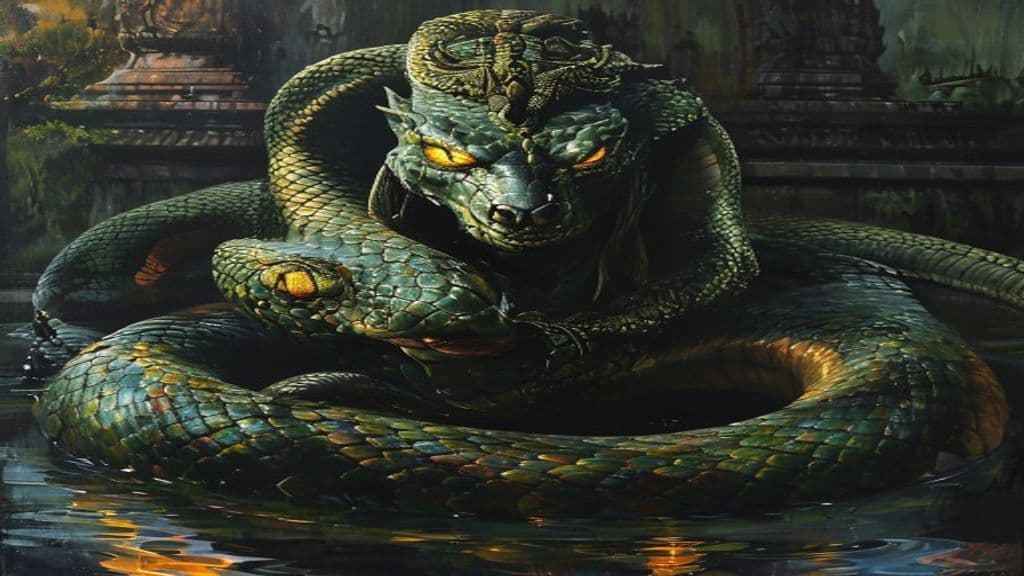
Naga
Divine serpent beings of Hindu, Buddhist, and Jain cosmology — powerful guardians of water, earth, and underground treasures. Revered as deities in South and Southeast Asia.
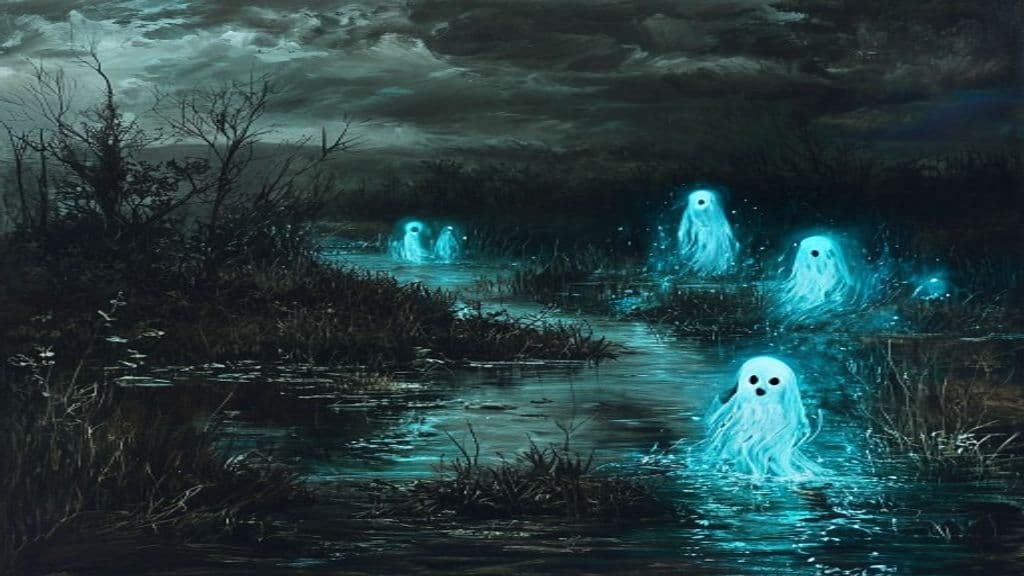
Will-o'-the-Wisp
A wandering light seen over marshy ground at night, leading travellers astray into bogs and fens. Possibly a spirit, possibly the soul of the unbaptised dead, possibly the devil himself.
Phaeno
Phaeno (Ancient Greek: Φαινώ, Phainô) is attested in classical sources as one of the 3,000 Oceanids, daughters of the Titans Oceanus and Tethys, and listed as a companion of Persephone. The name also designates a modern science centre in Wolfsburg, Germany (Phæno), but in a folklore context the relevant referent is the Oceanid listed in mythological catalogues.
Phaeocomes
Phaeocomes is a named centaur warrior appearing in Ovid's Metamorphoses (Book XII) during the Centauromachy; he is described wearing joined lions' hides as armor and wielding an enormous wooden club, performing violent martial deeds in the epic battle. The same lexical form also appears as a species epithet in mycological taxonomy (Pyrenophora phaeocomes) in unrelated scientific literature.
Phaethon
Phaethon (Ancient Greek: Φαέθων, "radiant") is a mythic youth of Greek tradition, usually described as the son of the sun‑god Helios and the Oceanid Clymene, who borrows his father's sun‑chariot for a single day, loses control, produces cosmic disorder (scorching and freezing of the earth), and is killed by Zeus' thunderbolt; his death and his sisters' mourning supply etiologies for amber and other natural phenomena.
Phantes
Phantes (Ancient Greek Φάντης, 'visible') is a named figure in Greek mythic genealogies, identified as a son of King Aegyptus who married the Danaid Theano and was slain on his wedding night. He appears in classical lists of the Aegyptid princes and is otherwise absent from cultic or ritual records.
Phantom kangaroo
A modern folkloric and cryptozoological label applied to reports of kangaroos, wallabies, or their tracks appearing in places outside their native range. Accounts range from documented feral/introduced populations and escaped captive animals to sensational, apparitional, or misidentified sightings discussed in urban‑legend and Fortean contexts.
Phartis
Phartis is a named daughter of Danaus in Greek mythic genealogies, attested as one of the Danaids and recorded as the wife of an Aegyptid named Eurydamas. One source specifies her mother as an Ethiopian woman. Sources provide only brief genealogical notice and no narrative detail about her actions.
Phellus
Phellus is an ancient Lycian hilltop town known from classical sources and archaeology rather than a supernatural being. The site, called Φέλλος (Phellos) in Ancient Greek and recorded in Lycian as Wehnti/Vehinda, preserves substantial funerary architecture, sarcophagi, and city walls and served as a regional inland centre in classical and Byzantine periods.
Phenex
Phenex is a Goetic spirit listed in The Lesser Key of Solomon as a Great Marquis of Hell who appears like the mythical phoenix, sings with a child's voice, governs twenty legions, and is said to teach sciences and poetry when compelled into human form. The primary practical caution in the Goetic text is that conjurors must not listen to his singing and must promptly command him to assume humane shape.
Pheres
Pheres is a mythic genealogical figure in ancient Greek tradition, named as the son of Cretheus and Tyro, brother of Aeson and Amythaon, founder of the city Pherae in Thessaly, and father of Admetus and Lycurgus. He functions as an eponymous ancestral founder whose placement in genealogies links local ruling houses to wider heroic cycles such as the Argonauts and the Alcestis/Admetus narratives.
Phersipnai
Phersipnai (also attested as Persipnei) was the Etruscan queen of the underworld, described in the sources as the consort of the underworld ruler Aita and functionally equivalent to the Greek Persephone and Roman Proserpina. The available references state that the Etruscan name was borrowed from Greek and place her among the ruling figures of the Etruscan chthonic realm.
Phi Am
A vernacular Thai spirit invoked to explain the experience of sleep paralysis: a conscious sleeper who perceives an oppressive presence and is temporarily unable to move. The label links a brief, often frightening nocturnal episode to an unseen agent pressing on the sleeper.
Phi Hua Khat (Rice-Field Ghost)
Phi Hua Khat is presented here as a named rice-field ghost in Thai folkloric terminology supplied by the user; however, the provided source set does not contain any specific attested information about this entity. General statements about Thai ghost beliefs are drawn only from Source 1; no direct descriptions, stories, rituals, or attributes for Phi Hua Khat itself appear in the supplied materials.
Community Record
- [1]Nāga. Wikipedia, 'Nāga' (discussion of nāga as divine/semi-divine half-human, half-serpent beings and their association with water and dragons).wiki
- [2]Phaya Naga (Wikidata). Wikidata entry: 'mythical creatures believed to live in the Laotian stretch of the Mekong River.'wiki
- [3]Phaya Naga | Cryptid Wiki. Cryptid Wiki: overview of Phaya Naga (Thai: พญานาค; RTGS: phaya nak), association with Mekong river and attribution of Naga Fireballs to these creatures; also notes popular hypotheses such as oarfish explanations.folk
- [4]Loy Khatung: the night of the Naga. Travelfish: connects Lao observance of Buddhist Lent and festival nights with nāga-themed nights and cultural events on the river.other
- [5]Earth Lights: Spooklights and Ghost Lights, etc.. Discussion of earth lights and anomalous light phenomena as naturalistic explanations sometimes offered for luminous events attributed in local belief to nāga.other