
The supplied materials do not provide a detailed mythic birth or origin narrative for Qarinah. Comparative and syncretic sources present qarīn/qarīnah (Aqran) as a class of personal or attendant spirits — described conceptually as a 'demonic double' — that attach to or accompany humans. One fragmentary source frames protective talismans as copies of an agreement between a 'queen of the Aqran' and the biblical King David, indicating local narratives that imagine negotiated relations between named spirit-figures and authoritative scriptural personages, but no full origin myth is recorded in the provided excerpts.
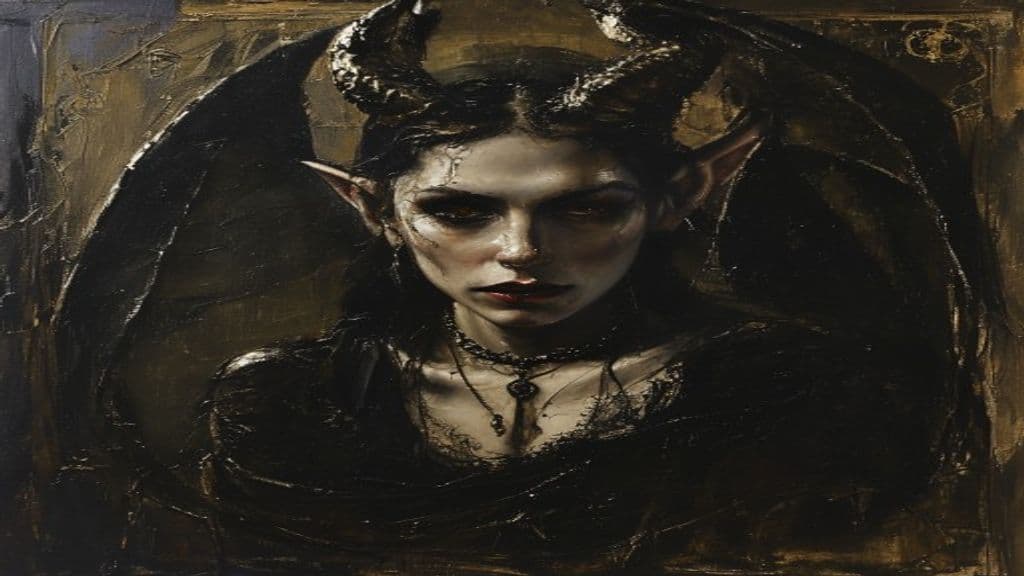
No specific or consistent physical description of Qarinah/Qareena is attested in the supplied sources. The available excerpts do not record bodily form, attire, or visible morphology for this figure; European succubus imagery appears in the material only as a comparative reference and is not documented evidence for appearance in the Egyptian/Coptic context.
In the provided materials Qarinah (as part of the qarīn/qarīnah/Aqran complex) is described conceptually as a nocturnal spirit-attendant or 'demonic double' that harms or afflicts sleepers and can weaken a person over ongoing interaction. Sources imply concerns about vulnerability in sleep and around pregnancy and indicate that these spirits are managed in local practice through written talismans or agreements. Comparative material (European succubus) is cited in the sources to illustrate a broadly similar pattern of nocturnal female spirits causing deterioration through repeated encounters, but that European material is not presented as a direct ethnographic account of the Qarinah.
Weaknesses
- otherNegated or bound by written talismanic agreements (magick square modeled on an agreement between the queen of the Aqran and King David) — attested in blog source
Wards
- ritualMagick square / written charm to protect an expectant mother (a talismanic text modeled on an agreement between the queen of the Aqran and King David)
Qaban
Qaban is not attested in the provided sources as a supernatural being. The string appears in the supplied corpus as a toponym (Iranian village names) and as an element of personal names in diverse documentary contexts; no myths, powers, appearance descriptions, rituals, or folkloric narratives for a supernatural 'Qaban' are present in these sources.
Qailertetang
Qailertetang is an Inuit sea-associated figure who functions both as a mythic caretaker of marine animals, fishers, and hunters and as a ritual persona enacted during Quviasukvik (the Inuit New Year). She is described as dwelling with Sedna at the bottom of the sea and in performance appears as gigantic masked figures who invoke winds, pair community members, and provide divinatory murmurs.
Qallupilluit
A shoreline-dwelling supernatural being in Inuit oral tradition that inhabits the liminal space between sea and ice. Presented primarily as a cautionary figure, the Qallupilluit lures and steals children who approach hazardous sea-ice edges.
Qamata
Qamata is the supreme creator being in Xhosa traditional religion, regarded as the monotheistic deity worshipped by the Xhosa people of southeastern Africa and credited with creating the heavens and earth. Qamata occupies the highest place in Xhosa cosmology, is associated symbolically with the Sun, and is described as instructing ancestors who in turn created other spiritual entities that guide human life.
Qantu (Cantua buxifolia)
A culturally significant evergreen shrub with pink flowers in the Inca tradition. (Note: 1. Add origin story based on the Inca tradition. 2. Change Power tier to Greater: Qantu's cultural significance, association with Andean shamanism, and connection between music and flowers suggest a m)
Qareen
The personal spirit companion assigned to every human being at birth in Islamic theology — a jinn double that knows all of a person's secrets and whispers toward sin throughout their life.
Qebehsenuef
Qebehsenuef is one of the Four Sons of Horus in ancient Egyptian funerary religion, principally represented as a falcon-headed mummiform deity who protects the intestines of the deceased. He appears on canopic jar lids and amulets and functions as part of the mortuary apparatus intended to preserve bodily integrity for the afterlife.
Qebui
Qebui is an ancient Egyptian deity personifying the north wind. Attested in modern summaries of Egyptian religion, Qebui is identified primarily by his directional role and distinctive iconography.
Qed-Her
Qed-Her is described in the cited reference material as an ancient Egyptian minor warrior and gate goddess of the underworld, functioning as a guardian placed at an entrance or threshold within the realm of the dead. The surviving record in the provided sources is minimal and consists chiefly of a brief encyclopedia-style entry and a linked data label.
Qi
Qi (氣/气) is a foundational concept in Chinese thought referring to a ubiquitous vital substance or vapor-like principle—commonly glossed as 'vital energy' or 'breath'—thought to underlie living beings, health, and cosmological processes. It is treated as an impersonal, polysemous principle rather than an individualized spirit or deity, and is central to practices that aim to cultivate or balance it (e.g., qigong, traditional Chinese medicine).
Qilin
A legendary hooved chimerical creature of Chinese literary tradition (麒麟, qílín) whose appearances in classical accounts function as auspicious omens tied to the birth, arrival, or death of sages and illustrious rulers. The creature is part of a broader East Asian set of correspondents (Japanese kirin, Korean girin) and was historically conflated with the real giraffe in Ming-dynasty court encounters.
Qin (Mandaeism)
Qin is attested in a modern English-language reference as a named inhabitant of the Mandaean underworld. The available source provides only a brief listing that calls Qin "a demon of the Mandaean underworld," without further description or context.
Community Record
- [1]The Demonic double in Egypt, past & present. (A Magick Square to protect an Expectant Mother) | Astro Egypt. Astro Egypt blog post: 'The Demonic double in Egypt, past & present. (A Magick Square to protect an Expectant Mother)' — notes a confluence of Islamic, Coptic, Biblical & Pharaonic traditions and describes a charm as a copy of an agreement between the queen of the Aqran & King David.folk
- [2]Succubus — Wikipedia. Wikipedia article on 'succubus' supplied as comparative material describing a European tradition of a nocturnal female demon who appears in dreams and whose repeated interactions can deteriorate a victim's health.wiki
- [3]Mandrake, Oxford | Astro Egypt (author page). Author page for Astro Egypt content cited in the supplied materials.other