
Qebehsenuef is historically attested as one member of a closely linked quartet of funerary deities collectively called the Four Sons of Horus. Within Egyptian mortuary practice these figures emerged as protective attendants whose roles were integrated into the practical technology of burial: each son became identified with a particular internal organ removed during mummification and with a corresponding canopic jar and lid. Over time the four sons were embedded in funerary texts, tomb equipment, and amuletic practice so that the gods were invoked materially — on jars, amulets, and in burial assemblages — to secure the deceased's bodily wholeness in the afterlife. Museum catalogues and summary references tie Qebehsenuef to this institutionalized role rather than to a standalone mythic narrative preserved in the cited sources.
In the material record Qebehsenuef is commonly depicted in later iconography (late New Kingdom and especially Late Period examples) as a mummified figure with the head of a falcon or as a mummified falcon. Canopic jar lids representing Qebehsenuef typically bear a falcon's head; surviving amulets and small figures follow the hawk/falcon representation and were often wrapped with the mummy. The sources note that earlier portrayals of the Sons of Horus as a group show variation in head-types across the quartet, and the falcon-headed form is the canonical late-period representation for Qebehsenuef in museum holdings.
The documented "ability" of Qebehsenuef is protective and custodial: he is entrusted with safeguarding the intestines of the deceased, ensuring their preservation and their restoration to the body in the afterlife. This role is enacted materially by placing canopic jars with falcon-headed lids and amulets bearing his image in the burial assemblage; museum descriptions summarize the duty of the Sons of Horus as protecting and restoring body parts in the hereafter. The cited sources do not record independent active myths, autonomous actions outside funerary contexts, or moral-agency behaviors for Qebehsenuef; any overlapping attributions (for example, occasional mention of the goddess Serket in association with intestines in a single object caption) are noted in the sources but are not broadly corroborated in the provided material.
Weaknesses
- otherNo recorded weaknesses in provided sources
Wards
- symbolImage on canopic jar lid / amulet

Imsety
Imsety is one of the Four Sons of Horus in ancient Egyptian religion, a mummiform, human-headed funerary deity invoked to protect the viscera of the deceased and to secure bodily wholeness in the afterlife. He commonly appears on canopic-jar lids and amulets and is named in funerary spells and ritual contexts tied to mummification and burial.
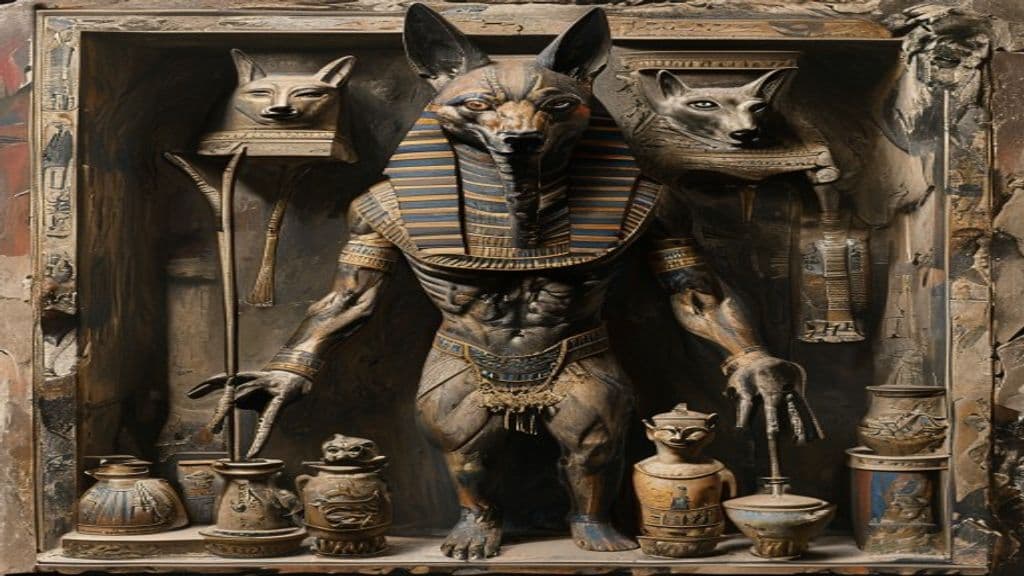
Duamutef
Duamutef is one of the four Sons of Horus in ancient Egyptian funerary religion, a jackal‑headed mummiform guardian whose primary role is to protect the internal organs of the deceased (most commonly the stomach) and to ensure restoration of the body in the afterlife. He appears on canopic jar lids, amulets, and tomb furnishings across a long chronological span from the New Kingdom through the Late Period and beyond.
Aati
Aati (also rendered Ati) is one of the 42 judges of the dead in ancient Egyptian funerary literature, attested in the Book of the Dead tradition (notably the Papyrus of Nebsemy). Described as originating 'from Heliopolis', Aati's documented function is to question the deceased about a specific moral accusation during the Duat judgment; the funerary texts supply a formulaic denial the soul must recite.
Amenhotep I (tradition)
Amenhotep I was a historical pharaoh of Egypt's Eighteenth Dynasty who, after his death, was deified and venerated locally as a patron figure of the Theban necropolis and the artisan community of Deir el-Medina. In later funerary contexts his image appears among protective iconography on coffins and in temple decoration, functioning as a local funerary patron rather than a volatile supernatural aggressor.
Cavern deities of the underworld
A class of ancient Egyptian minor, place-bound divine beings dwelling in the caverns of the Duat. They are recorded as punitive creatures that punish and devour wicked souls but are also shown in funerary contexts as beings who, if propitiated by offerings and spells, can be pacified and render aid to the deceased.
Medjed
Medjed is a minor, named supernatural figure attested in a few copies of spell 17b of the Egyptian Book of the Dead and depicted on nine New Kingdom/Late Period papyri dated to around the Twenty‑first Dynasty. Textual lines call him “that smiter,” say he “shoots with his eyes, yet is unseen,” and that “the sky is encircled with the fiery blast of his mouth,” and place him among those who belong to the House of Osiris in the Duat.
Qamata
Qamata is the supreme creator being in Xhosa traditional religion, regarded as the monotheistic deity worshipped by the Xhosa people of southeastern Africa and credited with creating the heavens and earth. Qamata occupies the highest place in Xhosa cosmology, is associated symbolically with the Sun, and is described as instructing ancestors who in turn created other spiritual entities that guide human life.
Qantu (Cantua buxifolia)
A culturally significant evergreen shrub with pink flowers in the Inca tradition. (Note: 1. Add origin story based on the Inca tradition. 2. Change Power tier to Greater: Qantu's cultural significance, association with Andean shamanism, and connection between music and flowers suggest a m)
Qareen
The personal spirit companion assigned to every human being at birth in Islamic theology — a jinn double that knows all of a person's secrets and whispers toward sin throughout their life.
Qarinah (Qareena)
A nocturnal female spirit-figure presented in comparative materials as a harmful attendant or 'demonic double' that afflicts sleepers; attested in fragmentary sources linking Arabic/Coptic folk notions of qarīn/qarīnah (Aqran) with talismanic protections in Upper Egyptian popular practice.
Qebui
Qebui is an ancient Egyptian deity personifying the north wind. Attested in modern summaries of Egyptian religion, Qebui is identified primarily by his directional role and distinctive iconography.
Qed-Her
Qed-Her is described in the cited reference material as an ancient Egyptian minor warrior and gate goddess of the underworld, functioning as a guardian placed at an entrance or threshold within the realm of the dead. The surviving record in the provided sources is minimal and consists chiefly of a brief encyclopedia-style entry and a linked data label.
Qi
Qi (氣/气) is a foundational concept in Chinese thought referring to a ubiquitous vital substance or vapor-like principle—commonly glossed as 'vital energy' or 'breath'—thought to underlie living beings, health, and cosmological processes. It is treated as an impersonal, polysemous principle rather than an individualized spirit or deity, and is central to practices that aim to cultivate or balance it (e.g., qigong, traditional Chinese medicine).
Qilin
A legendary hooved chimerical creature of Chinese literary tradition (麒麟, qílín) whose appearances in classical accounts function as auspicious omens tied to the birth, arrival, or death of sages and illustrious rulers. The creature is part of a broader East Asian set of correspondents (Japanese kirin, Korean girin) and was historically conflated with the real giraffe in Ming-dynasty court encounters.
Community Record
- [1]Four sons of Horus - Wikipedia (entry including Qebehsenuef). Wikipedia, 'Four sons of Horus' (Qebehsenuef summary and associations)wiki
- [2]Wikidata: Qebehsenuef. Wikidata entry for Qebehsenuefother
- [3]Canopic Jar with Falcon's Head (lid) - Cleveland Museum of Art (archive record). Cleveland Museum of Art archive item for a canopic jar with falcon-headed lid (Qebehsenuef representation)other
- [4]Canopic Jar with Man's Head - Cleveland Museum of Art (archive record). Cleveland Museum of Art archive item (context on the Four Sons of Horus and canopic jars)other
- [5]Global Museum: Necklace with Qebehsenuef (hawk) amulet. Global Museum object entry describing a hawk amulet representing Qebehsenuef commonly wrapped with the body for protectionother
- [6]Tutankhamun's Treasures - Qebehsenuef (object caption mentioning Serket). Object caption noting 'Qebehsenuef, who protects the intestines (along w/ Serket)' (single-source mention)other
- [7]Egyptian Canopic Jars Pictures (photographic reference). Photographic reference and descriptions of canopic jars and lids (contextual material culture)other
- [8]Ancient Egypt: the Mythology - Qebehsenuef. Reference summary on Qebehsenuef (secondary summary)other