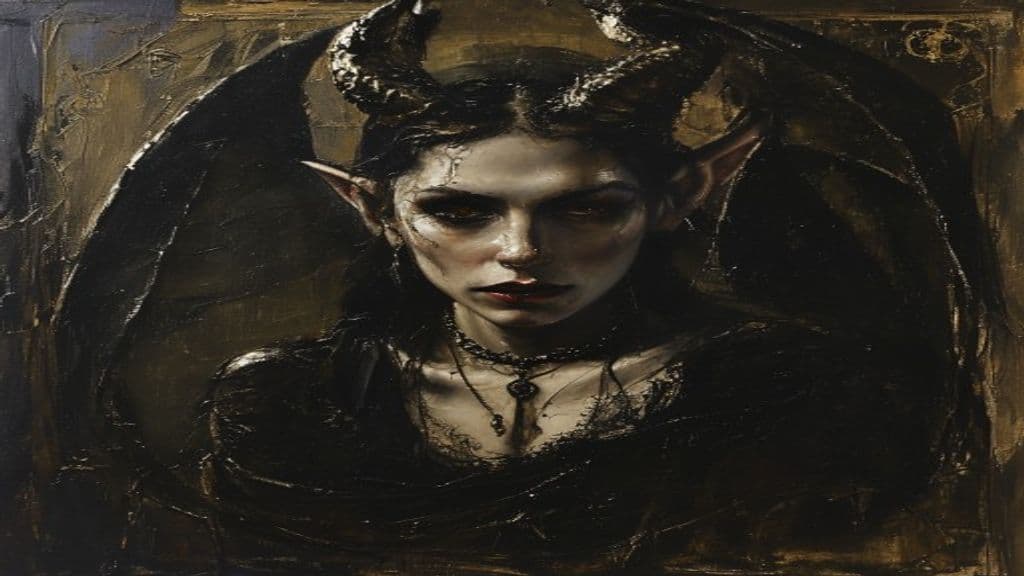
No information on physical appearance is provided in the source material.
A succubus seduces male humans through their dreams, leading to sexual activity and potentially resulting in the birth of a hybrid child called a cambion. If the relationship continues unchecked, it will lead to the man's mental and physical decline, eventually causing his death.
Cain (Jewish Tradition)
Biblical figure and symbol of sin and violence, human being with no supernatural abilities. (Note: 1. Power tier: Change to "Human" is correct. 2. Abilities: Specify that the abilities mentioned are a result of Cain's actions and decisions, not supernatural powers. 3. Weaknesses: Mention God's curs)
Fiery Flying Serpent
A metaphorical creature representing the Assyrian kingdom's power and destruction, used in Jewish tradition. (Note: * Power tier should be Greater, not Primordial, as it's a symbolic representation of a powerful regional entity (the Assyrian kingdom) rather than a cosmic or primordial force. * Abilities section nee)
Qippoz
A supernatural entity mentioned in the Hebrew Bible, described as an 'arrow snake' or 'owl', but its nature and classification are uncertain. (Note: 1. Power tier should be Undetermined/Lesser, as it's associated with desolation and ruined cities in Edom, which suggests a local spirit or entity, but its nature is still uncertain. 2. Add sensory cu)
Stymphalus (son of Elatus)
Stymphalus (Greek: Στύμφαλος) is a mythic, eponymous founder and heroic-age ancestor in Arcadian local tradition. In surviving sources he is presented as a son of Elatus (sometimes by Laodice), a grandson of Arcas, and the name-giver of a spring, a lake/region, and a city in Arcadia; he is treated as a mortal genealogical figure rather than a supernatural creature in the cited material.
Styx
In Greek myth Styx is both a divine river-goddess and the underworld river she embodies; her waters form an ontological and ritual boundary of Hades and serve as the medium for the most solemn divine oaths, with specified punitive consequences for perjury.
Su İyesi
Su İyesi is a Turkic water spirit — a localized guardian (iye) of bodies of water such as rivers, lakes, ponds and springs. It appears in male and female personifications (Su Ana, Su Ata) and is associated with both beneficent functions (bringing rain) and dangerous actions (drownings, floods, wrecks) when offended.
Suanggi
A malevolent spirit from Indonesian folklore, known for its harmful intentions towards humans. (Note: * Power tier should be Lesser, as it's only described as a "malevolent spirit" without any indication of regional or deity-level power. * Sensory cues, weaknesses, and wards are not mentioned in the s)
Suangi
In the belief systems of western Papua (Indonesia) a suangi is an accused human male alleged to practice harmful sorcery by physically and spiritually preying on victims — reportedly eating blood and internal organs and devouring the victim's soul. Accusation functions as a local explanatory category for mysterious illness and death, and punitive communal responses are reported in some accounts.
Suen
Suen (also vocalized Sin or Nanna) is the Mesopotamian lunar deity who personifies the moon, widely worshipped in the Mesopotamian pantheon and associated with the lunar month, pastoral life, and in some texts with adjudication of the dead.
Sugaar
A male deity associated with storms and thunder in pre-Christian Basque mythology. (Note: 1. Power tier: Lower power_tier (e.g., Ancient or Greater) as Primordial implies a level of cosmic influence not described in the source. 2. Summary should be revised to indicate Sugaar is associated )
Suijin
Suijin (水神, also Mizugami 水神 / みずがみ) is a general name in Japanese/Shinto practice for water deities and water-associated spirits. The term covers heavenly and earthly manifestations enshrined at springs, wells, rivers, ponds, irrigation works and in Suitengū shrines, and is connected with purification, safe water provision, fishing, fertility, and childbirth.
Suiko (水虎)
Suiko (水虎, literally "water tiger") is a Chinese legendary river creature described in the cited sources as inhabiting river systems in areas such as Hubei Province. The available descriptions are minimal and chiefly record its riverine habitat and a single physical detail: it is said to be the size of a three- or four-year-old child.
Community Record
- [1]