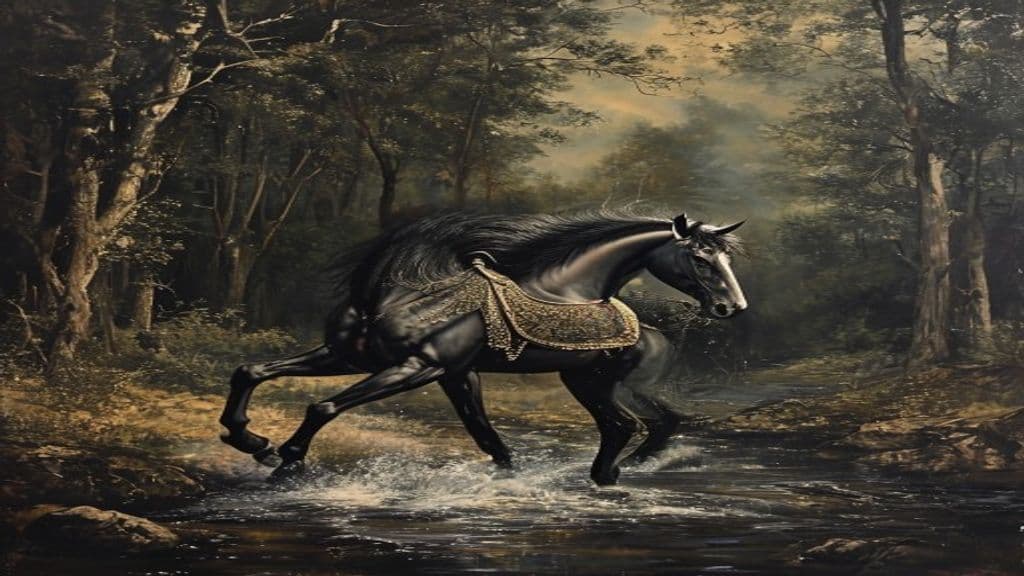
Rakhsh appears specifically in the Persian national epic Shahnameh, which is set in ancient Persia. The exact locations and times of Rakhsh's appearances are not specified.
No detailed physical description of Rakhsh is provided in the source material; it simply states that Rakhsh is a stallion, indicating that it is a male horse.
Rakhsh's abilities and behaviors are not described in detail in the source. However, as Rostam's companion, it can be inferred that Rakhsh possesses strength, speed, and possibly other qualities that make it a worthy steed for a legendary hero.
Al (Georgian Tradition)
In Georgian tradition, Al is a supernatural entity that interferes with human reproduction, acting as a demon of childbirth. (Note: - Power tier should be "Ancient" (Al is a demon of childbirth, but not cosmic-level) - Abilities need to specify that Als can cause spontaneous abortions, stillbirths, and infant mortality, as stated )
Amir Arsalan-e Namdar (The Exalted Prince Arsalan)
A powerful, potentially benevolent figure in Persian mythology with magical abilities. (Note: 1. Power tier needs to be adjusted based on abilities described (as benevolent figure with magical abilities), could be Lesser or Minor Spirit instead of Greater. 2. Summary should mention specific my)
Ashkbous
Legendary warrior and champion in Persian mythology, from the Shahnameh epic poem. (Note: 1. Remove the statement "No physical description of Ashkbous provided in the source material." since the article explicitly mentions an appearance is not provided, implying one does not exist. 2. Powe)
Azhdaha (Aždahā)
Azhdaha (also Aždahā) is a serpentine/draconic monster in Persian literary and folkloric tradition, depicted as a gigantic, often dangerous creature that may inhabit air, sea, or land and appears in epic and cosmological texts.
Banu Goshasp
Important heroine in Iranian mythology, appearing in several Persian epics including the Banu Goshasp Nama. (Note: - The power tier should be Ancient, not Primordial, as there's no indication that she has cosmic-level abilities. - There are no sensory cues, weaknesses, or wards listed, but they could potentially b)
Bijan and Manijeh (Persian tradition)
Legendary figures from the Persian epic poem Shahnameh, embodying ideals of love, loyalty, and constancy. (Note: 1. Power tier should be Lowered to Ancient (deity-level) as they are figures from a legendary love story in an epic poem, but their abilities are symbolic ideals rather than cosmic or universe-changin)
Chamrosh
Supernatural bird entity inhabiting the summit of Mount Alborz in Persian mythology. (Note: 1. Remove "Origin story" section since no origin story is provided in the source material. 2. Add a statement about the lack of specific abilities or behaviors under the "Abilities" section to clarify)
Darda'il
In the cited Islamic tradition, Darda'il (Arabic: دردائيل, glossed 'Journeyers of God') are angels who travel the earth searching out assemblies where people remember God's name. The name is also attested as that of an angel invoked in exorcism; the figure appears in modern cultural references alongside other named angels.
Div-e Sepid
A powerful demon and chieftain of the Divs (demons) of Mazandaran in Persian mythology, known for his mastery over elemental forces and control over spirits or the dead. (Note: - Power tier: Greater (Div-e Sepid is not described as having deity-level abilities, but rather as a powerful demon chieftain) - Abilities: corrects "control over spirits or the dead" to be more speci)
Duzakh
In Persian mythology, Duzakh is a place of punishment and suffering in the afterlife. (Note: 1. Power tier should be adjusted to "Lesser" as Duzakh is a specific place of punishment, not a cosmic entity. 2. The origin story and appearance are missing. 3. Abilities could be more specific about)
Faramarz
Heroic figure in Persian epic tradition, son of Rustam and protagonist of the Faramarz-nama. (Note: - Power tier: Lower, based on source material (heroic figure, son of Rustam), should be at least Greater=powerful regional spirit - Origin story: Only mentions relationship to Rustam, no Primordial or)
Farhad (Persian literature)
In Persian literature and mythology, Farhad is a character associated with the love story of Khosrow and Shirin. (Note: 1. Power tier should be revised to "Minor Spirit" since Farhad's abilities are more related to his devotion and determination, rather than cosmic or deity-level powers. 2. Remove description of "Appea)
Community Record
- [1]Wikipediawiki