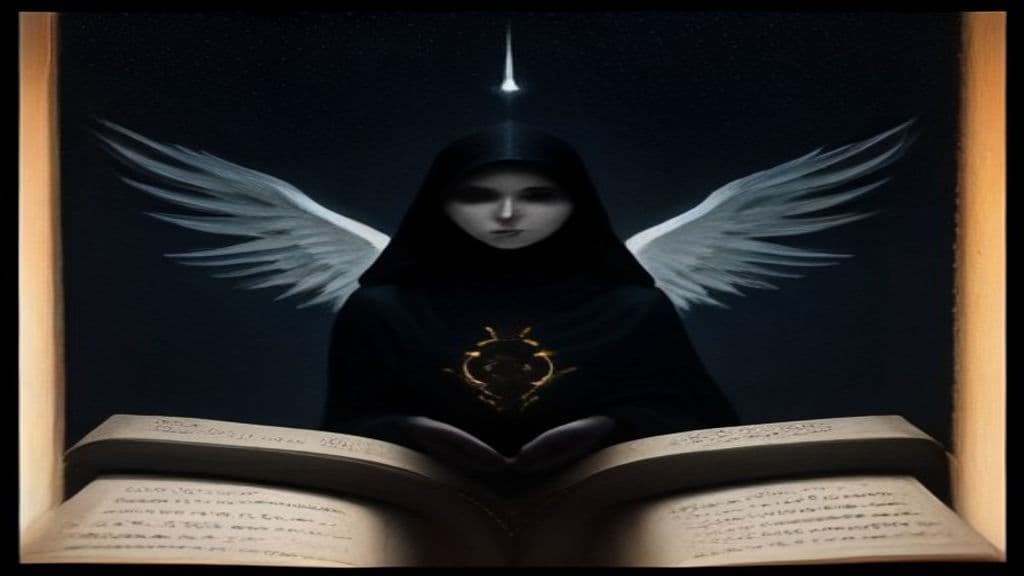
Attested sources identify Darda'il by name and role within Islamic tradition as angels associated with movement across the earth to seek assemblies engaged in remembering God's name. The available materials do not provide a narrative origin story or cosmogonic account for Darda'il specifically.
No specific physical description is provided in the cited sources. Sources identify Darda'il as angels but do not detail form, wings, or other physical attributes.
Primary attested behavior: "travel in the earth searching out assemblies where people remember God's name," as stated in the cited Islamic-tradition source. Additionally, an angel named Darda'il is reported to be invoked in exorcism; the sources do not describe the mechanics or procedures of that invocation.
Jinn
A class of supernatural beings from pre-Islamic Arabian religion later integrated into Islamic theology; jinn are created, morally accountable entities distinct from humans and angels, often unseen but capable of taking visible forms and interacting with people in varied ways.
Mahd al-Aadiyya
A chronicle character in Arabian tradition, serving as a vessel for conveying divine warning through poetry. (Note: 1. The power tier should be Primordial (as she serves as a vessel for conveying divine warnings from Allah, which would imply a connection to cosmic forces rather than regional or local). 2. Appearanc)
Rakhsh (Persian Tradition)
A mythological stallion and companion to the legendary hero Rostam in the Persian national epic Shahnameh. (Note: 1. Power tier: Based on Rakhsh's association with a legendary hero, it seems more likely to be Greater (deity-level) rather than Lesser. 2. Abilities: While we can infer that Rakhsh has strength and s)
Shaddād
A legendary king in Arabian folklore, described as tyrannical. (Note: 1. The power tier should be Greater (deity-level abilities are implied by association with a lost city and connection to Qur'anic lore). 2. Add appearance description from source material, mentioning )
Tahmina
In Persian epic tradition, Tahmina is a human character in the Shahnameh, a 10th-century epic poem. She is Rostam's wife and Samanganshah's daughter, appearing in the story 'Rostam and Sohrab'. Tahmina serves as a figure illustrating themes relevant to 10th-century Persian society. (Note: 1. Power tier should be "Lesser" since Tahmina is a human character with no supernatural powers. 2. Origin story section is missing. 3. Appearance section needs to state that there is no physical desc)
Daragang Magayon
Daragang Magayon is the heroine of a Bicol legend in the Philippines whose tragic life and death are the etiological explanation for the naming and formation of Mt. Mayon. Presented as a mortal maiden of extraordinary beauty, her story functions as a foundational regional myth and a cultural archetype of idealized beauty and tragic love.
Darak
No attested supernatural being named 'Darak' appears in the provided sources. The term 'Darak' is documented as a toponym (places in Cameroon and Iran), as the Tagalog common name for rice bran used in traditional Philippine medicine, and as a personal or fictional proper name in varied modern sources. There is no corroborated ethnographic or mythological description of Darak as a spirit, deity, or monster in the consulted materials.
Darakh
Darakh is not documented in the supplied sources as a supernatural being; the string 'Darakh' appears in the materials as a place-name in Nepal, a modern surname, a lexical item in a constructed language, and as a name used in fictional/fantasy settings. No folkloric cosmology, powers, appearance, or rituals for a spirit called Darakh are attested in the provided corpus.
Daramulum
Daramulum is a southeastern Australian Aboriginal sky-hero and ancestral figure associated with the major creator Baiame and with an emu-wife. He is embedded in rock‑art, sky knowledge (constellation identification), and initiation ritual practice, notably as a presence voiced through the bullroarer.
Dardan (Shannara)
In the supplied Shannara source fragments, Dardan is attested only as the personal name of one of the king's guards who was killed by a changeling. The name also exists in real-world onomastic and ethnonymic sources, but those uses are not connected to the fictional character in the provided materials.
Dardanians (Trojan)
A named human people or subgroup in the Homeric Trojan tradition, repeatedly distinguished from the Trojans in epic formulae (e.g., the Iliad). Later Roman poets and classical writers used the ethnonym in genealogical and territorial discourse (Dardania, Dardanus).
Dardanus (son of Zeus)
Dardanus is a mythic progenitor and eponymous founder in Greek tradition, named as a son of Zeus and the Pleiad Electra and presented as ancestor of the Trojan royal line and the namesake of places on the Asian shore of the Hellespont.
Community Record
- [1]Darda'il - Wikipedia. Wikipedia contributors, 'Darda'il,' Wikipedia, The Free Encyclopedia.wiki
- [2]Pixelated Audio 143 - Splice with Dain Saint (track listing includes 'Darda'il'). Pixelated Audio archive listing, 'Splice with Dain Saint' track list (includes track titled 'Darda'il').other