
In the Puranic/genealogical tradition Rambha is presented as a Danava, a descendant of Danu and the sage Kashyapa. Textual summaries (notably the Devi Bhagavatam, Fifth Book, Chapter 2) and later retellings describe Rambha and his brother Karambha undertaking austere penances seeking powers for the Danavas. Several narrative strands associate Rambha with an extraordinary union with a water-buffalo that results in the birth of Mahishasura (Mahi), although accounts differ on whether this birth arises directly from a union, from a boon, or from events surrounding Rambha's funeral pyre; other retellings supply further incidental details (for example, variants that report divine involvement in Rambha's death) that are not uniform across sources.
Primary sources and the provided summaries do not give a sustained physical description of Rambha himself. Descriptive emphasis in the available texts falls on his progeny: Mahishasura is explicitly described in some accounts as having the body of a buffalo. Where Rambha's corporeal form is mentioned in secondary summaries, those references are not consistent or detailed in the cited primary excerpt.
Attested behaviors in the sources portray Rambha as an asura who undertakes tapas (penances) and seeks boons—standard means by which asuras attempt to gain powers or protections in Puranic narratives. Some retellings report that he sought a boon protecting him from being killed by humans, gods, or asuras; other accounts emphasize his sexual/parental behavior resulting in a buffalo-bodied son. Beyond penance, boon-seeking, and his role in producing Mahishasura, the supplied materials do not document sustained lists of magical abilities or extraordinary combat feats for Rambha himself. Variants in the secondary literature mention his death by divine action (one retelling says Indra, disguised as a crocodile, killed him) but these details are presented as divergent or tertiary.
Weaknesses
- conditionvulnerability during penance submerged in water (attested in some retellings where Rambha is killed while performing penance)
Wards
None recorded.

Mahishasura
Mahishasura (Sanskrit: महिषासुर, IAST: Mahiṣāsura) is a bovine asura in Hindu tradition, commonly described as a shape‑shifting buffalo‑demon who wages war against the devas and is ultimately slain by a manifested goddess (Durga/Mahishasuramardini). The episode is narrated in the Devi Mahatmya (part of the Markandeya Purana) and is commemorated in festival cycles such as Navaratri and Durga Puja.
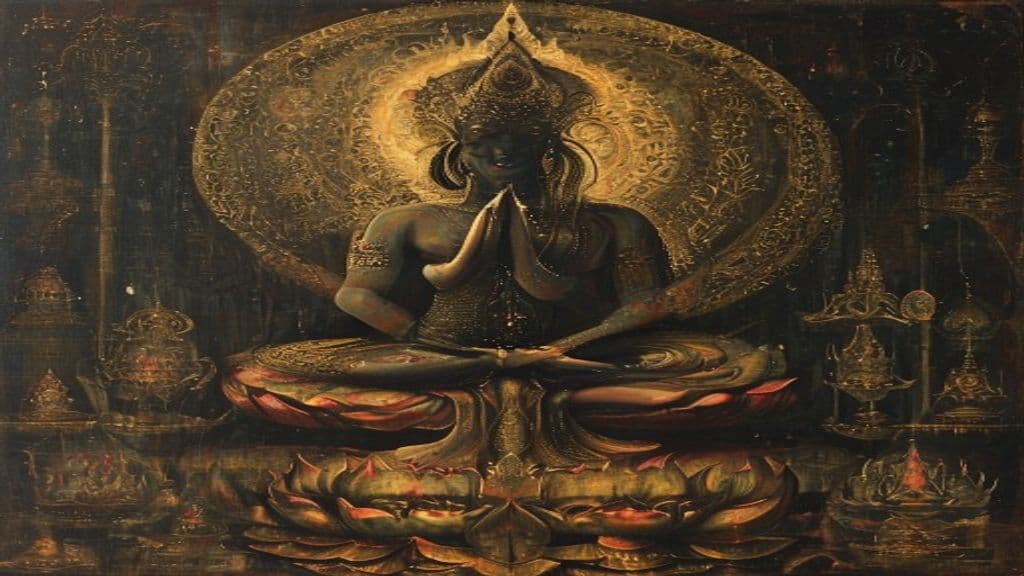
Deva (Buddhism)
In Buddhist cosmology a deva is a class of celestial being or heavenly rebirth occupying higher planes than humans; devas are longer‑lived, more powerful, and generally happier than humans but remain impermanent and subject to karma. The category spans formless meditative beings through subtle form devas to sensual gods, and maps onto the three dhātus (Ārūpyadhātu, Rūpadhātu, Kāmadhātu).
Community Record
- [1]Rambha (asura) — Wikipedia. Wikipedia, entry 'Rambha (asura)'wiki
- [2]The Devi Bhagavatam: The Fifth Book: Chapter 2. Devi Bhagavatam, Fifth Book, Chapter 2 (summary lines referenced in the provided notes)literary
- [3]Story Of Navratri - RESEARCHUT. ResearchUT summary retelling of the Navratri/Devi traditions referencing Rambha and the buffalo-son narrativeother
- [4]Why is Goddess Durga Known as Mahishasura Mardini? — VedicFeed. VedicFeed summary discussing Mahishasura's origin and related narratives (noted as a modern retelling/summary)other
- [5]How was Mahisasura, the demon killed by Mahalakshmi, (Mother Goddess) born? — Hinduism StackExchange. Hinduism.StackExchange question and answers summarizing variant accounts (marked in notes as tertiary/uncertain)other