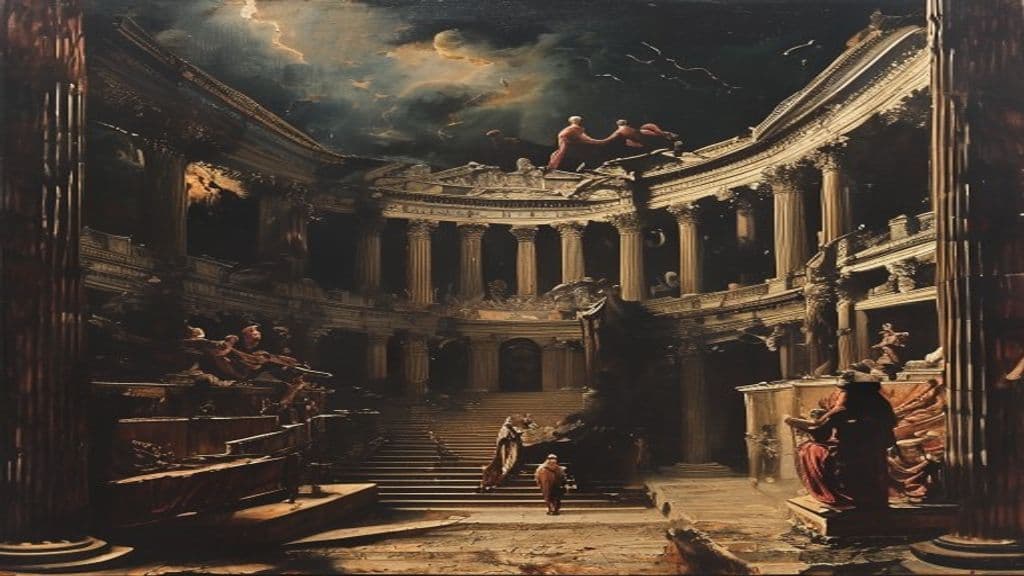
No physical description is provided for this entity, as it is a concept rather than a supernatural being.
The Roman theology of victory serves to legitimize and justify the exercise of power by those who claim victory, often through military conquests.
Weaknesses
- conditionLoss of legitimacy through failure to deliver victories or unjust wars
Wards
None recorded.
Cephalion
Cephalion is attested in classical and late-antique sources as a human name appearing in two distinct registers: (1) an authorial/historian or rhetorician cited by later chroniclers (placed by one source in the time of Hadrian and by another as author of a multi-volume history beginning with Assyria), and (2) a mytho‑genealogical figure named as the son of Amphithemis and the nymph Tritonis. The supplied materials present these as separate, unreconciled references rather than as a single supernatural entity.
De Divinatione
An abstract concept in Roman tradition related to prophecy and divination, described in De Divinatione by Cicero. (Note: * Power tier: The text does not support Primordial power, which typically refers to entities that are cosmic or universal in scope. A more accurate classification would be Ancient (deity-level), as it)
Interpretatio germanica
Process by which Germanic peoples identified Roman gods with their own deities, facilitating cultural exchange and syncretism. (Note: - Power tier should be Ancient (deity-level) instead of Primordial (cosmic), as it's a cultural exchange process rather than an otherworldly power. - Appearance and sensory cues sections are missing; )
Rohham
Loyal paladin and hero in the Persian epic Shahnameh, embodying values of loyalty and military prowess. (Note: * Power tier should be Primordial or Ancient, as Rohham is described as a hero in an epic that deals with "ancient Iranian history and mythology", implying a high level of power. Greater seems too low)
Rohini
Rohini is a Hindu divine figure who personifies the nakshatra (lunar mansion) identified with the bright star Aldebaran in Taurus and is described in sources as the favorite consort of Chandra (the Moon). She appears in genealogical lists as one of the twenty-seven daughters of Daksha and Asikni and functions primarily as an astronomical-mythic partner whose union with the Moon is used in some modern interpretive accounts as a temple-symbolic metaphor.
Rokurokubi
A Japanese yōkai-class apparition associated with humans (most often women) who display an uncanny bodily anomaly: either an extremely extendable neck or a head that detaches and moves independently (the latter often called nukekubi). Appears in classical kaidan collections and Edo-period encyclopedias and is variously framed in sources as a supernatural being, an illness, or the soul wandering during sleep.
Roman Charity
An exemplar of filial piety in ancient Greek and Roman tradition, representing a child's extraordinary devotion to their parent. (Note: 1. Power tier: "Minor Spirit" is incorrect; there are no supernatural powers or abilities associated with the Roman Charity, so it should be classified as a non-spirit entity or not included in the po)
Roman Ferryman
In Roman mythology, the Ferryman is a mythological figure tasked with guiding souls across the river Styx to the afterlife, requiring payment from each deceased person. (Note: * Power tier: Lesser (not Primordial), as it is more aligned with regional spirits, not cosmic forces. * Abilities: The Ferryman's role is focused on ferrying souls, but the implication that it contro)
Romulus and Remus
Romulus and Remus are twin brothers of Roman foundation myth who, according to tradition, survived abandonment, restored their grandfather Numitor, and (after a dispute that ended in Remus's death) Romulus founded the city of Rome and became its first king. Their story serves as an etiological account of Rome's origin, early institutions, and certain civic and religious symbols.
Rongo
Major god in Māori mythology associated with cultivated plants, particularly kūmara. (Note: - Power tier should be Ancient (deity-level) instead of Primordial. - Abilities could use further clarification or expansion based on the source material. - Sensory cues are missing entirely and need )
Rongokako
Rongokako is a named ancestral ariki and tohunga of the Tākitimu waka tradition, remembered in East Coast Māori narratives (Ngāti Kahungunu and related iwi) for superhuman leaping, deeds that explain local landscape features, and variable portrayals that range from heroic ancestor to dangerous elder in different local accounts.
Rongomai-wāhine
Rongomai-wāhine is presented in the provided sources as a historical/matricentred tupuna (ancestress) and rangatira (chieftainess) from the Māhia Peninsula. Her personal name is the eponym for Ngāti Rongomaiwahine and is invoked in whakapapa that underpins tribal identity, land interests, and contemporary iwi authority rather than describing a supernatural being.
Community Record
- [1]