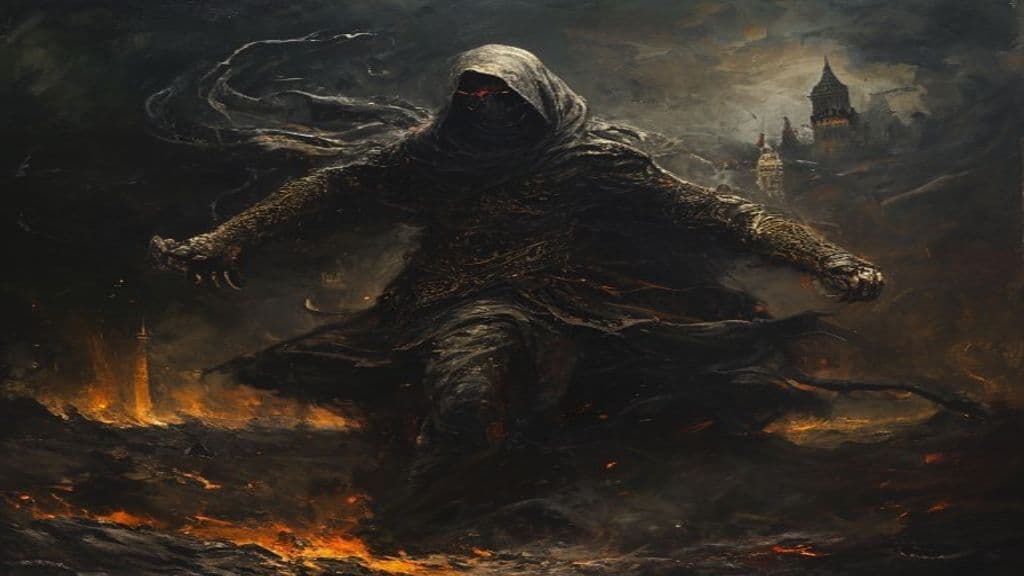
Rohham is a character in the Shahnameh, a Persian epic that tells the story of ancient Iranian history and mythology.
No physical description of Rohham is provided in the source material.
Rohham is described as loyal and militarily skilled, serving under the reigns of Kay Kavus and Kay Khosrow.
Aghrirat
Aghrirat is a named Turanian noble and peacemaker in the Shahnameh and Iranian mythic tradition, presented as a son of Pashang and brother of Afrasiab and Garsivaz. He is notable for his kind and gentle character and for attempting, largely unsuccessfully, to end the hostilities between Iran and Turan.
Azadeh
Azadeh (Persian: آزاده) is a Persian female given name meaning broadly 'free' or 'free-minded'; some sources also gloss it as 'someone noble'. The name appears in modern Iranian usage (borne by several contemporary public figures) and as the name of a character in Ferdowsi's Shahnameh. It is a personal name rather than a supernatural being in the provided sources.
Banu Goshasp
Important heroine in Iranian mythology, appearing in several Persian epics including the Banu Goshasp Nama. (Note: - The power tier should be Ancient, not Primordial, as there's no indication that she has cosmic-level abilities. - There are no sensory cues, weaknesses, or wards listed, but they could potentially b)
Darab-nama (Persian tradition)
Historical romance novel from 12th-century Persia, with possible references to supernatural entities in Persian folklore. (Note: - Power tier: Primordial (due to its historical significance and cultural impact) - Summary: Needs more specific information on supernatural entity references - Appearance: No information provided in )
Farhad (Persian literature)
In Persian literature and mythology, Farhad is a character associated with the love story of Khosrow and Shirin. (Note: 1. Power tier should be revised to "Minor Spirit" since Farhad's abilities are more related to his devotion and determination, rather than cosmic or deity-level powers. 2. Remove description of "Appea)
Huma Bird
In Persian tradition, the Huma bird is a mythical creature that inhabits the air, never touching down on the ground. (Note: - Power tier: Primordial (or not specified at all), as it has cosmic abilities - Appearance: Invisible entity (already correct) - Abilities: Add "existing solely as a concept rather than a tangible be)
Tahmina
In Persian epic tradition, Tahmina is a human character in the Shahnameh, a 10th-century epic poem. She is Rostam's wife and Samanganshah's daughter, appearing in the story 'Rostam and Sohrab'. Tahmina serves as a figure illustrating themes relevant to 10th-century Persian society. (Note: 1. Power tier should be "Lesser" since Tahmina is a human character with no supernatural powers. 2. Origin story section is missing. 3. Appearance section needs to state that there is no physical desc)
Vis and Rāmin
Vis and Rāmin are the protagonists of a classical Persian romantic tale composed by Fakhruddin As'ad Gurgani in the 11th century. The narrative reflects the traditions and customs of ancient Persia. (Note: 1. Power tier should be "Minor Spirit" given that no supernatural abilities or behaviors are described. 2. Origin story is incorrect; source material states Parthian origin and not likely to have Part)
Zafarnamah (Mustawfi)
Persian epic poem written by Hamdallah Mustawfi, exploring Iranian history and culture. (Note: 1. Power tier should be Ancient (deity-level) does not fit; Primordial is typically reserved for entities related to the creation of the world or fundamental forces. 2. Appearance section is missing 3)
River gods (Greek mythology)
In the supplied sources, 'river god' denotes the anthropomorphic divine personification of a particular river, a localized nature divinity associated with a watercourse. The available materials are limited to a modern reference disambiguation and a museum object record showing later artistic depiction; they do not supply detailed ancient mythic narratives, rites, or consistent iconography.
Ro-langs
A Tibetan folkloric animate corpse — a dead body reanimated by ritual or an evil spirit that moves among the living. Accounts emphasize corpse-like rigidity, inability to bend joints or speak, and two main origin types: tantric (raised to serve a practitioner) and demonic (occupied by an evil spirit that may infect others).
Rohini
Rohini is a Hindu divine figure who personifies the nakshatra (lunar mansion) identified with the bright star Aldebaran in Taurus and is described in sources as the favorite consort of Chandra (the Moon). She appears in genealogical lists as one of the twenty-seven daughters of Daksha and Asikni and functions primarily as an astronomical-mythic partner whose union with the Moon is used in some modern interpretive accounts as a temple-symbolic metaphor.
Community Record
- [1]Wikipedia: Rohham. 1.wiki