
There is no preserved indigenous mythic narrative describing Ruhurater’s birth or origin in the cited materials. Scholarly proposals place him within or adjacent to Elamite creator-deity groups (Napratep) or read his name with elements meaning 'creator' or 'offspring,' but these etymological and functional connections are explicitly presented as contested and not settled by the sources. Historically attested cultal origins include his role as the city god of Huhnur (Tepe Bormi), where a royal inscription of Amar-Sin (Third Dynasty of Ur) records rebuilding his temple and returning a cult statue, establishing him as a civic patron in the historical record.
No iconographic description of Ruhurater survives in the cited sources. Material-cultic attestations indicate a cult statue and temple: Amar-Sin's inscription records that he rebuilt Ruhurater's temple at Huhnur and returned a statue of the god, and a temple shared with Hishmitik is attested at Chogha Zanbil. Beyond these references to a statue and temples, the sources do not preserve physical or anthropomorphic details.
In the extant texts Ruhurater functions chiefly as a divine witness invoked in legal and administrative documents (appearing alongside gods such as Shamash, Inshushinak, and Nahhunte). He is described as capable of bestowing kiten, an Elamite concept translated as 'divine protection.' Some scholars have tentatively connected him to creator-deity groups (Napratep) or proposed readings of his name that would yield meanings like 'creator (of) man' or relate to 'offspring,' but the sources treat such creator associations as uncertain. In at least one legal text the 'kidinnu' of Ruhurater is mentioned in relation to a silver loan, suggesting the use of a divine emblem or device associated with the god, though the term's exact nature is unclear. In Mesopotamian god-lists he is equated with Ninurta, an external classificatory placement rather than an Elamite self-definition.
Weaknesses
None recorded.
Wards
- ritualInvocation as divine witness / petition for kiten
- ritualTemple maintenance and statue installation/restoration

Inshushinak
Inshushinak is the principal tutelary deity of the city of Susa in Elamite tradition, functioning as the city's lord, protector, royal legitimizer, and divine judge with associations extending into funerary and underworld contexts.
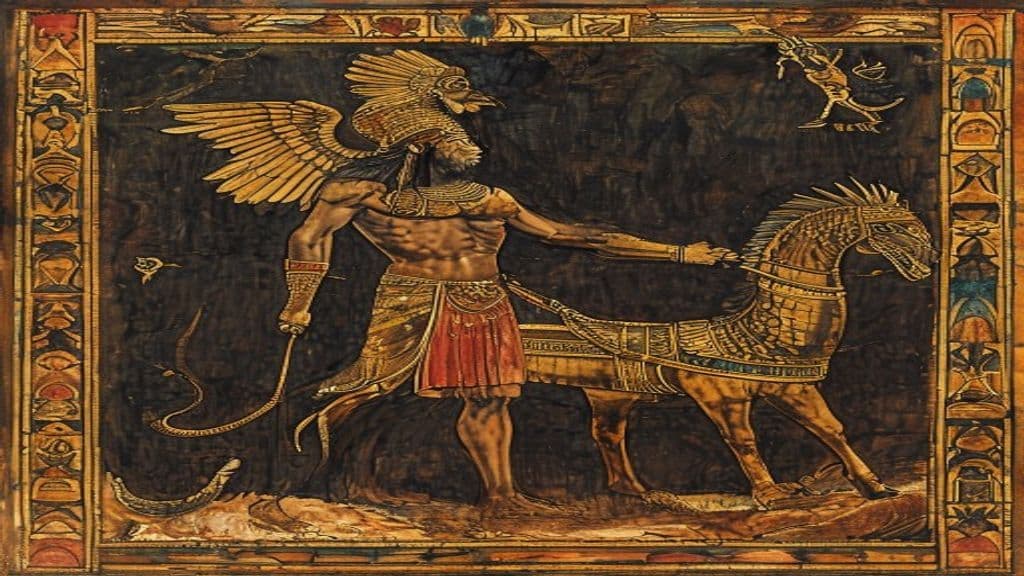
Ninurta
Ninurta is a major deity of ancient Mesopotamia (Sumerian–Akkadian–Assyrian–Babylonian) whose roles include agriculture, healing/exorcism, law and scribal authority, and martial champion of the gods. He is attested from the mid-third millennium BC onward and was venerated at city cult-centers such as Nippur (Eshumesha), Girsu/Lagash (as Ninĝirsu), and later in Assyrian Kalhu.
Community Record
- [1]Ruhurater - Wikipedia. Wikipedia, entry 'Ruhurater'wiki