In the dominant mythic tradition Semele is the youngest daughter of Cadmus and Harmonia of Thebes. She becomes Zeus's mortal consort and conceives Dionysus. Hera, jealous of Zeus's liaison, deceives Semele (in some accounts in the guise of an old woman) and persuades her to demand that Zeus reveal himself in his true divine form. Having sworn by the River Styx to grant her any request, Zeus must comply; he appears with thunder and lightning, and Semele, being mortal, is destroyed by the vision. Zeus rescues the unborn child by sewing him into his thigh (accounted in sources by the epithet Eiraphiotes, 'insewn'), and the child is later revealed as Dionysus. In later versions Dionysus descends into Hades and rescues his mother, bringing her to Olympus where she is deified under the name Thyone and associated with the ecstatic frenzy of Dionysian worship. Variants of the conception and genealogical tradition exist in the sources (e.g., associations with Zagreus or differing heart/gestation motifs).
Primary ancient sources emphasize Semele's identity as a Theban princess rather than a fixed visual iconography; she is described as the youngest daughter of Cadmus and Harmonia and is connected to the Cadmeia (the palace on the Theban acropolis). The supplied materials do not record consistent physical details (height, dress, features). Later literary, dramatic, and operatic adaptations (Aeschylus' lost tragedy Semele, Handel's opera Semele, modern stagings) present varied portrayals informed by artistic convention rather than a canonical ancient portrait. Overall, the tradition offers no single authoritative iconographic description in the cited sources.
Semele herself, in the surviving accounts summarized in the sources, does not possess inherent supernatural powers prior to her death and apotheosis; her significance lies in her narrative roles—mortal lover of Zeus, mother of Dionysus, and recipient of apotheosis as Thyone. In one variant she appears as a priestess of Zeus and participates in ritual activity (for example, a version records her slaughtering a bull at an altar and bathing in the river Asopus), but this is explicitly presented as one version among others. Her transformational capacities are posthumous: after death she is rescued by her son and elevated to divine status, presiding over aspects of Dionysian frenzy; she does not independently demonstrate godlike powers in the cited materials prior to that elevation.
Weaknesses
- conditionmortal frailty – destroyed by direct vision of a god's full divine form
- othervulnerability to divine jealousy and deception (Hera's instigation leads to her downfall)
Wards
- othernone attested — sources do not record protective rites, talismans, or wards directed against Semele

Dionysus
Dionysus (Ancient Greek: Διόνυσος) is a major ancient Greek deity associated with wine and winemaking, vegetation and fertility, festivity and theatre, ritual ecstasy and possession, and liminal links with death and the underworld. He is an epiphany-god who travels between worlds, whose cult includes ecstatic rites and mystery initiation.

Zeus
Zeus (Ancient Greek: Ζεύς) is the supreme deity of the classical Greek pantheon, a sky-and-thunder god who rules as king of the gods on Mount Olympus and functions as a sky‑father who assigns roles among the immortals.
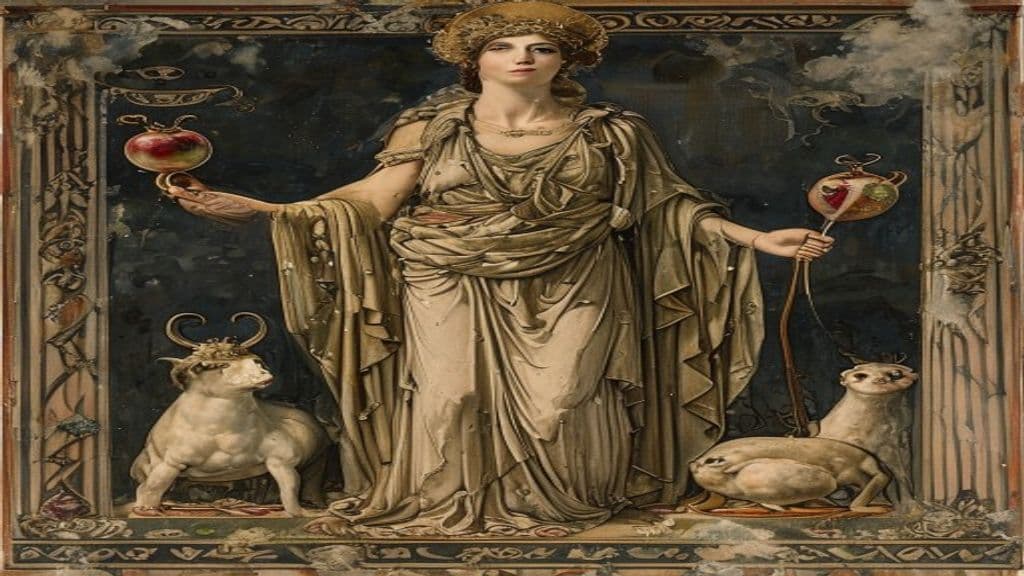
Hera
Hera is an ancient Greek goddess, queen of the Olympian gods, and a principal tutelary deity of marriage, women, and family. She functions in myth and cult as protector of lawful marriage and women in childbirth, a civic tutelary figure (notably of Argos), and a sometimes-jealous consort of Zeus with archaic fertility associations in certain local rites.
Community Record
- [1]Semele. Wikipedia: Semelewiki
- [2]Semele (Wikidata). Wikidata entry for Semeleother
- [3]Semele (Handel). Wikipedia: Semele (Handel)wiki
- [4]Semele - in ancient sources @ attalus.org. attalus.org: Semele in ancient sourcesother
- [5]The Classics Pages: Semele. Classics Pages: Semeleother
- [6]Semele - Royal Ballet and Opera tickets | London Theatre. London Theatre: Semele listings and reviewsother
- [7]The Handel Opera Project Performs Handel’s SEMELE. Category: Arts & Events from The Berkeley Daily Planet. Berkeley Daily Planet: Handel's Semele performance noticeother