
Shullat and Hanish are attested across Mesopotamian periods rather than in a single creation story: their names appear in Sargonic theophoric personal names, a temple was built to them by King Shulgi in the Ur III period, and they occur as preexisting divine agents in major flood narratives (Atrahasis, the Epic of Gilgamesh Tablet XI). God lists and astrological texts (An = Anum and related corpora) integrate them into the wider Mesopotamian divine system, sometimes equating them with or associating them to greater gods in specific contexts, though their independent twin‑pair identity persists in the literary and ritual record. Their lexical origins are Semitic but etymologies remain uncertain in modern scholarship.
Primary literary descriptions do not provide a fixed anthropomorphic iconography. In narrative passages (notably Gilgamesh Tablet XI) they are depicted functionally — "heralds" advancing before the storm — rather than with detailed physical attributes. No standardized cult statue descriptions or consistent visual markers are preserved in the supplied sources; surviving attestations emphasize their role and function (storm‑heralds) instead of pictorial detail.
Shullat and Hanish function as personifications or divine agents of violent weather: storm, gale, wind and flood. They are described by modern commentators and in primary texts as "warlike and destructive" and as "twin agents of destruction," often advancing before Adad (the storm god) in flood narratives and acting within ensembles of destructive deities. They appear in omen and military contexts (mentioned as marching with troops) and are invoked in oath formulas and ritual lists. In some astrological and god‑list contexts they are linked or equated with other gods (e.g., Shullat sometimes with Shamash, Hanish with Adad), and some astral scholarship associates them with twin stars (suggested identifications Mu and Nu Centauri), though such identifications are context‑dependent and not uniform.
Weaknesses
- conditiontaboo restrictions at places of divinatory decision (purity/fitness rules)
Wards
- ritualThe taboo of Shullat and Hanish (restrictive prescriptions for approach to divinatory places)
- ritualOath invocations including Shullat and Hanish (use as guarantors in oath formulas)
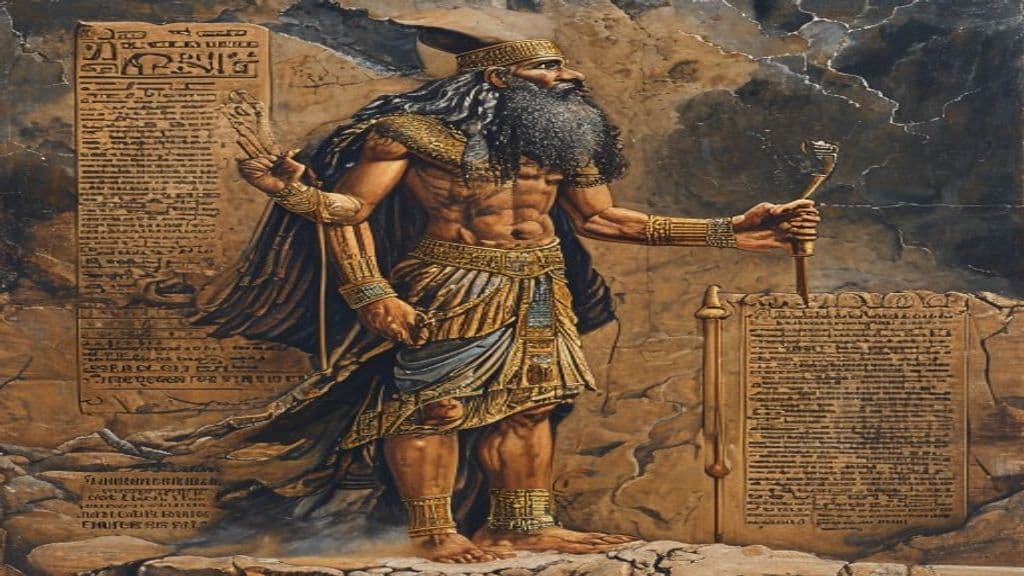
Adad
Adad (also Hadad, Haddad; Sumerian Iškur) is the storm- and rain-deity attested in ancient Mesopotamian and Canaanite religious contexts. Sources identify him as a principal weather god whose domain is storms and rainfall and whose name appears across multiple Near Eastern languages and sites, including Ebla (as Hadda, c. 2500 BCE).

Shamash (Utu)
Shamash (Akkadian šamaš; Sumerian Utu) is the ancient Mesopotamian sun god, a principal deity responsible for the visible sun and for juridical, protective, and divinatory functions. He is venerated especially at Sippar and Larsa, appears in major myths as an ally of heroes, and is regarded as the divine witness whose sight underwrites justice and truth.
Community Record
- [1]Shullat and Hanish - Wikipedia. Wikipedia article 'Shullat and Hanish'.wiki
- [2]Epic of Gilgamesh, Tablet XI. Epic of Gilgamesh, Tablet XI; literary passage describing Shullat and Hanish preceding the storm.literary
- [3]Research notes and modern scholarship summaries (compiled). Compiled scholarly summaries cited in research notes (Gelb; Edzard; Lambert; Schwemer; Andrew R. George) concerning etymology, function as storm‑heralds, ritual attestations, and astral identifications.other