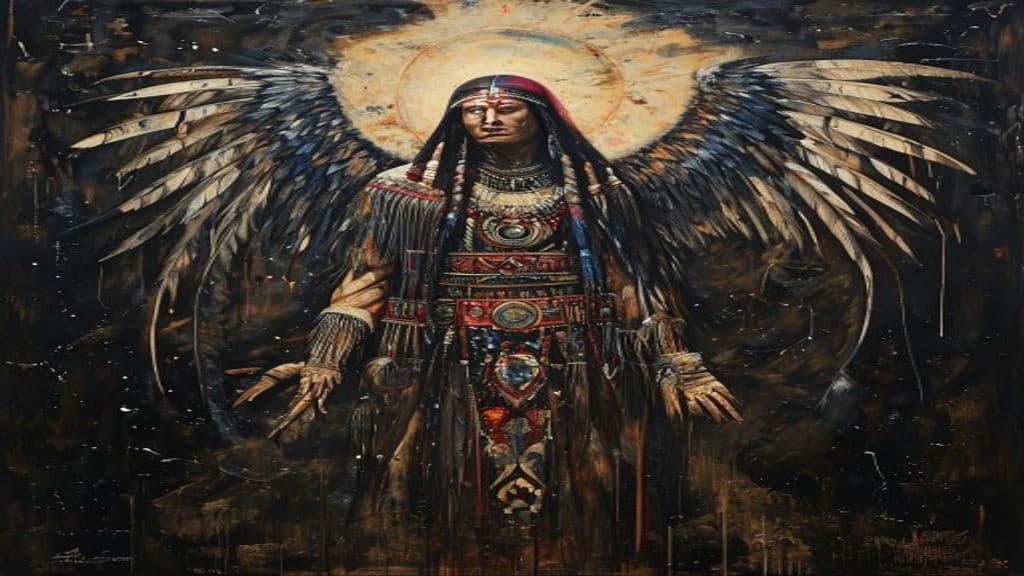
In Lakota cosmology, Škaŋ was created by Wakáŋ Tȟáŋka (The Great Spirit) at the beginning of time as one of the four fundamental elements to comprise the universe.
Škaŋ represents a fundamental element of the universe and plays an active role, but its abstract concept has no independent agency or behavior.
Anog Ite
In Lakota mythology, Anog Ite is a complex entity associated with emotional pain and chaos. She is punished for attempting to disrupt balance. (Note: 1. Power tier should be revised based on the entity's abilities described in the source material (Primordial=cosmic, Ancient=deity-level, Greater=powerful regional, Lesser=local spirit, Minor Spirit=w)
Pahá Sápa (Black Hills)
Sacred site and geographical feature in the Lakota tradition, comprising an isolated mountain range in western South Dakota. (Note: 1. Power tier: change to Ancient (the entity's formation and spiritual significance in Lakota tradition do not align with Primordial). 2. Appearance: add that the name "Pahá Sápa" translates to "Black)
Sun Dance (Lakota tradition)
A spiritual practice and ritual ceremony practiced by certain Native American and Indigenous communities in North America, emphasizing personal and community sacrifice to reaffirm beliefs about the world and the supernatural. (Note: 1. Remove "certain" from the summary as it's not specified which communities participate. 2. Power tier should be Primordial as the Sun Dance has a more cosmic significance and isn't necessarily tied )
Untunktahe (Lakota Water Spirit)
In Lakota mythology, Untunktahe is a water spirit associated with bodies of water. (Note: 1. Power tier: Greater seems inconsistent with "associated with bodies of water", which could imply Lesser or Primordial. 2. Abilities: Not enough information to determine abilities; should be marked )
Śreyānsanātha
Śreyānsanātha (Shreyansanath) is the eleventh Tīrthaṃkara of the present age (Avasarpini) in Jain tradition. According to the supplied sources he was born to King Vishnu and Queen Vishna at Simhapuri near Sarnath, belonged to the Ikshvaku dynasty, and attained Siddhahood (liberation by destroying all karma).
Śuri
Śuri is an ancient Etruscan deity combining chthonic (underworld), volcanic/fiery, and solar aspects. Centered on Mount Soracte and served by the Hirpi Sorani, he is associated with volcanic fire and lightning, the sun and the Manes, oracular functions, and communal health/plague rites.
Śāntinātha
Śāntinātha (Śānti) is the sixteenth tīrthaṅkara of Jainism in the present age, revered as a spiritual exemplar who attains omniscience and establishes the tirtha (ford) enabling liberation. Tradition also presents him in some accounts as having held the worldly statuses of a Chakravartin and a Kamadeva in the same lifetime, and he is traditionally invoked by devotees as a deity of peace to avert calamities and epidemics.
Šassūrātu
Šassūrātu are a collective of Mesopotamian goddesses whose name is translated as 'midwives.' Attendants of the goddess Ninmah, they are attested in Mesopotamian mythic texts and are regarded as tutelary goddesses of pregnant women.
Šulak
Šulak is an ancient Babylonian and Assyrian lavatory demon associated with the bīt musâti ('house of rinse-water'). Texts portray Šulak as a harmful spirit blamed for sudden bodily afflictions (notably stroke and epilepsy) that befall people while defecating and prescribe protective deposits and amulets placed in lavatory thresholds, foundations, and drainage pipes.
Šumugan
Šumugan (also Šamagan, Šumuqan, Šakkan; logogram 𒀭𒄊) is a Mesopotamian and ancient Syrian pastoral deity who functions as a divine shepherd responsible for herd animals, grazing landscapes, and watering places. Attested in southern Mesopotamian cities and in western Syrian polities, he appears in cultic, literary, and incantatory contexts and occasionally in texts with underworld associations.
Šēp lemutti
Šēp lemutti (Akkadian šēp lemutti) is the ritual idiom and title of a Mesopotamian ritual corpus (not a single named individual) meaning “foot of evil” used for blocking or expelling an intrusive hostile force from a private house. The ritual prescribes manufacture, invocation, and deposition of apotropaic figurines and the invocation of gods and protective beings to prevent sickness, death, and other misfortunes attributed to netherworld demons entering the household.
Žaltys
A household spirit in Lithuanian mythology embodied by the grass snake; sacred to the sun goddess Saulė, kept near the stove as a guardian of the home and a symbol of fertility, and believed to bring good harvest and wealth while bringing misfortune if killed.
Community Record
- [1]Wikipedia: Skanwiki