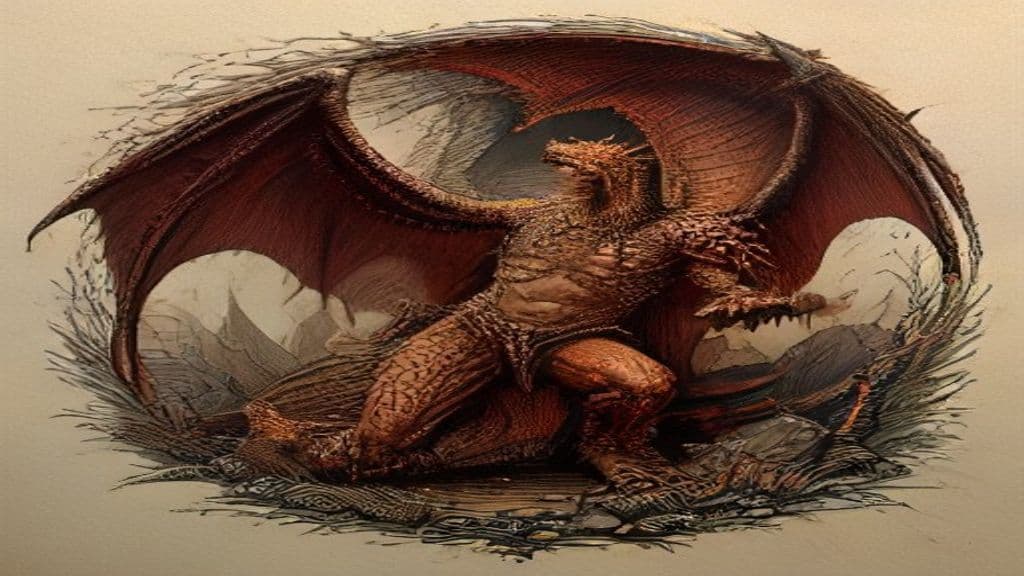
Smaug is presented in Tolkien's narrative as a dragon who came from the dragon-haunts in the Withered Heath beyond the Grey Mountains. He 'arose and without warning came against King Thrór and descended on the mountain in flames,' drove out the Dwarves of Erebor, destroyed the nearby town of Dale, and thereafter occupied the interior of the mountain for roughly 150 years guarding a vast hoard. The invasion of Erebor is dated in the narrative tradition as occurring 171 years before the events of The Hobbit.
Smaug is described as a winged, fiery, reptilian being with an armoured, jewel-encrusted belly; Bilbo notices 'a small bare patch on Smaug's jewel-encrusted underbelly' which is crucial to the plot. He is centuries old, of great size and destructive capability (able to destroy towns), and possesses wings and the ability to fly and breathe fire.
Smaug is a cunning, speaking dragon who guards a vast hoard and knows its contents 'to the ounce,' immediately detecting the theft of a cup. He breathes fire, flies, and can lay waste to settlements (he destroyed Dale and later attacked Lake-town). He demonstrates keen perception—sensing Bilbo's presence despite Bilbo's use of the One Ring to be invisible—and engages in prolonged conversation, showing vanity and wiliness. Ordinary townsmen's arrows and spears 'proved useless against the dragon's armoured body.' His death results from a single small bare patch on his underbelly being struck by Bard the Bowman after a thrush relays the information.
Weaknesses
- othersingle small bare patch on the underbelly
Wards
- conditionphysical fortification and distance (Lake-town houses on stilts, surrounded by water)
- otherknowledge of specific vulnerability combined with skilled marksmanship (thrush informing Bard; Bard's arrow)
- otherstealth and secrecy for approach (Bilbo's use of the One Ring and covert entry into the lair, though Smaug still perceived him)
Ainur
The Ainur are the immortal spiritual intelligences created by Eru Ilúvatar before the physical Creation in J. R. R. Tolkien's legendarium. Through the Music of the Ainur (Ainulindalë) their themes were given being as the universe (Eä); some of the Ainur entered that world and became its guardians, the Valar and the Maiar.
Ar-Pharazôn
Ar-Pharazôn is the twenty-fifth and last King of Númenor in J. R. R. Tolkien's legendarium; a mortal ruler whose political and military leadership, and whose acceptance of Sauron's counsel, precipitated the rebellion of Númenóreans against the Valar and the Downfall of Númenor.
Avari (Middle-earth)
The Avari are identified in the provided sources as a subgroup of Elves in J. R. R. Tolkien's fictional legendarium. The supplied materials (Wikipedia and Wikidata entries) classify them as fictional Elven people but contain no extended narrative, descriptive, or ritual detail about them.
Balrog
In J. R. R. Tolkien's legendarium, a Balrog is a Maiar spirit corrupted into a warlike, fire-associated servant of the Vala Melkor (Morgoth). Balrogs appear as towering, shadowed figures wreathed in fire and wielding fiery whips and weapons; in Tolkien's later conception they are rare, exceptionally powerful beings whose defeat generally required opponents of comparable metaphysical order.
Barliman Butterbur
Barliman Butterbur is a human resident of Bree in J. R. R. Tolkien's Middle-earth. Source material classifies him simply as a man in Tolkien's legendarium and situates him within Bree-land, the village region where Hobbits and Men live side by side.
Beren and Lúthien
Beren and Lúthien are the central protagonists of a foundational First‑Age tale in J. R. R. Tolkien’s legendarium about the love between a mortal Man (Beren) and an immortal Elf‑maiden (Lúthien), their quest to take a Silmaril from Morgoth’s crown, Beren’s death and unique return, and Lúthien’s choice to become mortal.
Children of Ilúvatar
In J. R. R. Tolkien’s legendarium, the Children of Ilúvatar are the two principal kinds of sentient, created beings—Elves and Men—brought into being by the supreme creator Ilúvatar (Eru) and occupying a central place within Tolkien’s cosmology.
Company of the Ring
A fictional constituted questing body in J. R. R. Tolkien's Middle-earth, formed to escort the Ring-bearer and destroy the One Ring. Composed of nine members drawn from diverse Free Peoples, it functions as a communal, multi-cultural alliance opposed to Sauron's Nine Riders.
Círdan
Círdan is a named Elf in J. R. R. Tolkien's legendarium, portrayed as a shipwright and leader associated with the Grey Havens (Mithlond) who prepares vessels for the westward departure of the Elves from Middle-earth.
Dáin II Ironfoot
Dáin II Ironfoot is a named Dwarven king and military leader of the Iron Hills in J. R. R. Tolkien’s legendarium, presented in sources as a kinsman of Thorin Oakenshield who brings reinforcements to the Lonely Mountain and who is reported to have warned that Moria remained dangerous because of Durin's Bane.
Edain (Men)
The Edain, rendered in sources as Man or Men, are the human peoples of J. R. R. Tolkien's Middle-earth. They are the 'second' or younger people, created after the Elves and distinguished chiefly by their mortality; they are counted among the 'free peoples' of Middle-earth alongside other autonomous races.
Elendil
Elendil is a human Númenórean leader in J. R. R. Tolkien’s legendarium: a refugee of Númenor who founded the northern realm of Arnor, led the Faithful, and fought in the Last Alliance against Sauron. He is remembered as a dynastic founder whose proclamation and heirlooms shaped later kingship in Middle-earth.
Community Record
- [1]Smaug — Wikipedia. Wikipedia article 'Smaug'.wiki
- [2]Smaug — Wikidata. Wikidata item Q3486900 for Smaug.other
- [3]Archive materials and commentary excerpts (research notes). Selected archival references and compiled research notes provided for the entity; includes secondary commentary linking Smaug to Beowulf and Fafnir and noting textual descriptions from The Hobbit.literary