
Folklore situates the soucouyant within Caribbean syncretic cosmologies as one member of the broader class of spirits called jumbies. Sources describe the figure as arising from a blending of local and diasporic influences — scholars and folklorists note correspondences with African beliefs (for example, Yoruba Aje) and points of contact with European motifs (e.g., folk terms related to loup-garou/loogaroo), but emphasize that the soucouyant is a distinct regional formation rather than a direct equivalent of any single Old World type.
By day the soucouyant is traditionally depicted as a reclusive old person, often an old woman, though accounts allow other genders and ages. At night the being is said to strip off its wrinkled skin (leaving it stored, in some tellings, in a mortar) and take the form of a glowing, flying fireball that can enter houses through very small openings such as keyholes and cracks. Victims found after an attack are reported to have black and blue marks on arms, neck, legs and other soft regions.
Folk descriptions hold that the soucouyant removes and stores its human skin before nocturnal activity, flies through the sky as a luminous ball, and enters dwellings through tiny cracks to suck human blood from sleeping victims, leaving bruises; excessive blood loss is said in some accounts to kill victims, and narratives report that death may lead to the victim becoming a soucouyant or to other exchanges involving skins. The soucouyant is also described as practicing black magic and, in some accounts, trading victims' blood with a demonic figure associated with the silk cotton tree (named 'Bazil' in one source). Stories also report compulsive behaviors (for example, an obligation to gather scattered grains) that provide opportunities for exposure.
Weaknesses
- substancecoarse salt (when placed in the mortar with the shed skin)
- conditioncompulsion to collect scattered grain (exposure vulnerability)
Wards
- ritualrice-scattering at thresholds and crossroads
- substancecoarse salt placed with the stripped-off skin in the mortar

Hag
A hag is a folkloric figure typically depicted as an old, wizened woman who appears across European traditions in multiple roles: a nightmare spirit, a witch-like or fairy-type being, a river or household monster, or (in some cases) a form adopted by sovereignty or storm goddesses. The figure functions variously as a cautionary monster, an explanation for sleep paralysis and nightmares, and a liminal test-figure in myth.
Vampire (tradition)
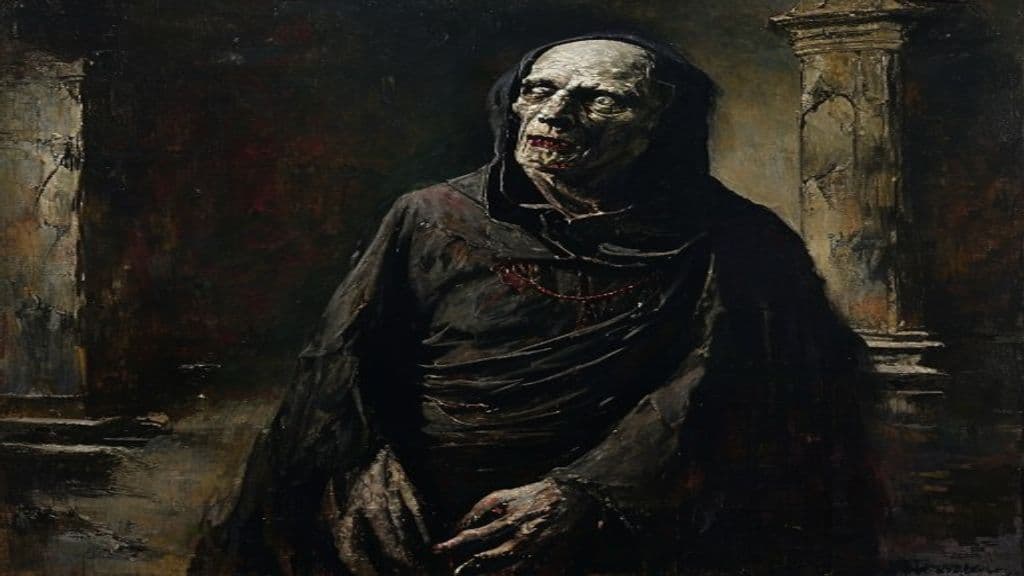
A class of revenant beings in southeastern and eastern European folk belief that subsist by feeding on the vital essence (generally blood) of the living. Recorded chiefly in early modern to modern oral traditions, these vampires are typically described as reanimated corpses whose presence explains unexplained illness, death, and post-mortem disturbances in their communities.
Community Record
- [1]Soucouyant. Wikipedia: Soucouyantwiki
- [2]Haunted Trinidad and Tobago (archive). Archive: Haunted Trinidad and Tobagoother
- [3]Haunted Turks & Caicos Islands (archive). Archive: Haunted Turks & Caicos Islandsother
- [4]On jumbee/jumbie usage and Caribbean spirit categories. Regional folkloric overviews referenced in Source 3 and Source 4 (see research notes)folk