Suen appears in Mesopotamian literary and cultic sources as the personified moon. Attested names include Akkadian Suen/Sin (𒀭𒂗𒍪, dEN.ZU) and Sumerian Nanna (𒀭𒋀𒆠, DNANNA), with an additional well-attested name Dilimbabbar (𒀭𒀸𒁽𒌓). Hymnic fragments address him in royal and temple contexts (for example, adab and ululumama compositions for rulers such as Shu-Suen and Ibbi-Suen), and in at least one limited tradition he is depicted at a status comparable to major sky gods like Enlil and Anu. The sources provided do not supply a single unified cosmogonic birth narrative; rather, the deity's identity is expressed through cultic names, logograms linking him to the days of the lunar month, and hymnic roles that tie him to rulership and temple centers (e.g., a shrine at Nibru in one hymn fragment).
In art and textual description Suen is primarily signified by the crescent. Anthropomorphic depictions commonly show him wearing headwear decorated with the crescent or holding a staff topped by a crescent; on kudurru (boundary stones) the crescent alone can stand for him. Textual notes also record an association with boats. Direct anatomical descriptions are not provided in the supplied sources; visual identity is conveyed through the crescent emblem, crescent-adorned regalia, and related iconographic markers.
Suen's principal functions are astral and calendrical: he personifies the moon and is linked to the measurement of time through logograms referring to days in the lunar month. Hymnic language describes his luminous presence — for example, an ululumama fragment speaks of him spreading "majestic light from above over the land" — reflecting his role as a luminous overseer in ritual texts. He is closely associated with cattle herding and pastoral concerns, and some evidence (described as limited) indicates he could act as a judge of the dead in certain underworld contexts. In hymn fragments he also functions in rhetoric of kingship and legitimacy, being invoked in dedications tied to princely sons and rulership.

Enlil
Enlil is a principal deity of ancient Mesopotamia, originally preeminent in the Sumerian pantheon as a supreme lord who orders the world by separating heaven (An) from earth (Ki). His principal cult center was the E-kur temple at Nippur, and his cult practices focused on daily offerings and priestly care of his cult statue; mythic traditions portray him as both benefactor and punisher in the administration of cosmic and social order.
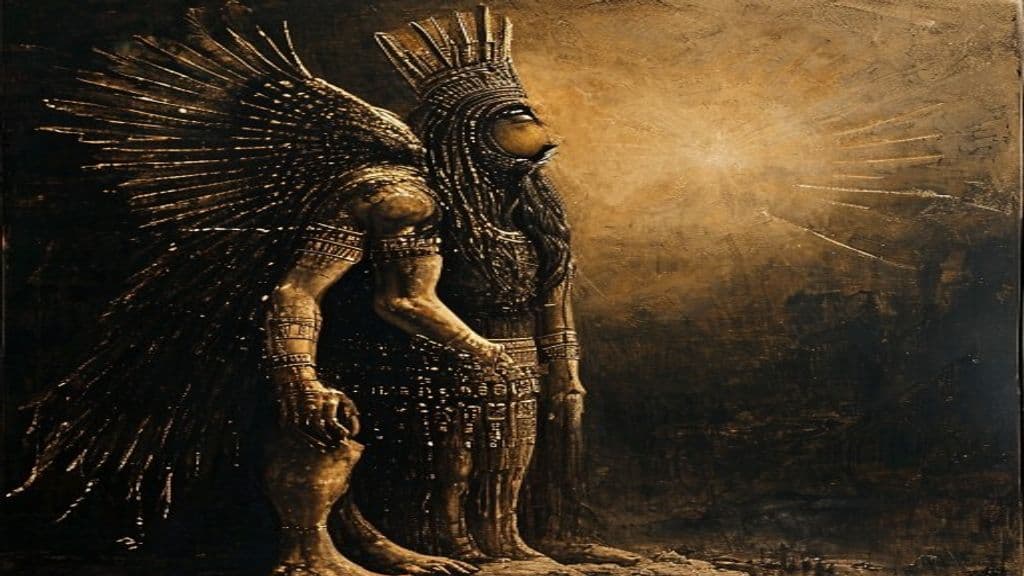
Anu
Anu (Sumerian An; Akkadian Anu/Anum) is the divine personification of the sky in ancient Mesopotamian religion, traditionally ranked at the top of god‑lists as the source of heavenly authority (anûtu/anuti) and the fount of legitimate rule for gods and kings. Though supreme in genealogies and astronomical schema, many periods portray him as a relatively passive or figurehead deity whose active cultic role is limited until a late Seleucid reinvention in Uruk.
Community Record
- [1]Sin (mythology) - Wikipedia. Wikipedia, article 'Sin (mythology)'wiki
- [2]An adab (?) to Suen for Shu-Suen (Shu-Suen F): translation. ETCSL translation: 'An adab (?) to Suen for Shu-Suen (Shu-Suen F)'academic
- [3]An ululumama to Suen for Ibbi-Suen (Ibbi-Suen D): translation. ETCSL translation: 'An ululumama to Suen for Ibbi-Suen (Ibbi-Suen D)'academic
- [4]Wikidata: Q3543591. Wikidata entry for Sin/Suenother