
In Māori cosmology Tangaroa is one of the children of the primal parents Ranginui (Sky) and Papatūānuku (Earth) and participated in the generation that separated them. That genealogy identifies him as an ancestral progenitor of marine life; his descendants include figures such as Punga and through Punga the ancestors of fish (Ikatere) and reptiles (Tū-te-wehiwehi / Tū-te-wanawana). Regional variants alter his place in origin narratives: in some Western Polynesian traditions cognates like Tagaloa can be a supreme creator, while in Manihiki Tangaroa is invoked in myths about the origin of fire. Local genealogical arrangements and ranks therefore vary by island.
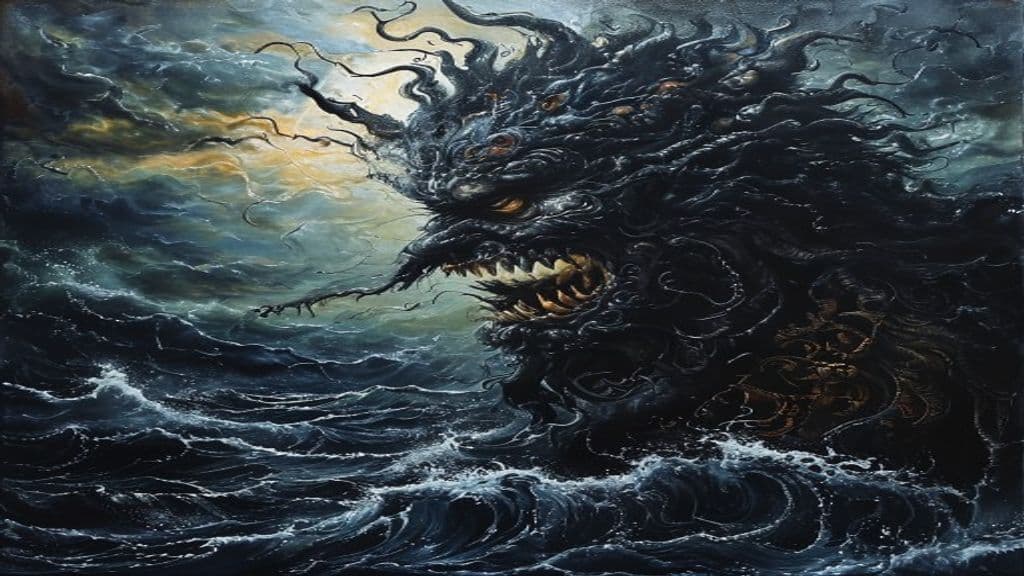
Descriptions vary by island. In some Māori accounts Tangaroa is represented in whale form. Mangaia tradition records him with yellow hair. In Rennell and Bellona a localized Tangagoa was said to appear as a sparkling flame in the night sky on a coastal cliff and to fly with a flame when taking spirits. There is no single standardized anthropomorphic portrait across the traditions summarized here.
Tangaroa is a domain-holder of the sea and inland waters and is regarded as the progenitor and guardian of marine creatures, especially fish. Under the epithet Tangaroa-whakamau-tai he is associated with control over tides. Mythically he is attacked by Tāwhirimātea after the separation of the parents and driven into the sea, and he is in tension with Tāne over the refuge given to his runaway children — motifs that explain relations between sea and land. In specific island narratives he may hold additional roles: Manihiki myths relate Tangaroa to the origin of fire and Māui's obtaining of fire; Rennell/Bellona material records a psychopomp-like sparkle seen at deaths. Abilities and emphasis vary regionally rather than forming a single uniform power-set.
Weaknesses
None recorded.
Wards
- ritualOffering to Tangaroa before sea expeditions
Aitu (Māori)
Malevolent spirits in Māori tradition, often taking the form of plants or animals and associated with trouble-making and mischief. (Note: - Power tier should be Greater, not Lesser (Aitu being lesser gods in some cultures, but also associated with deity-level abilities) - Abilities: Add detail about their role as patrons of specific vil)
Aotearoa (Canoe)
An ancestral vessel in Māori tradition, associated with the migration and settlement of New Zealand. (Note: 1. Power tier should be Ancient, not Primordial. 2. Remove "Historical significance" from sensory cues as it is a general statement rather than a specific cue. 3. Add "Its presence is often associated)
Ascalapha odorata (Hawaiian)
A nocturnal moth associated with death or misfortune in Hawaiian tradition, possibly tied to Central and South American folklore. (Note: - Summary should note that Ascalapha odorata's association with death/misfortune is found in Central and South American folklore, not explicitly mentioned in Hawaiian tradition. - Power tier: Primordi)
Atea
Atea is a primordial creator-associated being in multiple Polynesian traditions (Marquesas, Tuamotu, and Māori) closely associated with light and the ordering of the cosmos. Variants depict Atea as a self-originating giver of light, a progenitor who fathers gods and humans, or as the cosmic universe that is sex-differentiated into Heaven and Earth in one reported account.
Atua (Māori Deity)
In Māori mythology, Atua are supernatural beings believed to have created the world and all living things. They are considered rulers of the spiritual realm with powers over nature, fertility, and human destiny. (Note: 1. Power tier: Based on the abilities described (controlling nature, fertility, and human destiny), Atua likely belong to the Primordial power tier, not Greater. 2. Weaknesses: Add a specific weakness)
Edward Tregear
Historical figure, not considered a supernatural entity in Māori tradition. (Note: * The Power tier should be "Primordial" as Edward Tregear is a historical figure, implying no supernatural abilities or powers. * The Appearance section should indicate that there is no physical descr)
Hawaiian hawk (ʻio)
The Hawaiian hawk, called ʻio (Buteo solitarius), is an endemic raptor of Hawaiʻi and a culturally significant bird mentioned in the Kumulipo and used as a royal emblem ('ʻiolani'). Sources treat it as a native animal species with symbolic importance rather than as an explicitly supernatural being.
Hikairo
Hikairo is attested in the provided sources as a personal and group name within Māori contexts (used for individuals and iwi/hapū identifiers such as Ngāti Hikairo), rather than as a documented supernatural being. References show historical and contemporary usages tied to leadership, ceremonial roles, and local guardianship projects.
Hina
Hina is an onomastic category in Polynesian traditions naming a number of related female divine figures—often sovereign goddesses or queens—who are variously associated with domains such as the moon and, in specific local tales, natural forces like rain or fire. Rather than a single pan‑Polynesian personage, Hina functions as a flexible role filled by distinct local figures (e.g., Sina, Hanaiakamalama).
Hineahuone
First woman created by Tāne from clay, becomes his partner and gives birth to Hinetītama. (Note: 1. The source material only describes Hineahuone as being "made" or "created", but does not explicitly state that she was crafted from clay from the earth, implying primordial power. 2. The descriptio)
Hoʻohōkūkalani
Hoʻohōkūkalani (also attested as Kahoʻohokuokalani-i-kau-i-kaheahea) is named in the cited sources as a Hawaiian goddess mentioned in ancient chants; she is described in those brief accounts as a beautiful woman who became a consort to her own father. The available sources are concise and do not provide extended narrative, ritual, or iconographic detail.
Hākuturi
The hākuturi (Te Tini o Hakuturi) are a multitudinous host of Māori forest guardian-spirits, often described as birdlike and associated with Tāne. They enforce proper ritual conduct toward trees and can rebuke or repair human transgressions against the forest, as in the Rātā narrative.
Community Record
- [1]Tangaroa - Wikipedia (summary source). Wikipedia contributors, 'Tangaroa', Wikipedia, The Free Encyclopedia.wiki