
Classified in international folktale indices as part of the Swan Maiden narrative cycle (ATU/AaTh 400*; local Lithuanian indexing sometimes cited as 404*), the Swan Queen appears across Baltic and adjacent Finno-Ugric oral traditions. Lithuanian folklorists Jonas Balys and Bronislava Kerbelyté record the type within collected Lithuanian variants (Kerbelyté lists multiple Lithuanian entries), while analogous Mari (Cheremis) catalogue entries index closely related 'Swan Girl' stories. Variants share a core pattern: a bird-woman who removes a feathered covering to assume human form, is prevented from reattaching it by humans, and later may be restored by her bird community.
Typically presented as a white swan that can shed wings or a full feathered cloak to become a beautiful young woman; variants include goose- and duck-forms. In most retellings the human form is radiant and attractive; one Lithuanian variant (Stepas Zobarskas) describes cosmic ornamentation—a sun on her breast, stars in her ears, and a moon on her head. The being is ontologically dual: a member of a swan flock who temporarily assumes human personhood when unrobed.
The Swan Queen's defining ability is transformation via a feathered covering (swanskin/swanskin cloak): while wearing or possessing it she is avian and can fly with her flock; by removing it she becomes human and may live among people, perform household tasks, marry, or bear children. Her return to the avian realm depends on regaining or reattaching the feathers; conversely, if humans hide or destroy the swanskin (burning is attested) she remains in human form. Some variants record the swan community restoring a new garment, enabling her flight away; maternal visitation motifs appear in which she intermittently returns to visit or soothe her human offspring.
Weaknesses
- conditionSeparation from swanskin / loss of feathered cloak (destruction or concealment)
Wards
- substanceBurning or destroying the swanskin (fire)
- substanceTar on a windowsill (adhesive binding of wings)
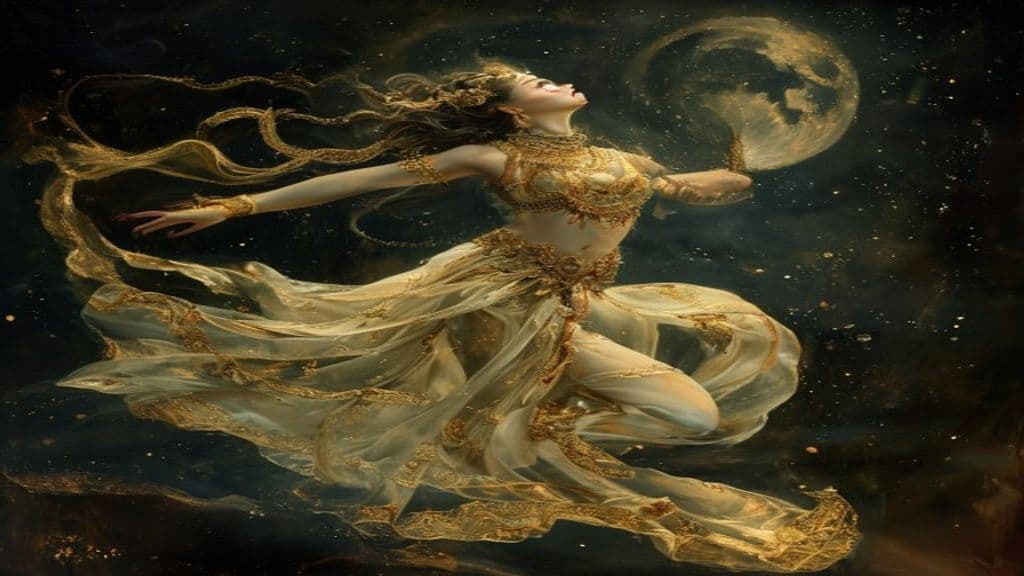
Apsara
Celestial dancers and water nymphs of Hindu cosmology — beautiful semi-divine beings who dance at the court of Indra and, by his command, descend to earth to distract sages from excessive asceticism.
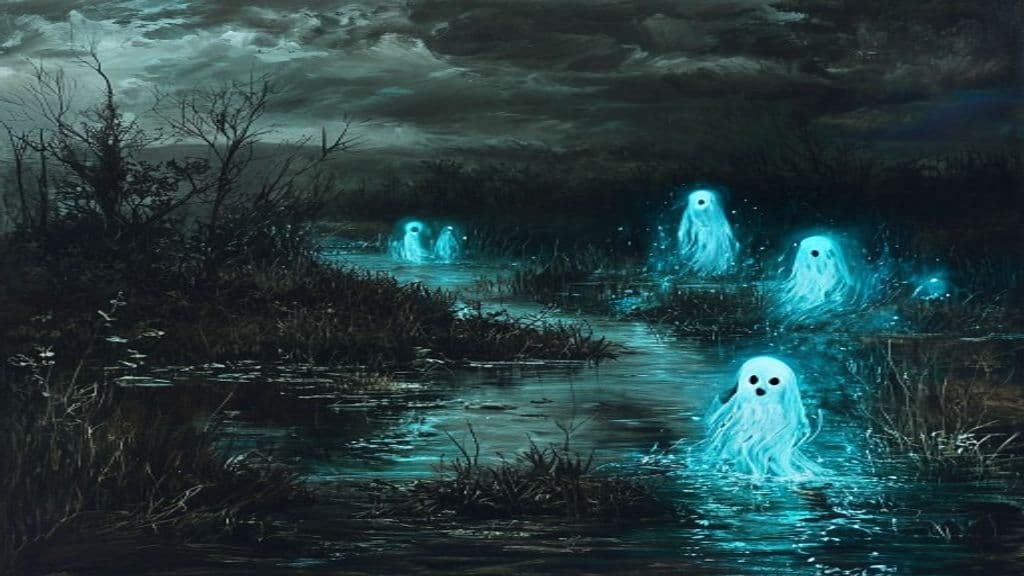
Will-o'-the-Wisp
A wandering light seen over marshy ground at night, leading travellers astray into bogs and fens. Possibly a spirit, possibly the soul of the unbaptised dead, possibly the devil himself.
Aušrinė
Aušrinė is the Lithuanian personification and deity of the morning star (planet Venus) in traditional Baltic cosmology. She is a feminine liminal figure associated with dawn, beauty, youth, love, health and renewal who appears each morning to prepare the way for Saulė (the Sun).
Dievas
Dievas (Lithuanian; Dievs in Latvian; Diews in Old Prussian) is the primordial supreme sky deity in Baltic religion, understood as the luminous sky-dome, a creator and ruler of gods, and a god of light, prosperity and time. The lexeme is a Baltic reflex of Proto-Indo-European *Dyēus and, following Christianization, the same word came to denote the Christian God.
Eglė the Queen of Serpents (Žilvinas)
A central figure of a Lithuanian folktale in which a speaking serpentine ruler—called the grass-snake/serpent prince Žilvinas—marries the human maiden Eglė, keeps an underwater palace and household, can be summoned by a secret chant, and whose story culminates in human→tree metamorphoses after betrayal.
Jūratė (Jūratė and Kastytis)
Jūratė is a Lithuanian legendary sea‑woman variously described in sources as a sea‑goddess, mermaid, or undine who dwells beneath the Baltic in an amber palace. In the best‑known tale she falls in love with a mortal fisherman, Kastytis; a thunder god (Perkūnas) destroys her amber castle in anger, and the shattered amber or 'tears' are said to wash up on Baltic shores.
The Nine Diseases (Finnish)
The sons of Louhi, personifying various diseases and disasters. (Note: - Power tier: Primordial (as they are the sons of a goddess, their origins are more cosmic) - Appearance: Specify that there is no direct description in source material - Abilities: Clarify that they )
The Nine Worlds
In Norse cosmology, the universe is composed of nine interconnected worlds that coexist and interact with one another. (Note: - Power tier: Primordial (The Nine Worlds are the fundamental structure of the universe, making them more primordial than deity-level) - Origin story and Appearance: missing, should be included based )
The Sacred Tree at Uppsala
A large, evergreen tree in Norse tradition, used as a focal point for spiritual practices and rituals. (Note: - Power tier should be Primordial, given that it's described as having a dark and ominous connotation and its "request" is granted only if no human sacrifices are near. - Appearance: Remove "evergreen)
The Sixteen Dreams of King Pasenadi
A series of sixteen disturbing dreams experienced by King Pasenadi, as interpreted by the Gautama Buddha in Buddhist literature. (Note: - Power tier should be Primordial=cosmic, but given no evidence of direct cosmic intervention or power beyond a mere interpretation, it may be more fitting as Ancient=deity-level (still high, but not )
The Water Nixie
A water-associated supernatural antagonist appearing in the Brothers Grimm tale 'The Water Nixie' (collected at Hanau). In the story she captures a brother and sister from a well, compels them to work for her, and pursues them overland when they flee, only to be impeded by the children's thrown transforming objects.
Theandrios
Arabian deity worshipped by North Arabian tribes in pre-Islamic Arabia, similar to Greek 'God-man' deities. (Note: - Power tier should be Primordial or Ancient, not Lesser, given the entity's association with a Greek deity and being worshipped by North Arabian tribes. - Sensory cues, wards, and weaknesses are miss)
Thebe
Thebe is a feminine proper name in Greek myth attached to multiple mythic women (including a nymph daughter of the river-god Asopus) and toponyms derived from them; the name also appears in modern usages (e.g., a moon of Jupiter). The supplied material does not present a single coherent supernatural being with stable powers, appearance, or rituals.
Theia
Theia is a primordial Titaness in Greek myth, daughter of Uranus and Gaia and mother (by Hyperion) of Helios (Sun), Selene (Moon), and Eos (Dawn). Her identity is chiefly genealogical and poetic: she is associated with sight, brilliance, and the radiant quality of gold rather than with an extensive independent mythic narrative or widespread, detailed cult practice in the surviving record.
Community Record
- [1]The Swan Queen (Wikipedia). Wikipedia article 'The Swan Queen' summarizing Lithuanian and Mari variants and citing Jonas Balys and Bronislava Kerbelyté; accessed via supplied research notes.wiki
- [2]Lithuanian folktale indexing and commentary (Bronislava Kerbelyté; Jonas Balys cited in Wikipedia summary). Summaries and indexing information attributed to folklorists Jonas Balys and Bronislava Kerbelyté as reported in the Wikipedia summary (Kerbelyté's collected variants list Lithuanian entries for the Swan Maiden type).folk
- [3]Mari (Cheremis) tale indexing (S. S. Sabitov note as cited). Reference to Mari catalogue entry 'Девушка-лебедь' and parallels to the Swan Maiden cycle, as reported in the Wikipedia summary and supplied research notes.folk
- [4]Stepas Zobarskas variant (Lithuanian retelling with cosmic ornamentation). Variant retelling summarized in the research notes describing the maiden 'with a sun on the front, stars in her ears and a moon on top of her head' (attributed to Stepas Zobarskas in the supplied notes).folk