
In variants summarized in the supplied sources, the narrative opens with Eglė bathing at a lake or sea-lagoon (marios) where she finds a coiled grass-snake (žaltys/žalčius). The snake demands that she pledge herself in exchange for the return of her clothing; she agrees and becomes the serpent's wife. The male serpent identifies himself as Žilvinas, escorts her to a palace beneath the sea (reached via a nearby island and an underground tunnel), and establishes an otherworldly household and family with her. The tale functions as an aetiology: after betrayal and the serpent's death, Eglė transforms her children and eventually herself into trees whose species-names correspond to the characters' names, explaining local arboreal identities.
Sources present the being in two primary registers: as a coiled grass-snake (žaltys/žalčius) at the water's edge that speaks and as a handsome man—described in summaries as the grass-snake prince—when greeting Eglė and escorting her to the underwater palace. The serpent's principal domain is an underwater or subterranean palace beneath a sea-lagoon; visual depictions and theatrical/sculptural commemorations emphasize a royal, otherworldly household rather than a simple animal lair. The lexical term žalčius is ambiguous in the sources and may refer to a terrestrial grass snake or evoke an aquatic/mithical serpent (possibly comparable to an eel) in the tale's seascape.
Documented tale actions attribute to Žilvinas speech, intelligence, the capacity to take a human wife and father children, rule an underwater palace, impose conditions and tasks on his bride, and teach a secret chant by which he may be summoned from the sea. He sets tests (three tasks in motifs) and prescribes limits on Eglė's surface visits. The tale also shows that, once summoned ashore by the chant and brought to land, he can be attacked and killed by humans in the narrative variant provided. The story includes metamorphic magic enacted by Eglė (a whispered enchantment) that turns humans into specified tree species, but explicit ritual formulas or wider destructive powers for Žilvinas beyond those narrative capacities are not recorded in the supplied sources.
Weaknesses
- conditionvulnerability when lured to land (narrative-specific)
Wards
- conditionsecrecy of the summoning chant (Žilvinas' instruction not to reveal how to call him)
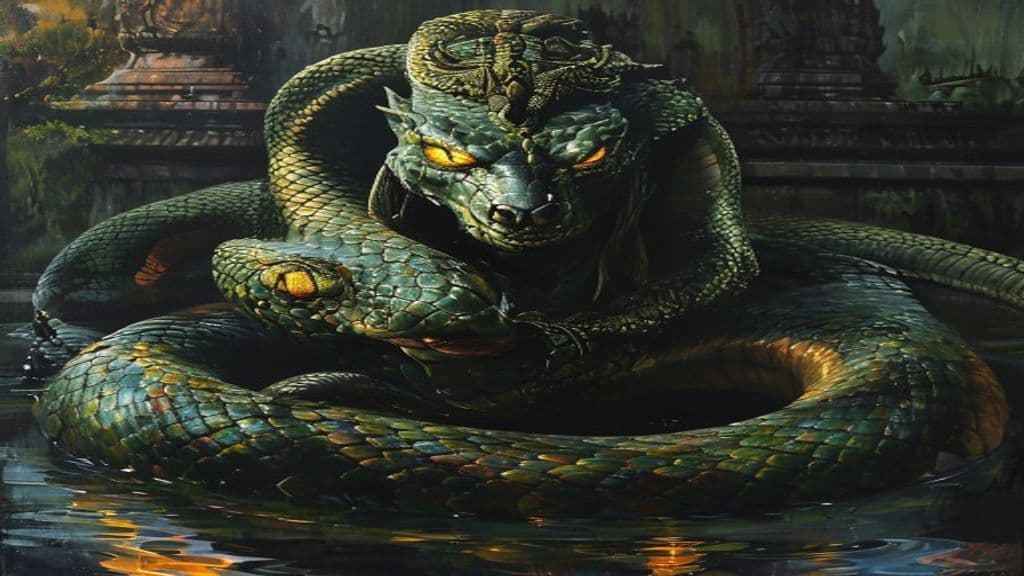
Naga
Divine serpent beings of Hindu, Buddhist, and Jain cosmology — powerful guardians of water, earth, and underground treasures. Revered as deities in South and Southeast Asia.
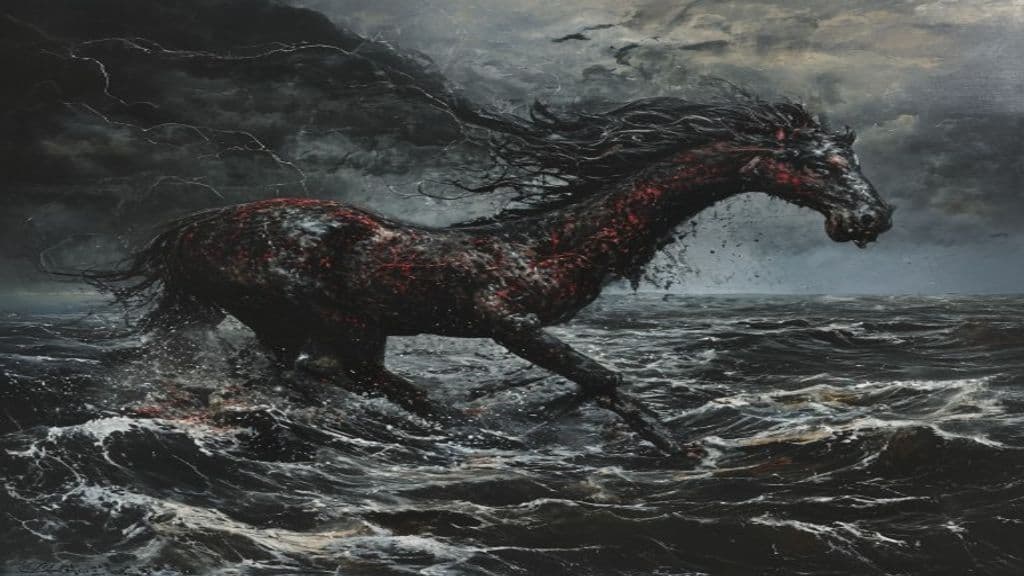
Nuckelavee
The most terrifying creature of Orcadian folklore — a skinless, horse-headed demon of the sea whose breath spreads plague and whose presence causes crops to wither. It cannot cross fresh water.
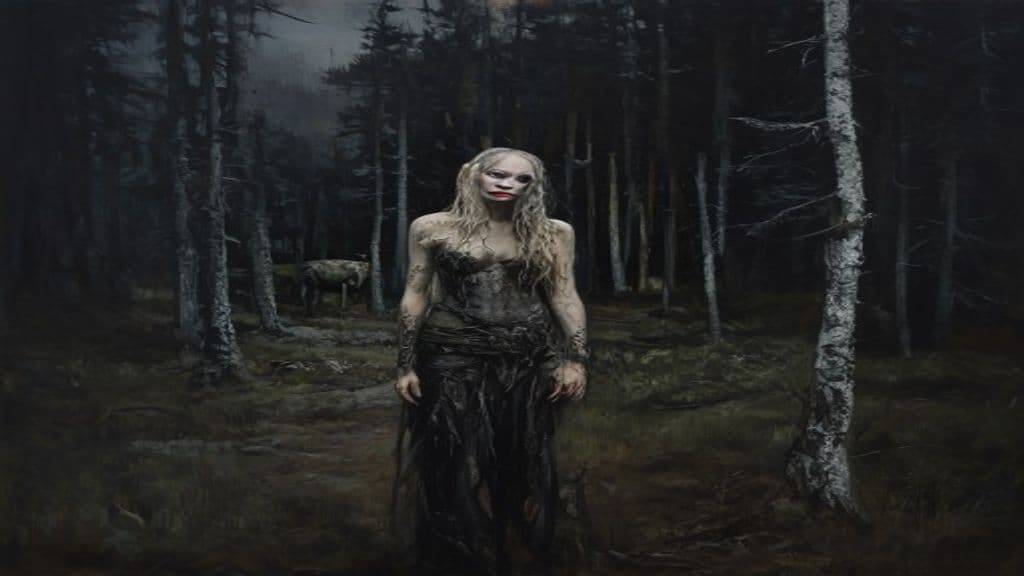
Huldra
A seductive forest spirit of Scandinavian folklore — beautiful from the front but with a cow's tail or hollow back — who lures men into the wilderness, sometimes to their ruin.
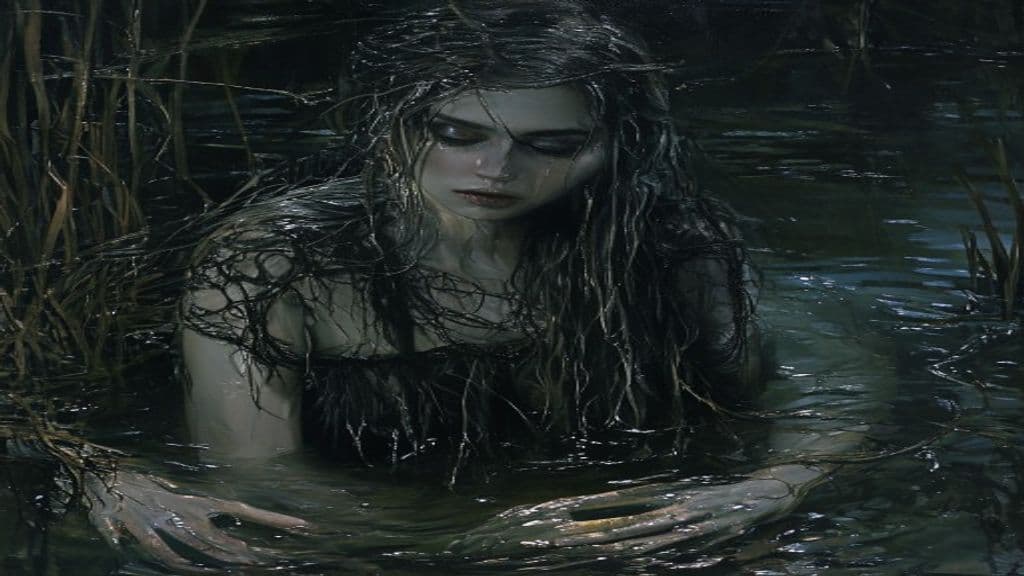
Rusalka
Water spirits in Slavic folklore — the spirits of young women who died by drowning or suicide, bound to rivers and lakes. Beautiful and dangerous, they can bewitch men to their deaths.
Naga
Divine serpent beings of Hindu, Buddhist, and Jain cosmology — powerful guardians of water, earth, and underground treasures. Revered as deities in South and Southeast Asia.

Huli jing (Fox spirit)
Huli jing (狐狸精), commonly rendered in English as "fox spirit," are shapeshifting supernatural beings from Chinese folklore and mythology. Classified among the broader class of yāoguài, they are morally ambivalent figures that may be benevolent, malevolent, or trickster-like depending on the tale and context.
Aušrinė
Aušrinė is the Lithuanian personification and deity of the morning star (planet Venus) in traditional Baltic cosmology. She is a feminine liminal figure associated with dawn, beauty, youth, love, health and renewal who appears each morning to prepare the way for Saulė (the Sun).
Ašvieniai
Ašvieniai are the paired divine twins of Baltic (particularly Lithuanian) tradition, horse-associated celestial beings who pull the chariot of Saulė (the Sun) across the sky and appear as protective little horses used as apotropaic motifs in vernacular architecture and household objects.
Dievas
Dievas (Lithuanian; Dievs in Latvian; Diews in Old Prussian) is the primordial supreme sky deity in Baltic religion, understood as the luminous sky-dome, a creator and ruler of gods, and a god of light, prosperity and time. The lexeme is a Baltic reflex of Proto-Indo-European *Dyēus and, following Christianization, the same word came to denote the Christian God.
Jūratė (Jūratė and Kastytis)
Jūratė is a Lithuanian legendary sea‑woman variously described in sources as a sea‑goddess, mermaid, or undine who dwells beneath the Baltic in an amber palace. In the best‑known tale she falls in love with a mortal fisherman, Kastytis; a thunder god (Perkūnas) destroys her amber castle in anger, and the shattered amber or 'tears' are said to wash up on Baltic shores.
The Swan Queen (Swan Maiden)
A Baltic and adjacent folktale figure: a swan or goose that becomes a woman by shedding a feathered skin and lives among humans until she regains or is restored her swanskin. The motif is classed in folktale catalogs as the Swan Maiden (ATU/AaTh 400* / 404* in local indexing) and appears in Lithuanian and neighboring Mari (Cheremis) traditions.
Egbere
Malevolent humanoid supernatural beings in Yoruba mythology, residing in woods and active only at night. (Note: 1. Power tier should be Greater (powerful regional) based on the description as malevolent beings residing in woods. 2. Abilities need more specific information, such as their connection to darkness o)
Egeria
Egeria is a Roman nymph of springs and sacred groves, cast in legend as the divine consort and counselor of Numa Pompilius who imparted laws and ritual forms to Rome's foundational king. She functions as a local tutelary female deity associated with the origin of Roman rites rather than as a cosmic power or a hostile spirit.
Egg Ghost (Korean Tradition)
In Korean folklore, the Egg ghost is a malevolent entity that resembles an egg in appearance and serves as a harbinger of death. (Note: - The draft states "malevolent entity", but Source 1 doesn't explicitly state this. - Power tier: Based on the ability to determine a person's death upon sighting, it seems more likely that the Egg gh)
Eggþér
A jötunn figure in the Old Norse poem Völuspá who sits upon a mound striking a harp and is portrayed as joyful at the onset of Ragnarök; presented as the herder associated with a female jötunn of Járnviðr who raises wolves descended from Fenrir.
Ego the Living Planet
Ego the Living Planet is a fictional sentient planet created for American comic-book mythology (Marvel Comics) by Stan Lee and Jack Kirby. Presented as an individual, planetary-scale organism, Ego appears across Marvel cosmic stories as a thinking, willful celestial body that can interact with gods, heroes, and galactic civilizations.
Egregore
A polyvalent Western‑esoteric concept naming an emergent, non‑physical collective form produced by sustained coordinated thought, will, ritual, or activity of a group. Usage ranges from a descriptive term for a 'collective mind' to a belief in a semi‑autonomous spiritual entity nourished by group devotion, and in contemporary discourse is often used metaphorically for organized online or political phenomena.
Egremus
Egremus is a named mortal figure in Greek myth attested only as a combatant who fell in the war between Eumolpus and Eleusis. He is identified by the patronymic 'son of Eurynomus' and appears only in genealogical/war-list context in the cited source.
Community Record
- [1]Eglė the Queen of Serpents. Wikipedia: 'Eglė the Queen of Serpents' article (summary of variants and motifs)wiki
- [2]Wikidata: Eglė the Queen of Serpents. Wikidata entry classifying the central figure as a mythological serpent from Lithuanian folkloreother
- [3]Eglė – the Queen of Serpents (sculpture page). Cultural commemoration page documenting the tale's prominence in Lithuanian cultural lifeother
- [4]Eglė, Queen of Serpents | USC Digital Folklore Archives. Digital folklore archive summary and variant materialfolk
- [5]Europe Is Not Dead: Lithuania - Eglė the Queen of Serpents. Cultural summary and retelling noting motifs and settingother