
Historically attested in Lithuanian sources and early modern records, Aušrinė was first noted by 16th-century historian Jan Łasicki as Ausca, described as a 'goddess of the rays of the sun that descend and rise above the horizon.' Within Baltic mythic ordering she belongs to a family-like ensemble of celestial beings (planets and the sun), often portrayed as servant, child or court-member in relation to Saulė (the Sun) and paired with an evening counterpart Vakarinė. Comparative scholarship and source tradition place her in the broader Indo-European dawn-goddess archetype alongside Latvian Auseklis, Greek Eos, Roman Aurora and Vedic Ushas; after Christianization her cultic imagery was frequently syncretized with the Virgin Mary in local practice.
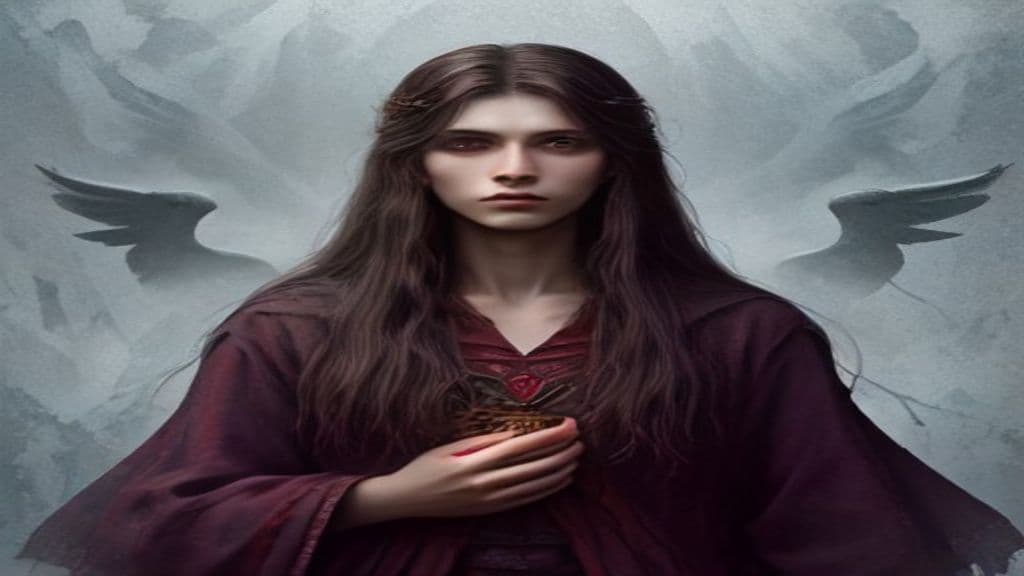
Primary descriptions present Aušrinė as the morning star (Venus) visible in the eastern sky at dawn and as a beautiful youthful maiden in folktale narrative contexts. In at least one tale-summarized tradition (the Saulė Ir Vėjų Motina tradition as discussed in summaries of Lithuanian folktales), she manifests in three modes — as a star in the sky, as a maiden on land, and as a mare in the sea — emphasizing a fluid identity between celestial, human and animal forms. Sources emphasize beauty and youth rather than fixed iconographic details.
Rather than catalogued magical powers, sources describe Aušrinė by her mythic roles and cultural attributions: she appears each dawn to 'prepare the way for Saulė,' inspires love and desire in other celestial figures (notably Mėnulis, the Moon, in the 'celestial wedding' narratives), and functions as a patronal figure for beauty, youth, health and rebirth. Folktales depict interpersonal dynamics (jealousy, courtship, punishment) among the sky-family that explain celestial motions and moral themes; these narrative functions are the basis for claims about her agency. Folklore also records she is accompanied by a servant called Tarnaitis, who is possibly identified with the planet Mercury in some accounts.
Ašvieniai
Ašvieniai are the paired divine twins of Baltic (particularly Lithuanian) tradition, horse-associated celestial beings who pull the chariot of Saulė (the Sun) across the sky and appear as protective little horses used as apotropaic motifs in vernacular architecture and household objects.
Dievas
Dievas (Lithuanian; Dievs in Latvian; Diews in Old Prussian) is the primordial supreme sky deity in Baltic religion, understood as the luminous sky-dome, a creator and ruler of gods, and a god of light, prosperity and time. The lexeme is a Baltic reflex of Proto-Indo-European *Dyēus and, following Christianization, the same word came to denote the Christian God.
Eglė the Queen of Serpents (Žilvinas)
A central figure of a Lithuanian folktale in which a speaking serpentine ruler—called the grass-snake/serpent prince Žilvinas—marries the human maiden Eglė, keeps an underwater palace and household, can be summoned by a secret chant, and whose story culminates in human→tree metamorphoses after betrayal.
Jūratė (Jūratė and Kastytis)
Jūratė is a Lithuanian legendary sea‑woman variously described in sources as a sea‑goddess, mermaid, or undine who dwells beneath the Baltic in an amber palace. In the best‑known tale she falls in love with a mortal fisherman, Kastytis; a thunder god (Perkūnas) destroys her amber castle in anger, and the shattered amber or 'tears' are said to wash up on Baltic shores.
The Swan Queen (Swan Maiden)
A Baltic and adjacent folktale figure: a swan or goose that becomes a woman by shedding a feathered skin and lives among humans until she regains or is restored her swanskin. The motif is classed in folktale catalogs as the Swan Maiden (ATU/AaTh 400* / 404* in local indexing) and appears in Lithuanian and neighboring Mari (Cheremis) traditions.
Auxesia
Auxesia (Αυξησία) is a figure in ancient Greek religious tradition associated with growth and increase of fields. She appears in local cults around the Saronic Gulf (Epidaurus, Aegina, Troezen) as an independent local goddess or as an epithet/aspect of better-known deities (notably Persephone), often paired with Damia.
Auxo
Auxo is a name attested across modern commercial, taxonomic, and fictional contexts and, in classical reference frameworks, is historically associated with the Horae — the Greek goddesses of the seasons and natural portions of time. The provided sources do not supply a consistent folkloric persona, mythology, or rites tied to a supernatural being named Auxo.
Auðr
Auðr (Old Norse 'prosperity') is a personified figure attested in Snorri Sturluson's Prose Edda as a child of the personified Night (Nótt) by Naglfari, and thus made an uncle of Thor within Snorri's genealogical schema. The figure otherwise appears only as a referent in skaldic diction and is sparsely attested, leading some scholars to regard the attestation as possibly a Snorrian creation.
Auðumbla
Auðumbla is the primeval cow of Old Norse cosmogony attested in the Prose Edda: she nourishes the primordial jötunn Ymir with rivers of milk and by licking salty rime-stones reveals Búri, an ancestor of the gods. Her name and role link fertility, nourishment, and the emergence of key lineages in the Norse origin narrative.
Avalokiteśvara
A central Mahāyāna and Vajrayāna bodhisattva who embodies great compassion (mahākaruṇā), Avalokiteśvara hears the cries of sentient beings and manifests in many forms to relieve suffering. Venerated across South, Central, and East Asia, the figure functions devotionally (mantra and sutra recitation) and iconographically in multiple gendered and regional guises.
Avandra
Avandra is a deity-name employed within modern Dungeons & Dragons tabletop gaming and related media. In the supplied sources Avandra appears in player and podcast discourse as a referent for randomness or luck and as a fictional proper name used in campaign material.
Avari (Middle-earth)
The Avari are identified in the provided sources as a subgroup of Elves in J. R. R. Tolkien's fictional legendarium. The supplied materials (Wikipedia and Wikidata entries) classify them as fictional Elven people but contain no extended narrative, descriptive, or ritual detail about them.
Community Record
- [1]Aušrinė (Wikipedia). Wikipedia contributors. "Aušrinė." Wikipedia, The Free Encyclopedia. https://en.wikipedia.org/wiki/Au%C5%A1rin%C4%97wiki
- [2]Wikidata: Aušrinė. Wikidata entry Q12649763 for Aušrinė. http://www.wikidata.org/entity/Q12649763wiki
- [3]Name Doctor: Aušrinė. Name-Doctor. "Ausrine: Meaning & Origin." https://www.name-doctor.com/meaning/ausrineother
- [4]Skyhold: Ausrine (Skyhold Leusana page). Skyhold. "Ausrine." https://skyhold.org/leusana/ausrine/other
- [5]Skyhold: The Spring Festival (blog reference to dawn/renewal themes). Skyhold blog. "The Spring Festival." https://skyhold.org/blog/2015/07/2015-07-30-7331/other