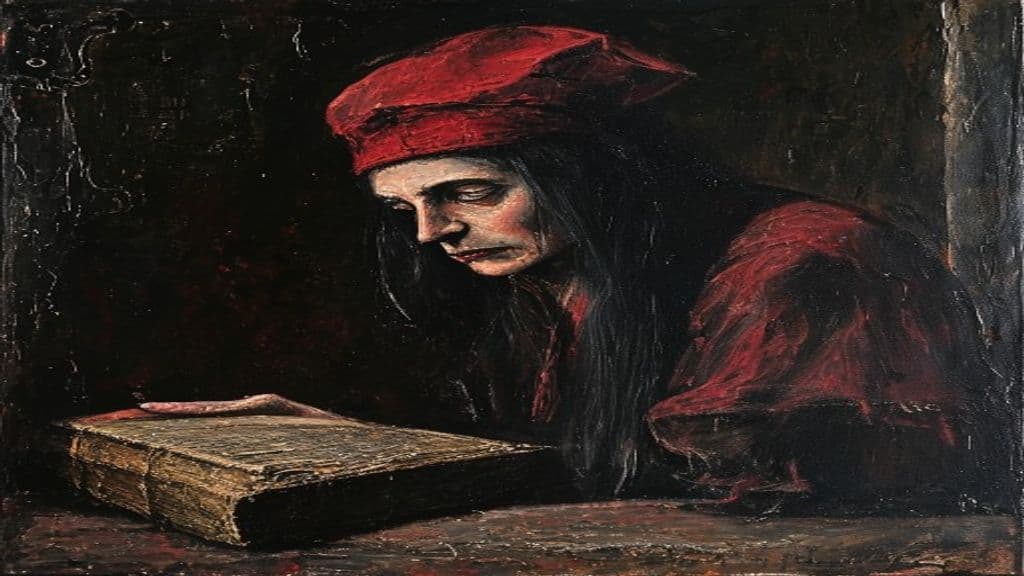
Tintilinić is said to be the soul of an unbaptized child, embodying a liminal state and potential malevolence.
Tintilinić is described as wearing a red cap.
It is believed that Tintilinić can interact with humans in their domestic environments, specifically 'strolling through houses at night'.
Blue Stone (Russia)
A type of sacred stone in Slavic tradition, held significant spiritual significance and venerated through simple rituals. (Note: - Power tier should be Lesser (since they don't have major hallows and are venerated in a simpler way). - Abilities: "Venerated through simple rituals" is vague; clarify that these rituals include pou)
Tikoloshe (Tokoloshe)
In Nguni (Zulu/Xhosa) belief the tikoloshe is a small, dwarf‑like water spirit invoked as a mischievous or malevolent agent. It is commonly described as an implement of human malice—used to frighten children or to cause illness and even death—and is countered by household precautions (e.g., raising beds) and intervention by spiritual specialists such as sangomas or certain pastors.
Tiktik
Tiktik is a named variant within the Philippine aswang tradition: a feared nocturnal, shape‑shifting predator-type figure treated in folklore and adapted in modern Philippine media. Sources emphasize its placement inside the broader aswang umbrella and a cultural motif linking some aswang variants to ominous birdlike calls.
Timalcus
Timalcus (Ancient Greek: Τίμαλκον) is presented in Greek mythic genealogies as a Megarian prince, son of Megareus and Iphinoe, known primarily as a member of that royal house and as being killed by Theseus during a campaign with the Dioscuri against Aphidnae. Sources are brief and genealogical, and a competing tradition noted by Alcman casts doubt on Theseus' presence in the episode.
Tinana
Historical canoe in Māori tradition, significant to the migrations and history of the Māori people. (Note: * Power tier should be Lesser (local spirit) or at least not Primordial, as it's a historical canoe and not a supernatural entity. * Abilities section is correct as Tinana is not a supernatural entity)
Tinia
Tinia (also Tin, Tinh, Tins, Tina) is the chief sky god of the Etruscan religion, associated with thunderbolts, divination, and the guarantying of boundaries. He occupies a role analogous to Roman Jupiter and Greek Zeus and appears in Etruscan votive inscriptions and on the Piacenza Liver used for haruspicy.
Tinirau and Kae
In Māori mythology, Tinirau is the guardian of fish and a son of Tangaroa. He has pet whales and plays a crucial role in maintaining balance within the oceanic realm. (Note: 1. Power tier should be Greater (not Lesser) due to his divine or semi-divine lineage as a son of Tangaroa. 2. Appearance description is incomplete; add that no physical description of Tinirau is prov)
Tiny Tony
Tiny Tony is a Filipino comic-book character created by Mars Ravelo and illustrated by Jim Fernandez, later adapted into a 2008 television series (Komiks Presents: Tiny Tony) starring John Prats. He is a fictional media superhero/protagonist from Philippine popular culture rather than a supernatural or folkloric being.
Tiphys
Tiphys (Greek: Τῖφυς) is the appointed helmsman of the Argo in the Argonautic tradition. Portrayed across ancient sources as a skilled, practical navigator whose reading of winds, waves, sun and stars is vital to the voyage, he is a mortal specialist whose death during the expedition requires a successor.
Tiresias
Tiresias is the canonical Theban seer of Greek myth: a human prophet granted divinatory gifts by the gods, famed for longevity, episodes of gender transformation, physical blindness paired with supernatural sight, and continued prophetic authority even after death.
Tirian
Tirian is a fictional human character in C. S. Lewis's Chronicles of Narnia, the last King of Narnia and the protagonist of The Last Battle. He is a mortal ruler and skilled swordsman who leads Narnia in its final conflict, witnesses the deception of a false Aslan, and ultimately enters Aslan's Country.
Tisamenus
Tisamenus is a name attested in classical Greek myth and history for multiple human figures (notably mythic kings of Argos and Thebes and an historical seer of Elis) and is also the modern scientific name of a genus of Philippine stick insects (family Heteropterygidae). The classical attestations place Tisamenus within dynastic genealogies and as a divinatory specialist; the taxonomic usage names an endemic insect genus redescribed in modern entomology.
Community Record
- [1]Tintilinić (Wikipedia). 1wiki