Sources do not preserve a single, definitive mythic 'origin' narrative for Tishpak. Textual and scholarly evidence indicates he was a non-Sumerian/non-Akkadian tutelary god adopted at Eshnunna, replacing the earlier local god Ninazu in the city temple Esikil between the Akkadian and Isin–Larsa periods. Modern scholarship proposes various external connections (Hurrian, Elamite, or a transtigridian development), but no definitive etymology or origin is agreed in the provided sources.
Tishpak is typically presented anthropomorphically in Mesopotamian tradition but is frequently associated with serpentine imagery: he is linked with snake-monsters such as the mušḫuššu and bashmu, appears on some cylinder seals riding a mušḫuššu, and is on occasion described as green or 'scaled' (the latter attested in seal imagery from Eshnunna though some commentators debate specific identifications). Sacred regalia and temple-associated objects attested in sources include two maces (general cultic association), a seal mentioned as a weapon in a poorly preserved mythic context (Labbu-type material), and a bronze plough recorded as a sacred object in a year-name tied to his temple Esikil.
Tishpak functions primarily as a warrior and military leader—epithets include 'the warrior of the gods' (ursag ili) and 'lord of the troops' (attested in the Šurpu series and local inscriptions). In mythic tradition he combats and slays great serpentine or sea-dragon monsters (traditionally linked to the Labbu narrative). In at least one preserved mythic context he is credited with producing storms or atmospheric disturbances as a weapon, though sources caution that this single motif (from a poorly preserved Labbu text) does not equate him with canonical storm-gods; it instead reflects a common mythic device where non-storm deities employ atmospheric forces. He is also described with administrative/kingly titles in local Akkadian inscriptions (e.g., 'steward of the sea' and 'fierce hero'). His court includes serpentine attendants such as the bashmu (noted as his sukkal) and Abu/Ipahum ('viper').
Weaknesses
None recorded.
Wards
- ritualCity cult and temple maintenance (Esikil)

Ninazu
Ninazu is a Mesopotamian chthonic deity associated with the underworld, healing, snakes, and vegetation; his cult originated in Enegi and Eshnunna and appears in hymns, god lists, and incantations from the Early Dynastic through first-millennium traditions.
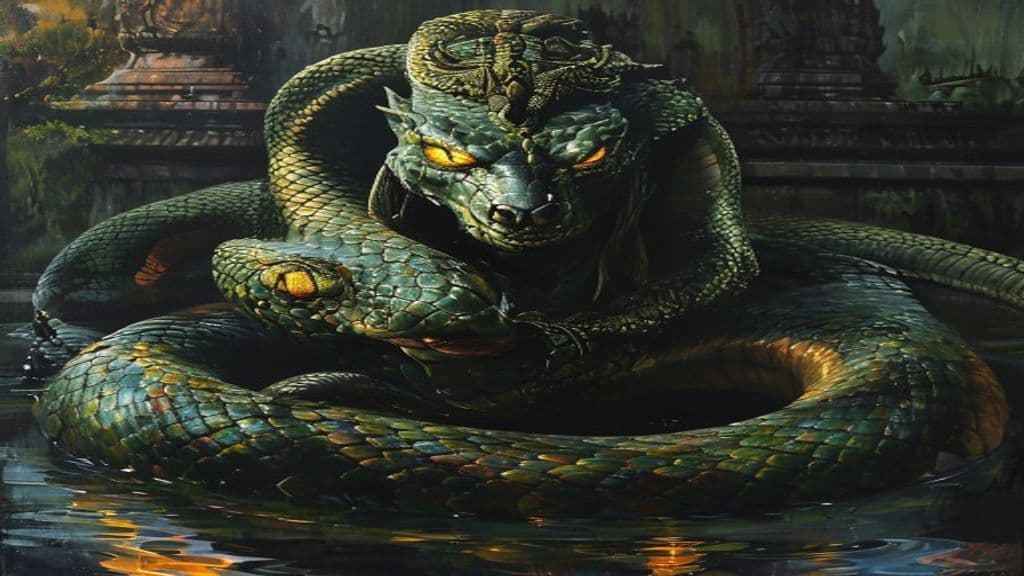
Naga
Divine serpent beings of Hindu, Buddhist, and Jain cosmology — powerful guardians of water, earth, and underground treasures. Revered as deities in South and Southeast Asia.
Community Record
- [1]Tishpak (Wikipedia). Wikipedia contributors, 'Tishpak,' Wikipedia, The Free Encyclopediawiki
- [2]Ibal-pi-el II (Wikipedia). Wikipedia contributors, 'Ibal-pi-el II,' Wikipedia, The Free Encyclopediawiki
- [3]Wikidata: Tishpak. Wikidata entry Q2037752, 'Tishpak'other
- [4]Archive: The Mušḫuššu: Ancient Proto-Dragon from Mesopotamia (Historic Mysteries). Historic Mysteries, 'The Mušḫuššu: Ancient Proto-Dragon from Mesopotamia'other
- [5]Various web summaries and archival materials referencing Mesopotamian dragon motifs and civic cult (provided materials). Collection of secondary summaries and archival links provided in research notes (including discussions of cylinder-seal imagery and the Labbu tradition)other