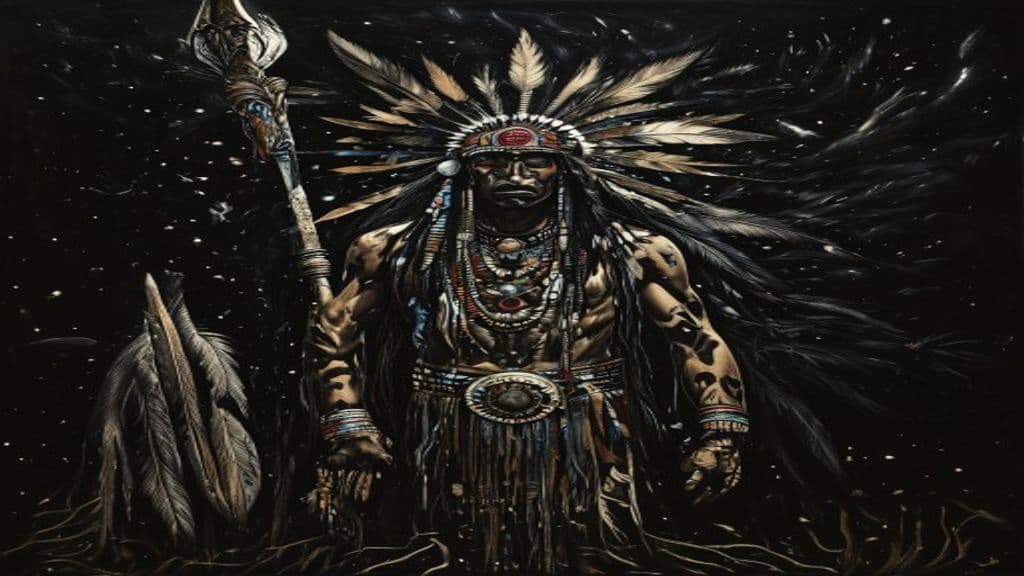
Tobadzischini is a complex entity with attributes of both a hero and a deity, associated with war and agriculture in Navajo mythology. He is often considered the lord of darkness, opposing his brother Nayéé‘ Neizghání /Nayenezgani, who appears to be a lord of light.
Tobadzischini may have powers related to darkness and possibly evil forces, as he is described as a lord of darkness opposing a lord of light.
Anaye (Navajo tradition)
A 'race of monsters or evil gods' in Navajo mythology, killed by the hero Nayenezgani. (Note: - Power tier: Primordial (as they are described as "evil gods") - Appearance: Add that it's unclear and no physical description is provided - Abilities: Clarify that their powers were formidable enoug)
Nayenezgani (Naayééʼ Neizghání)
Mythical hero from Navajo mythology who rid the world of the Naayééʼ alongside his brother Tóbájízhchíní, playing a significant role in Navajo cosmology. (Note: - Summary: Add "play a significant role in Navajo cosmology" after "world's creation". - Power tier: Reduce from Primordial to Ancient (deity-level), as Nayenezgani is considered a hero and not a cosm)
Tlacolotl
Tlacolotl is an Aztec-associated term linked to owls—often rendered as the 'horned owl'—and in secondary sources is portrayed as a symbol or personification of evil, darkness, sorcery, and ill-omen in central Mexican thought. Surviving references are fragmentary and vary between treating Tlacolotl as an owl-sign, an emblem of malignant forces, or (in some modern summaries) a god of evil.
Tlaltecuhtli
Tlaltecuhtli (Classical Nahuatl Tlāltēuctli) is a Mexica (Aztec) primordial earth-being whose dismembered body became the material world. She functions as both the living substance of the earth and a demanding power that must be ritually fed—notably with human blood and hearts—to maintain cosmic order and terrestrial fertility.
Tlepolemus
Tlepolemus (Ancient Greek: Τληπόλεμος, Tlēpólemos, 'enduring war') is a mortal hero of Greek myth, a son of Heracles who leads the Rhodian contingent at Troy, wounds and is slain by Sarpedon, and—after killing Licymnius—founds the three Rhodian cities Cameirus, Ialysus, and Lindus.
Tlesimenes
Tlesimenes is a poorly attested mythic figure recorded in a modern database as related to the Greek figure Parthenopaeus. No primary literary or ritual material for Tlesimenes is provided in the available sources; any identification with the class of nymphs is tentative and inferred from database placement and general descriptions of nymphs in secondary reference material.
Tláloc
Tláloc (Classical Nahuatl: Tláloc) is the Aztec god of rain, water, and earthly fertility, venerated as a giver of life and sustenance and feared for his power over destructive weather such as hail, thunder, and lightning. He is closely associated with mountaintop shrines (notably Cerro Tláloc), caves, springs, and ritual implements and was a central focus of offerings and impersonatory ritual in central Mexican religious practice.
Tohunga (Māori tradition)
A Tohunga is a respected expert and leader in Māori society, possessing specialized knowledge or skills in various areas. (Note: * Power tier should be Ancient or at least higher than Greater, considering their association with spiritual leadership, healing, and advising on various levels of Māori society. * Summary is partiall)
Toi-te-huatahi
Toi-te-huatahi (also Toi, Toi-kai-rākau) is a legendary Māori tūpuna (ancestor) associated with iwi of the Bay of Plenty and surrounding districts. Traditions link him to settlement, place-names (e.g., Te Moana-a-Toi), and genealogies (Te Tini-o-Toi), and recount episodes such as the dog story involving Uenuku and the planting of a karaka grove at Ōtara.
Tokoloshe (Tokolosh)
A diminutive non-human spirit in Nguni and broader Bantu-speaking Southern African traditions, frequently portrayed as a dwarf-like, sometimes hairy water spirit used by malicious people to harass, frighten, or harm others. It functions both as a bogeyman for social discipline and as an explanatory agent for unexplained illness and death, and communities invoke traditional healers or pastors with an apostolic calling to counter it.
Tongu do dia toinges mo thúath
An abstract concept representing the shared deity of a community, symbolizing communal loyalty and allegiance in early Irish society. (Note: 1. Power tier should be "Minor Spirit" as it is an abstract concept that doesn't possess physical presence or divine abilities. 2. Ability description should emphasize its role in emphasizing commitme)
Tootega
Tootega is presented in the available sources as a wisened, elderly female spirit or goddess associated with an island dwelling and with supernatural relations to kayaks, umiaks and the sea; she is described as able to 'dispense with kayaks, umiaks and other craft' and to walk on water.
Community Record
- [1]Wikipediawiki