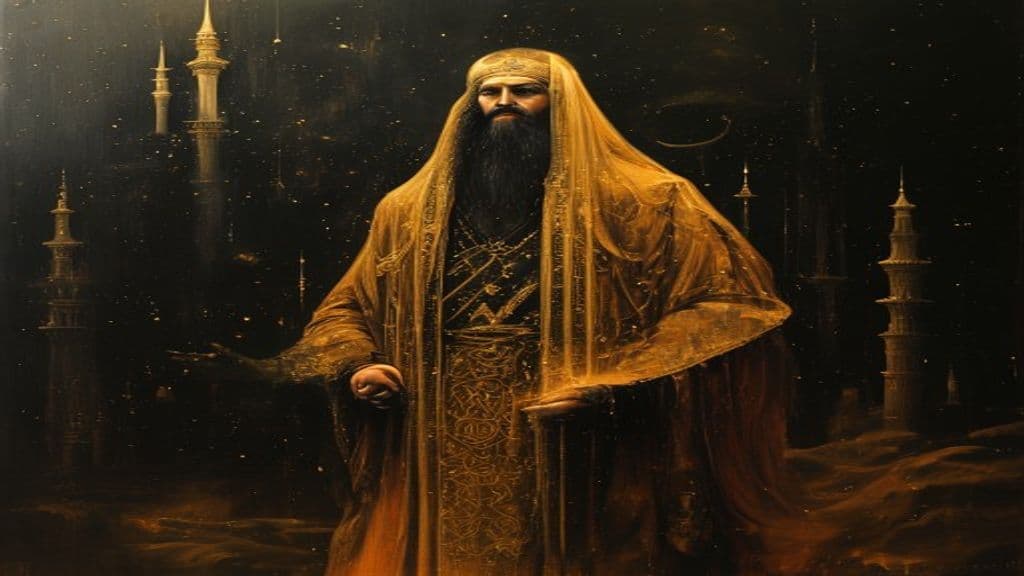
Hamdallah Mustawfi, a 14th-century Persian poet and historian, wrote the Zafarnamah as a literary work reflecting his interests in Iranian history and culture.
The Zafarnamah educates readers about Iranian history and culture through its vast scope and detail, allowing readers to gain insight into the time period of its creation (Arab conquest to Mongols).
Weaknesses
- historical accuracyLimited historical accuracy
Wards
None recorded.
Azadeh
Azadeh (Persian: آزاده) is a Persian female given name meaning broadly 'free' or 'free-minded'; some sources also gloss it as 'someone noble'. The name appears in modern Iranian usage (borne by several contemporary public figures) and as the name of a character in Ferdowsi's Shahnameh. It is a personal name rather than a supernatural being in the provided sources.
Darab-nama (Persian tradition)
Historical romance novel from 12th-century Persia, with possible references to supernatural entities in Persian folklore. (Note: - Power tier: Primordial (due to its historical significance and cultural impact) - Summary: Needs more specific information on supernatural entity references - Appearance: No information provided in )
Farhad (Persian literature)
In Persian literature and mythology, Farhad is a character associated with the love story of Khosrow and Shirin. (Note: 1. Power tier should be revised to "Minor Spirit" since Farhad's abilities are more related to his devotion and determination, rather than cosmic or deity-level powers. 2. Remove description of "Appea)
Huma Bird
In Persian tradition, the Huma bird is a mythical creature that inhabits the air, never touching down on the ground. (Note: - Power tier: Primordial (or not specified at all), as it has cosmic abilities - Appearance: Invisible entity (already correct) - Abilities: Add "existing solely as a concept rather than a tangible be)
Rohham
Loyal paladin and hero in the Persian epic Shahnameh, embodying values of loyalty and military prowess. (Note: * Power tier should be Primordial or Ancient, as Rohham is described as a hero in an epic that deals with "ancient Iranian history and mythology", implying a high level of power. Greater seems too low)
Scheherazade
Legendary human narrator and storyteller in the Persian tradition, known for recounting stories to save herself and others from execution. (Note: - Power tier: Primordial (Scheherazade's abilities are more akin to cosmic in scope, as she uses her storytelling to influence the fate of an entire kingdom and its people.) - No weaknesses listed (Ex)
Tahmina
In Persian epic tradition, Tahmina is a human character in the Shahnameh, a 10th-century epic poem. She is Rostam's wife and Samanganshah's daughter, appearing in the story 'Rostam and Sohrab'. Tahmina serves as a figure illustrating themes relevant to 10th-century Persian society. (Note: 1. Power tier should be "Lesser" since Tahmina is a human character with no supernatural powers. 2. Origin story section is missing. 3. Appearance section needs to state that there is no physical desc)
Vis and Rāmin
Vis and Rāmin are the protagonists of a classical Persian romantic tale composed by Fakhruddin As'ad Gurgani in the 11th century. The narrative reflects the traditions and customs of ancient Persia. (Note: 1. Power tier should be "Minor Spirit" given that no supernatural abilities or behaviors are described. 2. Origin story is incorrect; source material states Parthian origin and not likely to have Part)
Zaebos
Zaebos is a named infernal spirit recorded in European demonological catalogues (notably the Dictionnaire Infernal). He is presented as a high-ranking infernal noble — described as a 'Grand Count' or duke — and is traditionally said to appear as a handsome soldier mounted on a crocodile. Modern adaptations sometimes expand or reassign additional functions to the figure.
Zafar Jinni
An unattested or fragmentary name appearing in the supplied source excerpts; no traditional entity explicitly called "Zafar Jinni" is documented in the provided materials. The excerpts contain isolated occurrences of the word "jinni" and the lexical item "Zafar" (glossed in one footnote as "victory"), but do not combine them into a coherent folkloric being.
Zagovory
Magical entities invoked through incantations in Eastern Slavic folklore, capable of controlling reality with the power of words. (Note: - Summary: Add that they are not directly "invoked" through incantations, but rather the power of words is leveraged for magical effects. - Power tier: Based on source material, it seems more accurate)
Zagzagel
Zagzagel is an attested proper name appearing once in the supplied materials as an item in a syncretic, list-like litany. The sources supply no descriptive, ritual, linguistic, or functional information about the name; it is recorded only as a lexical item within a parade of names and terms.
Community Record
- [1]