
In the narrative cosmology of the Mahābhārata, one account (Sambhava Parva summary) frames Abhimanyu as the earthly manifestation of Varchas, a celestial youth and son of the lunar god Soma. According to that telling, Soma consented to Varchas being born on earth as Abhimanyu to aid in destroying evil men, provided the celestial youth would return to Soma when the human reached the age of sixteen. This Sambhava Parva motif is presented in the epic as a mythic explanation for Abhimanyu's brief life rather than a modern historical claim.
The available sources do not provide detailed physical description beyond representing Abhimanyu as a young (sixteen-year-old), valiant Kuru warrior of the Pandava lineage. Narratives emphasize his youth, his upbringing at Dvārakā among maternal relatives (including instruction from Krishna and Balarama), and his identity as son of Arjuna and Subhadra. Sources stress his martial bearing and reputation as courageous from birth, but they do not record measurements, clothing specifics, or distinctive coloration or iconography in the provided excerpts.
Abhimanyu is portrayed as an accomplished mortal warrior trained by Arjuna and instructed in martial arts by maternal relatives in Dvārakā (Krishna, Balarama, and Pradyumna are named among teachers). He knew the technique to breach the Chakravyuha, a complex circular military formation; sources note he was one of a quartet of warriors with knowledge of this skill. A later folk-told detail reports that he learned the entry technique while in his mother's womb but did not learn the exit procedure, a lacuna that contributed to his death. On the thirteenth day of the Kurukshetra War he penetrated the formation alone and was killed when multiple powerful Kaurava warriors attacked him simultaneously.
Weaknesses
- conditionlimited lifespan by mythic agreement (return of Varchas at age sixteen)
- conditionincomplete tactical knowledge (knew entry into Chakravyuha but not exit, per later folklore)
Wards
None recorded.

Arjuna
Arjuna is the central heroic prince of the Pandava brothers in the Sanskrit epic the Mahabharata. Son of Indra and Kunti, he is famed as the preeminent archer, recipient of divine weapons and teachings (notably Krishna's Bhagavad Gita), and a principal human exemplar through whom questions of duty (dharma), ritual kingship, and the human–divine relationship are explored.
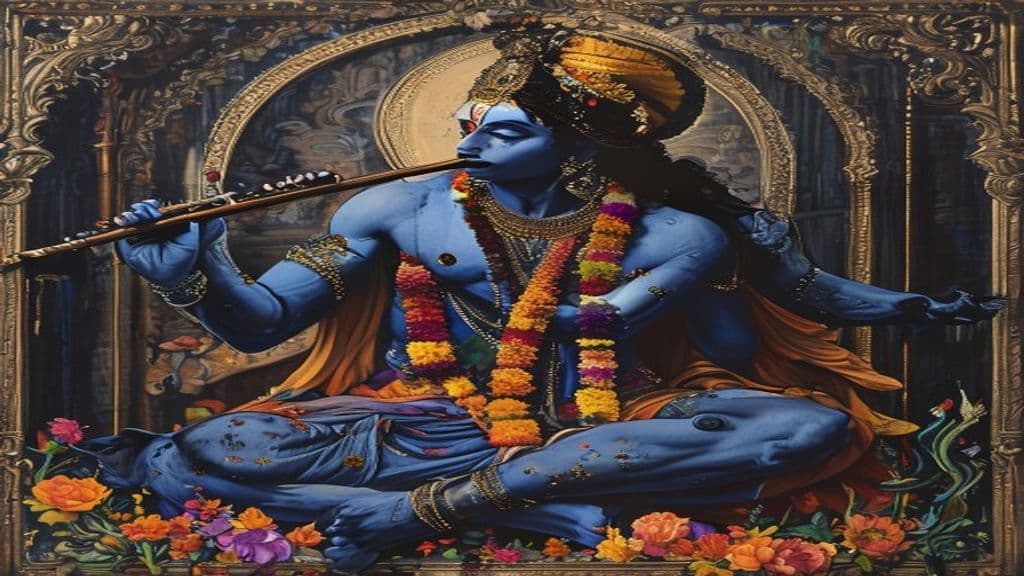
Krishna
Krishna (Sanskrit: Kṛṣṇa) is a major Hindu deity presented in the supplied sources both as the eighth avatāra of Vishnu and, in many traditions, as the Supreme Being (Svayam Bhagavān). He appears in a range of roles—child, cowherd, lover, charioteer, teacher and divine hero—and his life episodes (Krishna-līlā) are central to bhakti devotion, performance arts, and pilgrimage traditions.

Balarāma
Balarāma (Sanskrit: बलराम) is a major deity in the Indian religious tradition closely associated with the Krishna cycle and the Vrishni hero-cult. He is described as Krishna's elder brother, an agricultural patron identified with the plough (halā) and club (gaḍā), and is later associated with the cosmic serpent Śeṣa/Saṅkarṣaṇa and incorporated into Viṣṇu avatāra lists; his cult is attested in early coinage and sculpture from c. 2nd century BCE onward and in living traditions such as the Jagannātha triad and village devotional practice.
Abdul Qadir Gilani
A historical 11th–12th century Hanbali jurist, preacher, and Sufi shaykh who became the eponym and principal early figure of the Qadiriyya tariqa; venerated in Sunni Sufi traditions as an Awliya (saint) and often given exalted hagiographical ranks such as Muḥi al‑Dīn and Ghawth.
Abel
Abel is the second son of Adam and Eve in the Genesis narrative, a shepherd whose accepted offering and subsequent murder by his brother Cain form the biblical account of the first death. Later interpretive traditions expand his role, treating him as an archetypal righteous victim, a postmortem avenging or adjudicating figure, and in some systems (notably Mandaean) identifying him with an angelic lightbeing.
Abellio
Abellio is a theonym attested in Roman‑period inscriptions from the Comminges area of the Pyrenees and reported as worshipped in the Garonne Valley of ancient Gallia Aquitania. Surviving evidence is limited to a small number of inscriptions; scholars have variously hypothesized solar or arboreal associations and compared the name to forms of Apollo or to Celtic Belenus, but the deity's precise role in local cosmology remains uncertain.
Abena Mansa
A name attested in a single contemporary Ghanaian blog anecdote as a 'mysterious being'; available sources do not establish Abena Mansa as a coherent, traditional supernatural figure or provide corroborating ethnographic detail.
Abgal
Abgal (Arabic: أبغال) is a pre‑Islamic local tutelary figure attested in the Palmyrene cultural sphere (c. 154–270 AD), primarily venerated by nomadic Arab groups in the Syrian desert. He appears in inscriptions and reliefs as one of a constellation of armed, mounted protective deities associated with caravan and nomadic protection, though no ritual texts survive in the cited sources.
Abhean
Abhean is a named poet of the Tuatha Dé Danann in medieval Irish literature, described as a poet in particular of Lugh and recorded as having been killed by Óengus before Midir in a poem by Fland Mainistreach preserved in the Lebor Gabála Érenn.
Abhinandananātha
Abhinandananātha is the fourth Tīrthaṅkara (ford-maker) of the current Jain cosmic age (avasarpini). Traditional accounts place his birth in Ayodhyā to the Ikshvāku (Solar) dynasty, describe his renunciation and attainment of omniscience beneath a priyangu tree, and record his liberation on Mount Śikharjī.
Abiathar
Abiathar (Hebrew: אֶבְיָתָר, ʾEḇyāṯār) is a named human priestly figure in the Hebrew Bible. He is presented as a survivor of the Nob massacre who fled to David with priestly regalia, served as a priest and counselor in David's court, and was later deposed and sent to Anathoth by Solomon for supporting Adonijah.
Abib and Apollo
Abib and Apollo are Christian ascetics and hagiographic saints of Akhmim (Upper Egypt) attested in Coptic sources and the Historia Monachorum. Remembered for extreme asceticism, monastic leadership, angelic encounters, and inclusion in the Coptic Synaxarion (feast day November 4).
Abiel
Abiel is attested in the supplied sources only as a male given name — borne by several historical American individuals and listed as two minor biblical figures. The provided materials contain no evidence presenting Abiel as a supernatural, mythological, or folkloric entity.
Abigail
Abigail is a female figure in the Hebrew Bible portrayed in 1 Samuel 25 as the intelligent and beautiful wife of Nabal who intervenes to prevent David from committing violence; later tradition regards her as one of the Tanakh's seven female prophets and as a model of beauty and wisdom.
Abijah of Judah
Abijah (also Abijam or Abiah) is presented in the biblical and later interpretive traditions as a short-reigning human king of Judah from the Davidic line. He is portrayed as a dynastic successor whose military actions (notably the battle at Mount Zemaraim) and moral evaluation in rabbinic literature are interpreted theologically in relation to the Davidic covenant.
Community Record
- [1]Abhimanyu — Wikipedia. Wikipedia contributors. "Abhimanyu." Wikipedia, The Free Encyclopedia. https://en.wikipedia.org/wiki/Abhimanyuwiki
- [2]Abhimanyu — Wikidata entry (label/identifier record). Wikidata. Q97723013. http://www.wikidata.org/entity/Q97723013other
- [3]Archive references to the name Abhimanyu (contextual/occurrence records). Archive.org item: Abhimanyu patel Favorites. https://archive.org/details/fav-abhimanyu_patelother
- [4]Archive: YouTube excerpt (title includes Abhimanyu). Archive.org item: || SECTION 2 || : 2.2.6 All About Operators in Swift. https://archive.org/details/youtube-XOvaGyu52Ooother
- [5]Archive audio item referencing the name Abhimanyu. Archive.org item: AUD 20130308 WA 0000. https://archive.org/details/Abhimanyu_Singh_Rajviother