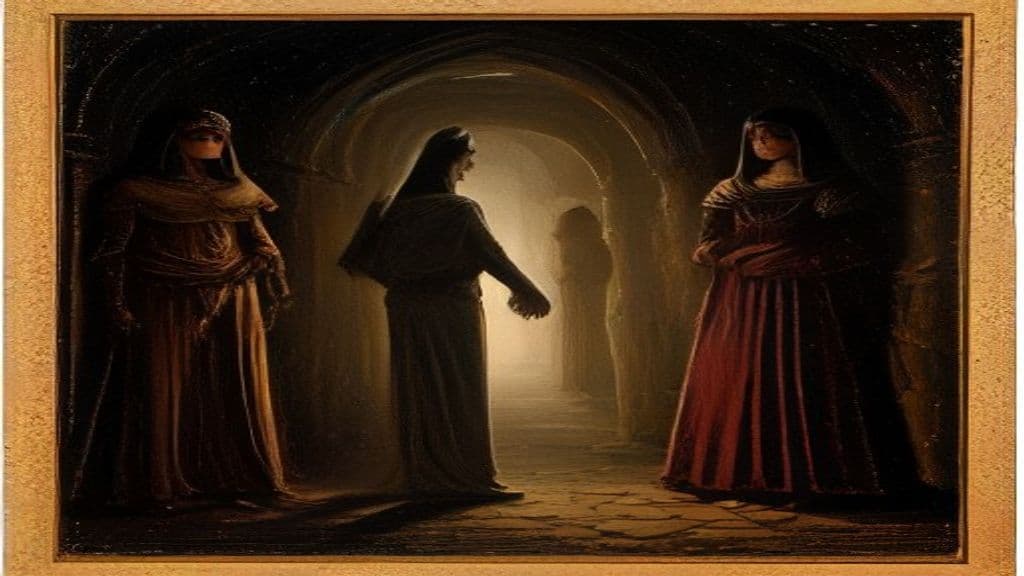
Hagiographical sources present Abib and Apollo as native sons of Akhmim who entered monastic life in youth and became notable ascetics. They lived within the milieu of fourth-century Egyptian monasticism: Abib served as a deacon and later died; Apollo continued ascetic practice, was reportedly moved by an angel to approach inhabited places after forty years in solitude (an event set by the Historia Monachorum during the reign of Julian the Apostate, 361–363 AD), and thereafter attracted many disciples who built a large monastery.
The surviving accounts do not provide physical descriptions. The sources portray them through deeds, spiritual reputation, and monastic roles rather than bodily features.
Sources describe behaviors and signs of sanctity rather than verifiable 'powers.' Apollo is reported in hagiography to have 'known by the spirit' that Macarius of Egypt was composing a letter to them and the time of its drafting; he is also cited among witnesses to a miracle in which a holy woman stood unburnt in a fire. Both are described as practicing rigorous asceticism, performing good deeds, and attracting disciples—Abib became a deacon; Apollo founded/oversaw a large monastic community (Historia Monachorum reports some 500 monks at the time of a visit). The accounts frame these traits as markers of sanctity (angelic calling, spiritual perception, miracle testimony) rather than naturalistic abilities.
Abanoub
Abanoub is a 4th‑century Egyptian Christian child martyr venerated in the Coptic tradition. Remembered for his public confession of Christ, miraculous healings associated with his passion, and the translation and veneration of his relics, his feast is observed on July 31 (Epip 24) and his cult centers include Nehisa and Samanoud.
Abraham of Farshut
Abraham of Farshut was a sixth‑century Coptic monastic leader and abbot associated with the Pachomian federation in Upper Egypt, venerated as a saint in the Coptic Church (feast day February 12). He is remembered for monastic leadership, founding a monastery and convent at Farshut, copying monastic rules, refusing imperial pressure to accept the Council of Chalcedon, and receiving a late‑life vision of earlier monastic fathers announcing his death.
Abraham of Scetis
Abraham of Scetis is an early Egyptian desert monk remembered in Coptic Christian tradition as a holy ascetic (a Desert Father). He is venerated as a saint with a feast day on January 4; his cell (Dshabih) later became a local Christian shrine.
Abāmūn of Tarnūt
A fourth‑century Coptic Christian presented in later hagiography as a martyr from the city of Tarnūt (Therenuti). Known primarily from a single late medieval Synaxarion notice, he is commemorated liturgically for his voluntary confession and violent martyrdom.
Abhean
Abhean is a named poet of the Tuatha Dé Danann in medieval Irish literature, described as a poet in particular of Lugh and recorded as having been killed by Óengus before Midir in a poem by Fland Mainistreach preserved in the Lebor Gabála Érenn.
Abhimanyu
Abhimanyu is a youthful Kuru/Pandava warrior-hero in the Sanskrit epic Mahābhārata. Son of Arjuna and Subhadra, he is famed for entering the Chakravyuha battle formation on the thirteenth day of the Kurukshetra War and dying at age sixteen; his posthumous son Parikshit continues the Kuru line.
Abhinandananātha
Abhinandananātha is the fourth Tīrthaṅkara (ford-maker) of the current Jain cosmic age (avasarpini). Traditional accounts place his birth in Ayodhyā to the Ikshvāku (Solar) dynasty, describe his renunciation and attainment of omniscience beneath a priyangu tree, and record his liberation on Mount Śikharjī.
Abiathar
Abiathar (Hebrew: אֶבְיָתָר, ʾEḇyāṯār) is a named human priestly figure in the Hebrew Bible. He is presented as a survivor of the Nob massacre who fled to David with priestly regalia, served as a priest and counselor in David's court, and was later deposed and sent to Anathoth by Solomon for supporting Adonijah.
Abiel
Abiel is attested in the supplied sources only as a male given name — borne by several historical American individuals and listed as two minor biblical figures. The provided materials contain no evidence presenting Abiel as a supernatural, mythological, or folkloric entity.
Abigail
Abigail is a female figure in the Hebrew Bible portrayed in 1 Samuel 25 as the intelligent and beautiful wife of Nabal who intervenes to prevent David from committing violence; later tradition regards her as one of the Tanakh's seven female prophets and as a model of beauty and wisdom.
Abijah of Judah
Abijah (also Abijam or Abiah) is presented in the biblical and later interpretive traditions as a short-reigning human king of Judah from the Davidic line. He is portrayed as a dynastic successor whose military actions (notably the battle at Mount Zemaraim) and moral evaluation in rabbinic literature are interpreted theologically in relation to the Davidic covenant.
Abiku
In Yoruba tradition, the Abiku is a Primordial entity representing the spirits of children who die young. (Note: - Power tier: Primordial seems plausible but should be supported by additional source material confirming its cosmic or deity-level abilities. - Appearance: While the draft mentions spirits often appe)
Community Record
- [1]Abib and Apollo — Wikipedia. Wikipedia, 'Abib and Apollo', accessed via provided research notes.wiki
- [2]Wikidata entry for Abib and Apollo (Q4055880). Wikidata entry Q4055880, accessed via provided research notes.other
- [3]Historia Monachorum in Aegypto (accounts referenced in notes). Historia Monachorum — account of Apollo's residence in the Thebaid, angelic call during the reign of Julian the Apostate, and report of an immense monastery of ~500 monks (as cited in the research notes).literary
- [4]Coptic Synaxarion (entry cited in notes). Synaxarion entry noting commemoration of Abib and Apollo on November 4 (as summarized in the research notes and Wikipedia).literary