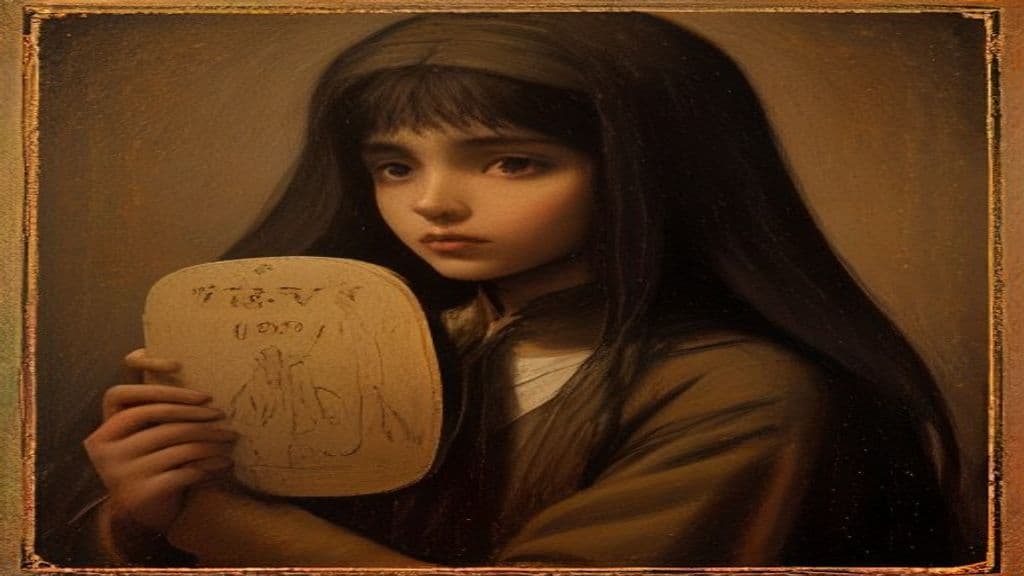
According to Coptic hagiographical summaries, Abanoub was a child of Nehisa in 4th‑century Egypt who, after receiving the sacraments, publicly confessed Christianity during the Diocletianic persecutions. He gave his inherited gold, silver, and apparel to the poor, entered churches to hear admonitions to remain faithful, and set out to declare his faith—acts that led to his arrest, torture, miraculous healings by angelic intervention, and eventual beheading. His vita is associated in later sources with St. Julius El‑Akfahsi, who took custody of his body and arranged its return to his hometown; in 960 AD sources record a translation of his relics to the St. Virgin Mary Church in Samanoud.
Hagiographical sources emphasize Abanoub's youth: he is repeatedly described as twelve years old at the time of his martyrdom. Narrative details include that he was effectively orphaned (having inherited goods from his father) and that he gave away his gold, silver, and apparel to the needy before beginning his public witness. The accounts also record that he experienced a vision of the Archangel Michael who foretold his suffering at Samanoud; beyond age and these comportamental details, no detailed physical description (height, hair, clothing) is provided in the supplied sources.
Sources do not present Abanoub as independently supernatural; rather, miracles in his life and after his death are described as divine or angelic interventions connected to his witness and relics. Narratives record that the Archangel Michael healed him after torture, that persecutors were stricken (blindness, paralysis) and later healed following his prayers and angelic intervention, and that many signs and miracles were manifested from his relics after translation. His role in tradition is intercessory: prayer to and veneration of his relics are credited with healing and signs in the sources.
Weaknesses
- otherNo folkloric weaknesses recorded — sources do not present Abanoub as a hostile supernatural being requiring banishment
Wards
- ritualVeneration, prayer, and relic custody: The appropriate communal response in sources is devotion and invocation of the saint (relic veneration, liturgical commemoration) rather than warding
Abib and Apollo
Abib and Apollo are Christian ascetics and hagiographic saints of Akhmim (Upper Egypt) attested in Coptic sources and the Historia Monachorum. Remembered for extreme asceticism, monastic leadership, angelic encounters, and inclusion in the Coptic Synaxarion (feast day November 4).
Abraham of Farshut
Abraham of Farshut was a sixth‑century Coptic monastic leader and abbot associated with the Pachomian federation in Upper Egypt, venerated as a saint in the Coptic Church (feast day February 12). He is remembered for monastic leadership, founding a monastery and convent at Farshut, copying monastic rules, refusing imperial pressure to accept the Council of Chalcedon, and receiving a late‑life vision of earlier monastic fathers announcing his death.
Abraham of Scetis
Abraham of Scetis is an early Egyptian desert monk remembered in Coptic Christian tradition as a holy ascetic (a Desert Father). He is venerated as a saint with a feast day on January 4; his cell (Dshabih) later became a local Christian shrine.
Abāmūn of Tarnūt
A fourth‑century Coptic Christian presented in later hagiography as a martyr from the city of Tarnūt (Therenuti). Known primarily from a single late medieval Synaxarion notice, he is commemorated liturgically for his voluntary confession and violent martyrdom.
Abaia
Abaia is a singular, enormous freshwater eel spirit from Melanesian tradition (notably Fiji, the Solomon Islands, and Vanuatu) that dwells in lake depths and protects all aquatic life; when humans harm lake creatures it responds by creating waves, storms, or floods that drown transgressors.
Aban (Āb/Ābān)
Aban (Avestan apas; Middle Persian āb/ābān) is the collective, sacred principle of the waters in Zoroastrian cosmology — both the element water and its personified hypostases (the Apas/Ahuranis). Aban functions as a primordial, life-giving creation, a calendrical and liturgical focus (day-name, month-name, Abanagan feast), and a ritual object of veneration (ape zaothra, Aban Yasht) rather than a malign force to be expelled.
Aban Yasht
The Aban Yasht is a hymn from the Persian tradition that praises Anahita, a goddess associated with water, fertility, and wisdom. It consists of 132 stanzas and is part of the 21 Yashts collection. (Note: - Power tier should be "Primordial" or possibly "Cosmic", given that it's a hymn of great spiritual significance and associated with a goddess. - The article incorrectly states that Anahita is associa)
Abandinus
Abandinus is a locally attested Romano‑Celtic theonym known from a single inscribed bronze feather (votive object) dedicated at Godmanchester (the Roman fort Durovigutum) in Cambridgeshire. Scholars interpret him as a local god or male spirit tied to a specific place and possibly associated with a nearby spring or stream; this association is tentative and based on etymological readings of the name.
Abarbarea
Abarbarea is a name attested in classical Greek and Roman sources for freshwater nymphs (naiads). The name appears for at least two individual mythic figures — a naiad wife of Bucolion and a naiad counted among ancestors of the Tyrians — and Hesychius records plural forms that may indicate the name was also used as a class-name (Abarbareai / Abarbalaiai).
Abarta (Ábartach)
Abarta (also Ábartach) is a figure of Irish myth who, in surviving accounts, tricks Fionn mac Cumhaill's warriors by giving them a supernatural grey horse that bears them into the Otherworld. Sources variably identify him as a member of the Tuatha Dé Danann or as a Fomorian; after the incident he is compelled to release the captured warriors and is refused entry to the Fianna.
Abas
Abas (Ancient Greek: Ἄβας, gen.: Ἄβαντος) is not a single mythic being but a recurring personal name borne by multiple mortals and minor mythic figures in Greek epic and genealogical traditions — kings, founders, seers, warriors, attendants, a centaur, and a youth transformed by a goddess. The name is glossed in the sources as 'guileless' or 'good-hearted' and appears across Argive, Theban, Trojan, Euboean, and other local cycles.
Abaset
Abaset is a localized ancient Egyptian goddess attested in tomb decoration at El‑Bawiti in the Bahariya Oasis during the 26th Dynasty. She is depicted anthropomorphically with a hedgehog motif incorporated into her headdress and appears on the walls of Qarat Qasr Salim, including twice in the Tomb of Bannentiu. No cult texts, myth narratives, or ritual prescriptions for her are recorded in the cited corpus.
Community Record
- [1]Abanoub. Wikipedia: Abanoubwiki
- [2]St. Abanoub - Synaxarium entry. CopticChurch.net: St. Abanoubfolk
- [3]Novena to Saint Abanoub. Catholic Doors: Novena to Saint Abanoubother