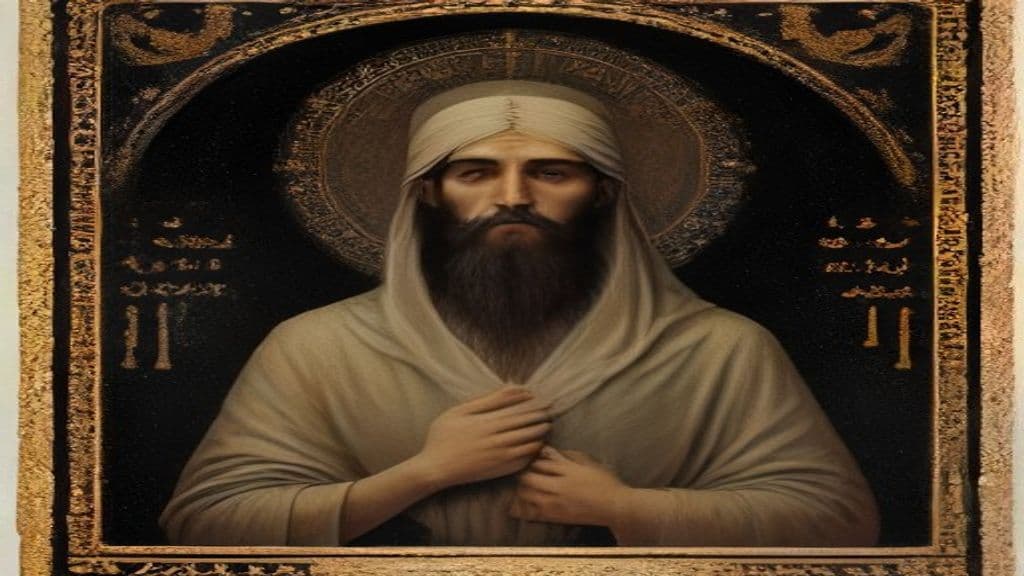
Abraham is presented in the sources as a monk of the Scetis (Sketis) desert monastic community. He is remembered within the corpus of Desert Fathers material and later Coptic liturgical memory as a blessed ascetic whose cell, called Dshabih, became a shrine. The tradition emphasizes his life of tears, manual labor, a visionary encounter with Christ, and a prolonged illness culminating in his death after eighteen years of sickness; he is commemorated in the Coptic Church on January 4.
The supplied materials do not give a detailed corporeal description. Hagiographic imagery preserved in the Sayings describes an ascetic mode of life: he lived in a cell (Dshabih), sat at manual labor, and 'had a hollow in his chest channelled out by the tears which fell from his eyes all his life,' an image used to signify continual weeping and penitential sorrow rather than a precise physical portrait.
The sources do not present Abraham as possessing inherent supernatural powers. He is described as an ascetic and visionary: he 'is said to have had a vision of Christ riding the chariot of the Cherubim.' His sanctity is signaled by prolonged ascetic practices (weeping, manual labor), endurance of an eighteen-year illness, and subsequent local veneration; the tradition frames these as marks of blessedness rather than magical abilities.
Abanoub
Abanoub is a 4th‑century Egyptian Christian child martyr venerated in the Coptic tradition. Remembered for his public confession of Christ, miraculous healings associated with his passion, and the translation and veneration of his relics, his feast is observed on July 31 (Epip 24) and his cult centers include Nehisa and Samanoud.
Abib and Apollo
Abib and Apollo are Christian ascetics and hagiographic saints of Akhmim (Upper Egypt) attested in Coptic sources and the Historia Monachorum. Remembered for extreme asceticism, monastic leadership, angelic encounters, and inclusion in the Coptic Synaxarion (feast day November 4).
Abraham of Farshut
Abraham of Farshut was a sixth‑century Coptic monastic leader and abbot associated with the Pachomian federation in Upper Egypt, venerated as a saint in the Coptic Church (feast day February 12). He is remembered for monastic leadership, founding a monastery and convent at Farshut, copying monastic rules, refusing imperial pressure to accept the Council of Chalcedon, and receiving a late‑life vision of earlier monastic fathers announcing his death.
Abāmūn of Tarnūt
A fourth‑century Coptic Christian presented in later hagiography as a martyr from the city of Tarnūt (Therenuti). Known primarily from a single late medieval Synaxarion notice, he is commemorated liturgically for his voluntary confession and violent martyrdom.
Arsenius the Great
Arsenius the Great (c. 350/354–c. 445/450) was a Roman-born imperial tutor who renounced court life to become an anchorite among the Desert Fathers in Egypt. Venerated as a saint in Eastern Orthodox, Coptic, and Roman Catholic traditions, he is remembered for extreme humility, prolonged solitude, silence, copious tears of devotion, and brief monastic writings and sayings preserved in the Apophthegmata Patrum and other collections.
Aborigines (mythology)
A mytho-historical label used in Roman and general reference sources to denote the oldest inhabitants of a region (specifically central Italy in the cited Roman context). The term functions as an identity/category for original human populations rather than as a characterized supernatural being in the provided sources.
Abraham
Abraham (originally Abram) is the foundational patriarchal ancestor in the Hebrew Bible whose life establishes a covenantal relationship between his family/people and God. He functions as an exemplar of faith, the progenitor of promised descendants, and a narrative anchor for claims of land, blessing, and communal identity in later religious traditions.
Abraham (Ibrāhīm) in Islam
Ibrāhīm (Abraham) in Islam is a human prophet and messenger chosen by God, a paradigm of pure monotheism (hanīf), patriarchal ancestor to later peoples and prophets, and traditionally regarded as having helped establish the Kaʿbah with his son Ismāʿīl. He is called Khalīl Allāh ('Friend of God') and is central to rites commemorated in Hajj and Eid al‑Adha.
Abraham Cornelius
Abraham Cornelius is a fictional human scientist in Marvel Comics, a senior Weapon X technician who helped develop the technique to bond adamantium to bone and who features in Wolverine's origin and later storylines, including Death of Wolverine.
Abrahel
Abrahel is a demonological entity attested in early modern sources (notably Nicholas Rémy's Demonolatria as summarized in modern reference) portrayed as a female sexual spirit who seduced a man in 1581, induced him to kill his son, then restored the child to life in exchange for worship; the revival produced a diminished, foul-smelling corpse that later died again.
Abraun
Abraun is an attested name in German-language plant-legend scholarship (Der abraun, ein beitrag zur pflanzensagenkunde, 1916) and a short database entry (Wikidata) labels it as a spirit from German mythology. Surviving accessible documentation is extremely limited: the principal academic treatment is a 1916 contribution to pflanzensagenkunde (plant-saga studies), but the excerpts available here contain only bibliographic metadata and do not record tales, descriptions, or rituals.
Abraxas
Abraxas (Abrasax) is a late‑antique Gnostic and magical name attested as a high-ranking cosmic power in heresiological summaries and as a potent name engraved on amulets (so-called Abraxas stones) in the Greco‑Roman magical milieu. Heresiologists associate Abraxas with rulership of 365 heavens and note the name's numerological value, while archaeological and papyrological contexts show its use as an amuletic formula.
Community Record
- [1]Abraham of Scetis — Wikipedia. Wikipedia, entry 'Abraham of Scetis'.wiki
- [2]Sayings of the Desert Fathers (Apophthegmata) — collected sayings. Apophthegmata / Sayings of the Desert Fathers (collected sayings; quoted image of continual weeping).literary
- [3]Desert Fathers overview (secondary portal). Overview and context for Desert Fathers monastic tradition.other
- [4]Coptic Synaxarium and related commemorations (portal reference). Coptic liturgical material and synaxarium context (portal reference).other