
Across the sources summarized, Abyzou is presented as a namable, personified cause of obstetric and neonatal misfortune rather than as a single unified origin-myth. The Testament of Solomon portrays her among a roster of hostile supernatural agents whom Solomon binds and interrogates; that narrative emphasizes her sleepless wandering in search of women about to give birth. Modern scholarship (A. A. Barb, as cited in secondary summaries) has proposed a historical link between the name-form and primeval-sea terms (Mesopotamian Abzu, Greek ábyssos), a hypothesis offered as an interpretive etymology rather than a primary-source self-identification. Regional syncretism is evident in later identifications (e.g., Gylou in Byzantine contexts, Alabasandria in Coptic Egypt) and the recurring motif that she possesses many names, a feature used in magico-medical strategies to control her.
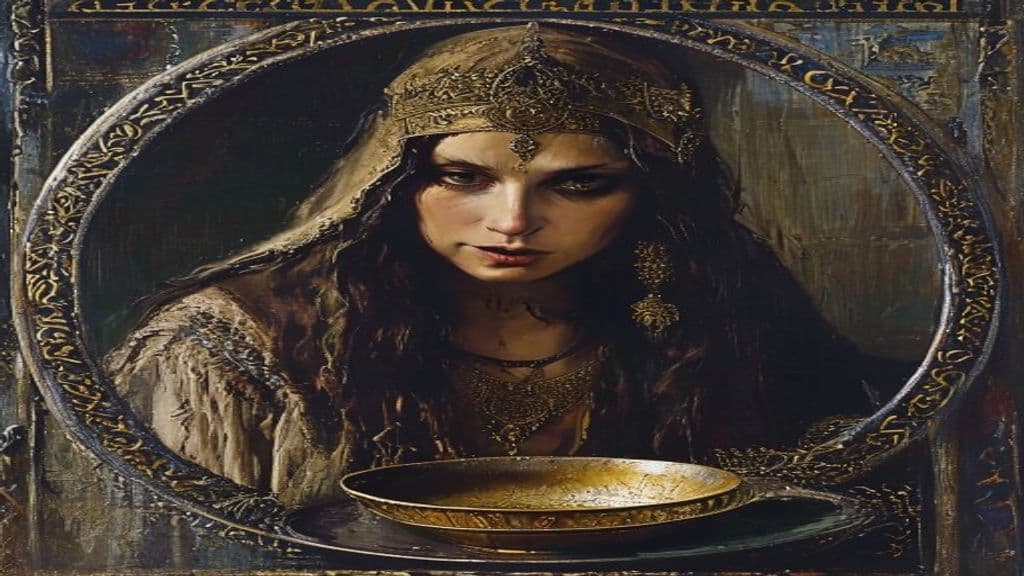
Testamental and amuletic descriptions present Abyzou as a female monstrous figure with serpentine or fish-like features and a troubling visage. The Testament of Solomon (as Obizuth) describes her as having 'a greenish gleaming face with dishevelled serpent-like hair' while the remainder of her body is 'covered by darkness' and she does not sleep. Amulet iconography often renders her with fish- or serpent-like attributes and shows her bound, kneeling with hands tied behind her back, whipped by a standing figure (identified as Solomon or an archangel figure) or trampled beneath a horseman; some commentators note that the dominant amulet image that subdues the figure has womb-like resonances, though that reading is interpretive and tentative in the sources.
Sources consistently attribute to Abyzou a focus on childbirth-related harm: she is said to seek out women in labor and to be responsible for strangling newborns, causing miscarriages and infant mortality. The Testament of Solomon additionally credits her with inflicting deafness, eye trouble, obstructions of the throat, madness, and bodily pains. In magico-medical contexts she functions as a named affliction who can be compelled to 'flee' when confronted with authoritative names, images, or seals; narrative and amuletic traditions emphasize that knowledge or inscription of controlling names and the presence of Solomon/archangelic authority can constrain or expel her.
Weaknesses
- ritualWriting her name on papyrus (Testament of Solomon: 'if her name is written on a scrap of papyrus when a woman is about to give birth, "I shall flee"')
- mantraRecitation/invocation of controlling names (a magic text records that the archangel Michael compelled Abyzou to reveal forty names that can control her)
- symbolImages or seals of Solomon / Seal of Solomon (amuletic inscriptions and depictions show these commanding her flight)
- ritualInvocation of saints/archangels (e.g., Sisinnios/Sisinnia, Raphael/Afarof/Arlaph) — sometimes substituted for Solomon on amulets
Wards
- ritualAmulets depicting Abyzou bound or trampled with inscriptions commanding 'Flee, flee, Abyzou' together with names of Solomon, Sisinnios, or archangels (attested on Byzantine bronze and medieval lead amulets)
- substancePapyrus scrap inscribed with her name placed at childbirth (Testament of Solomon attestation)
- symbolSeal of Solomon and ouroboros inscriptions used on amulets to compel her departure
Abu
Abu is a poorly understood Mesopotamian god attested in modern reference summaries. Secondary literature tentatively links him with vegetation and snakes and records that he was often paired with a deity written gu2-la2, but primary details about his cult, iconography, and myths are lacking in the cited sources.
Abumi-guchi
A Japanese yōkai classed as a tsukumogami: an animated stirrup (abumi) depicted in Sekien Toriyama's Gazu Hyakki Tsurezure Bukuro. Traditional accounts say it is formed from a stirrup that belonged to a soldier who fell in battle and that it waits where the stirrup lies for its dead owner to return.
Abundantia
Abundantia is the Roman divine personification of abundance and material plenty, used primarily in imperial propaganda and public iconography to signify secure grain supplies, wealth, and the promise of a 'Golden Age' under the emperor. She also appears in later medieval European folklore as Domina Abundia / Dame Habonde, a household benefactor in accounts condemned by ecclesiastical writers.
Abundia
Abundia is a sparsely attested name found in modern secondary sources as a beneficent, abundance-associated female supernatural figure; the name occurs in a Wikidata gloss as a "beneficent fairy who brings abundance" and is listed among goddesses in a modern Dutch lecture about historical witchcraft. No primary medieval or early-modern texts documenting her lore were provided in the sampled material.
Abura-akago
An Edo-period yōkai depicted as an oil‑licking infant or a ball of flame. First recorded in illustrated compendia (notably Toriyama Sekien's Konjaku Gazu Zoku Hyakki), the Abura-akago is tied to tales of oil‑stealing fires and functions in part as an etiological warning about wasting or stealing oil.
Abura-sumashi
A yōkai spirit from the Amakusa region of Kumamoto Prefecture, Japan, said to inhabit mountain passes. Traditionally explained as the ghost of a person who stole oil, it appears to surprise travelers and is represented in modern media with a straw-coat body and a potato- or stone-like head.
Abzar İyesi
A Turkic iyesi (possessive/guardian spirit) of the courtyard, outbuildings, and farmstead grounds; ambivalent in nature, it protects its domain but may harm livestock and cause mischief, often appearing in animal forms.
Abzû
Abzû (Sumerian abzû; Akkadian Apsû) is the primordial freshwater abyss in Sumerian–Akkadian cosmology: the deep fresh waters that underlie and surround the earth, source of springs, rivers and ritual holy waters, and a creative principle whose mingling with the salt sea (Tiamat) figures in Mesopotamian cosmogony.
Abāmūn of Tarnūt
A fourth‑century Coptic Christian presented in later hagiography as a martyr from the city of Tarnūt (Therenuti). Known primarily from a single late medieval Synaxarion notice, he is commemorated liturgically for his voluntary confession and violent martyrdom.
Abī-simtī
Abī-simtī (also rendered Abi-simti, Abisimti) is a named woman attested in third-millennium BCE Mesopotamian documentary and literary texts. She appears in administrative account records as a provider of animals and donor to temple cults and in Sumerian love-song literature as the named beloved/consort addressed by a royal speaker.
Abū Lahab
Abū Lahab (ʿAbd al-ʿUzzā ibn ʿAbd al-Muṭṭalib) is a historical Meccan figure — a paternal uncle of the Prophet Muḥammad and a Quraysh leader who opposed the Prophet; he is singled out and condemned in Qurʾān 111 (Sūrat al-Masad) and functions in Islamic textual memory as an exemplar of divine punishment for opposition.
Acacallis
Acacallis (Ancient Greek: Ἀκακαλλίς; also Acalle) is a mythological princess of Crete in Greek tradition, daughter of King Minos and Pasiphae. She functions primarily as a dynastic and etiological figure: in varying accounts she is mother, by gods such as Hermes (Mercury) or Apollo, of eponymous or founder-figures like Cydon (founder of Cydonia), Miletus, or Lydon/ Lydus.
Community Record
- [1]Abyzou - Wikipedia. Wikipedia entry 'Abyzou' (summarizing Testament of Solomon, amulet evidence, and scholarship such as A. A. Barb)wiki
- [2]Wikidata entry Q4748 (Abyzou). Wikidata identifier and linked statements for Abyzouother
- [3]Testament of Solomon (summarized in research notes). Paraphrase and attestations from the Testament of Solomon tradition as provided in the research notes (description of Obizuth; sleepless wandering; strangling newborns; bodily afflictions)literary
- [4]Byzantine and medieval magico-medical amulet evidence (summarized). Descriptions of early Byzantine bronze and medieval lead amulets depicting Abyzou bound or trampled, inscriptions commanding 'Flee, flee, Abyzou,' and invocation of Solomon/Sisinnios/archangels as reported in the research notesacademic
- [5]The new wave of Jewish horror: Ancient folklore (and a child-stealing demoness) in modern movies - UW Stroum Center. Discussion of modern film receptions and the use of Abyzou in contemporary storytelling (cited in the research notes)other
- [6]Archive: Abyzou (various modern/creative sources). Collection references to modern creative or audiovisual materials titled 'Abyzou' (not primary magico-medical sources) as listed in the provided URLsother