
No narrative origin myth for Ahhazu is attested in the provided sources. Instead, Ahhazu is presented in lexical and ritual texts as a named member of a roster of harmful beings (the DÌM / kamad group) and occurs in bilingual Sumerian–Akkadian lists where it forms part of a triad headed by the goddess Lamashtu/DÌM.ME. Its textual role is primarily as an etiological agent of particular disease presentations, invoked and countered in medical-astral, magical and anti-witchcraft corpora (for example Maqlû, Utukkū Lemnūtu, and the Group Eight anti-witchcraft rituals).
The cited sources do not supply a detailed physical description of Ahhazu. Textual evidence renders the name as meaning 'seizer' or 'the grabber' (Akkadian aḫāzu) and in Utukkū Lemnūtu Tablet 11 is translated as 'grabber' or as a jaundice-demon, which conveys a conceptual image of a being that seizes or takes hold of bodies or bodily functions. Beyond this epithet and its placement within the DÌM/kamad group led by Lamashtu, no explicit bodily traits or iconographic details are given in the provided material.
In the medical-magical texts cited Ahhazu is an agent of specific somatic disorders. It is repeatedly associated with jaundice and related biphasic fevers; sources also link it with alterations in mental status, fever accompanying skull fractures, abnormal posturing, and, in summary formulations, with injuries to the liver. Illnesses caused by Ahhazu are sometimes spoken of as the 'hand of aḫḫāzu' (i.e. a seizure by the being). Texts contrast Ahhazu with other illness-spirits (for example Labasu, associated with fever without jaundice, and amurriqanu, glossed as 'jaundice and bloating or wasting'), indicating a differentiated taxonomy in which named spirits correspond to particular clinical pictures. Ahhazu regularly appears alongside other hostile agents (Lamashtu, labāṣu, lilu, lilītu, utukku, šēdu, etc.) in incantations and anti-witchcraft rites.
Weaknesses
- ritualMaqlû anti-witchcraft ritual actions (torch/fire, burning statues/figurines)
- ritualUtukkū Lemnūtu (Udug-Hul) therapeutic incantations administered by exorcist/healer
- ritualGroup Eight 'Ceremonial Rituals for Undoing Witchcraft' formulae naming and opposing Ahhazu
Wards
- ritualRecitation of Maqlû incantations that denounce and expel named afflictors including Ahhazu
- ritualUtukkū Lemnūtu incantations directed at illnesses caused by evil demons (used protectively/therapeutically)
- conditionAvoidance or ritual attention during inauspicious astral configurations (implicit in astral-medical associations)
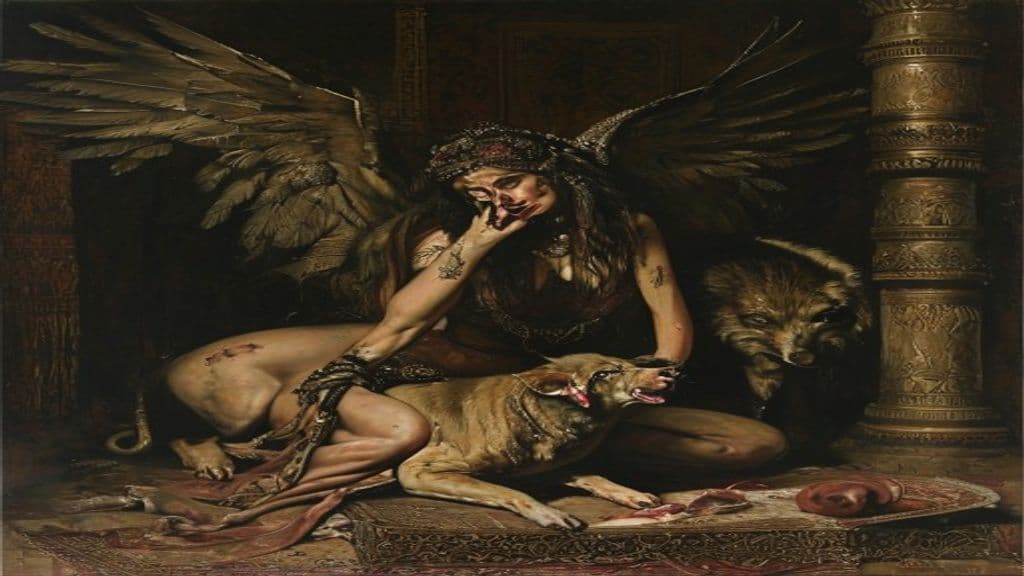
Lamashtu
The most feared demoness of ancient Mesopotamia — a divine daughter of Anu who preyed on pregnant women, caused miscarriages, and killed infants by nursing them with venom.

Utukku (Utukku Lemnu)
Utukku (Sumerian udug; Akkadian utukku) is an ambiguous class of underworld-born malignant spirits in ancient Mesopotamian tradition. Treated in ritual literature as agents of disease and affliction, they are distinct from the dingir (gods) and primarily addressed through exorcistic texts collectively known as the Udug Hul.
Agur ben Jakeh
Agur ben Jakeh is presented in the Hebrew Bible (Proverbs 30) as a sage and compiler or speaker of a distinct collection of sayings. The figure functions in textual tradition as a named human sage, a possible pedagogical persona, and—in some readings—an oracular voice; there is no evidence in the supplied sources that Agur is a supernatural being.
Agwé
Agwé is a high-ranking lwa in Haitian Vodou associated with the sea, navigation, fishing, and certain funerary conveyances. He is portrayed as a naval officer who lives in a palace beneath the sea, commands attendant spirits, and is propitiated with maritime offerings and ceremonies.
Ah Muzen Cab
Ah Muzen Cab is a Yucatán Maya divine figure associated with bees and honey, attested in summary sources as protector of Melipona bees and as a participant in Chilam Balam creation and ritual chapters. He is also linked in secondary accounts to the upside-down 'Descending' or 'Diving God' image found in Maya iconography at sites such as Tulum.
Ahab
Ahab (Hebrew: אַחְאָב, ʾAḥʾāḇ) is principally the historical/biblical seventh king of the northern Kingdom of Israel, son and successor of Omri, remembered in Hebrew scripture and later rabbinic literature for political activity, promotion of Baal worship, and confrontation with prophets. The name is also reused in later literature (notably Herman Melville's Captain Ahab), but the supplied sources treat these as distinct human figures rather than supernatural beings.
Ahalya
Ahalya is a mytho-legendary woman of South Asian (primarily Hindu) narrative tradition, described as created by the god Brahma, married to the sage Gautama, seduced (or tricked) by Indra, cursed by her husband, and ultimately redeemed by Rama. Her tale is a locus for themes of creation, desire, curse/penance, and redemption and she is counted among the ritual-mnemonic panchakanya.
Ahasuerus
Ahasuerus is a royal personal name in the Hebrew Bible applied to one or more kings of Persia, most prominently the monarch who rules from Susa in the Book of Esther. The name is etymologically derived from Old Persian Xšayāršā (Xerxes) but functions in the texts as a name-title whose precise historical referent is disputed across traditions.
Ahijah the Shilonite
Ahijah the Shilonite is a Levite prophet attested in the Hebrew Bible (1 Kings) who foretold Jeroboam's rise and is credited in Chronicles with a now‑lost work. Rabbinic literature expands him into a legendary long‑lived transmitter of sacred lore while also debating his moral fallibility in the Jeroboam episode.
Ahimaaz
Ahimaaz (Hebrew: אֲחִימַעַץ, ʾĂḥīmaʿaṣ, "My Brother Is Counselor") is a human figure in the Hebrew Bible presented as a son of the high priest Zadok, a priestly court official and messenger attached to King David's court, and later listed as Zadok's successor in the priestly genealogy. He appears in narratives of David's reign—notably during Absalom's revolt—and is associated with the royal and sanctuary leadership of Jerusalem.
Ahimelech
Ahimelech is a historical/biblical Israelite priest of Nob mentioned in the Hebrew Bible (primarily 1 Samuel). A descendant of Aaron through the line associated with Eli and Ithamar, he provides David with the showbread and is later accused of aiding David; Saul orders his death and that of the attending priests, an event carried out by Doeg the Edomite.
Ahinoam
Ahinoam (Hebrew: אֲחִינֹעַם, ăḥīnōʿam) is a personal name borne by one or possibly two women in the Hebrew Bible associated with the royal households of Saul and David. In the biblical narratives she appears as a wife and mother within the social world of ancient Israelite monarchy and is involved in episodes such as the Amalekite raid on Ziklag; scholars debate whether the references designate the same woman or distinct individuals from different narrative strands.
Ahiravan (Mahiravan)
Ahiravan (also Mahiravan) is a rakshasa-king of Patala in Ramayana-derived narratives who abducts Rama and Lakshmana to sacrifice them to a goddess. Presented as a brother or trusted ally of Ravana in eastern Ramayana recensions, he is defeated and beheaded by Hanuman with divine aid.
Ahithophel
Ahithophel (also Achitofel) is a human counselor in the Hebrew Bible famed for his wisdom. He served King David, later defected to Absalom during Absalom's rebellion, and after his advice was ignored he returned to Giloh and hanged himself.
Community Record
- [1]Ahhazu. Wikipedia: 'Ahhazu (Aḫḫāzu, Ahhāzu, Akhkhazu; Sumerian: ᵈdìm.me.ḪAB, …) is a Mesopotamian demon of jaundice...' (accessed source provided in research notes)wiki
- [2]Akhkhazu. Wikipedia entry cited in the research notes summarizing occurrences of Akhkhazu in Maqlû and Utukkū Lemnūtuwiki
- [3]Maqlû and Utukkū Lemnūtu citations (summaries). Summarized citations from Maqlû and Utukkū Lemnūtu quoted in the provided research notes (e.g., Maqlû Tablet I line: 'I am raising the torch and burning their statues... Lamaštu, labāṣu, ahhāzu-jaundice')other
- [4]Astral-medical text LBAT 1597 (summary). Summary in research notes: LBAT 1597 links ahhazu-group diseases with celestial regions (e.g., moon in region of Leo lists lamaštu, labašu, and ahhazu-demons)other