
No single canonical origin is given in the sources; multiple, conflicting origin narratives are reported. Versions include: a World War II–era girl killed while playing hide-and-seek during an air raid; a girl murdered by a parent or stranger; and a girl who committed suicide in a school toilet after bullying. The supplied material records these differing accounts without establishing one authoritative origin.
Accounts vary. Common descriptive elements reported across sources include a girl with a bobbed haircut and a red skirt or dress. Some tellings emphasize only a bloody or ghostly hand rather than a full-bodied apparition. Media portrayals range from benign to vengeful, and no single canonical appearance is fixed in the supplied material.
Reported abilities and behaviors are variable across versions. Consistently described is that Hanako-san may be summoned by a school-yard ritual (see rituals). If present, she will answer when asked. Variant outcomes recorded in the sources include manifestation of a bloody or ghostly hand; the hand or Hanako-san pulling the inquirer into the toilet; being taken to Hell; or being eaten by a three-headed lizard in some tellings. The supplied sources present these as alternative motifs across different tellings rather than as uniform powers.
Weaknesses
- otherNo consistent weaknesses attested in supplied sources
Wards
- otherNo consistent protective wards or repellents are documented in the supplied sources
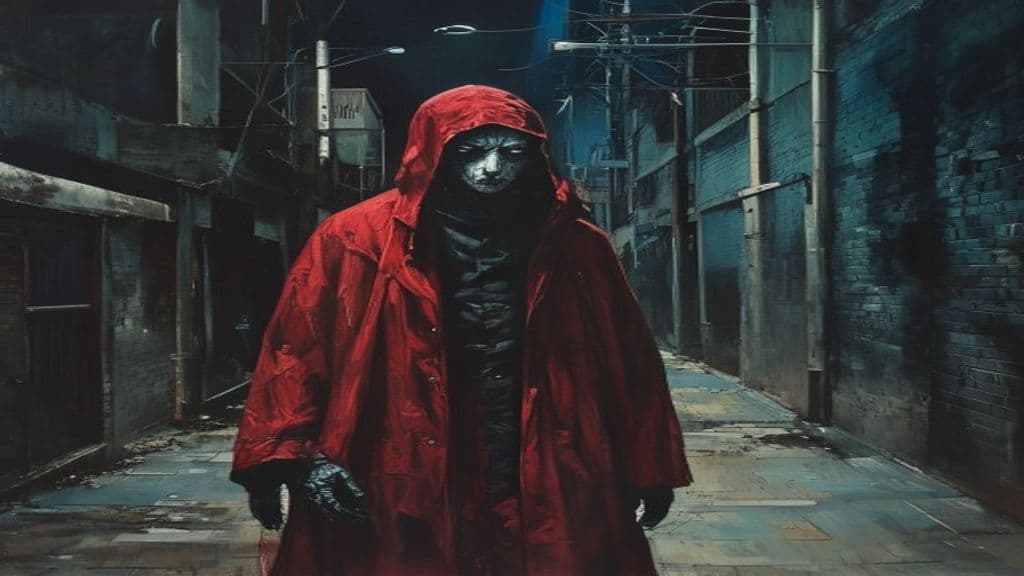
Aka Manto
Aka Manto (赤マント, "Red Cloak") is a Japanese urban legend and schoolyard ghost-story about a masked, cloaked figure who appears in public or school toilet stalls and forces occupants to choose between colored toilet paper; each choice in the tale produces a violent supernatural consequence. The legend is part of modern popular folklore recorded in school contexts from the 1930s onward rather than a formal religious myth.
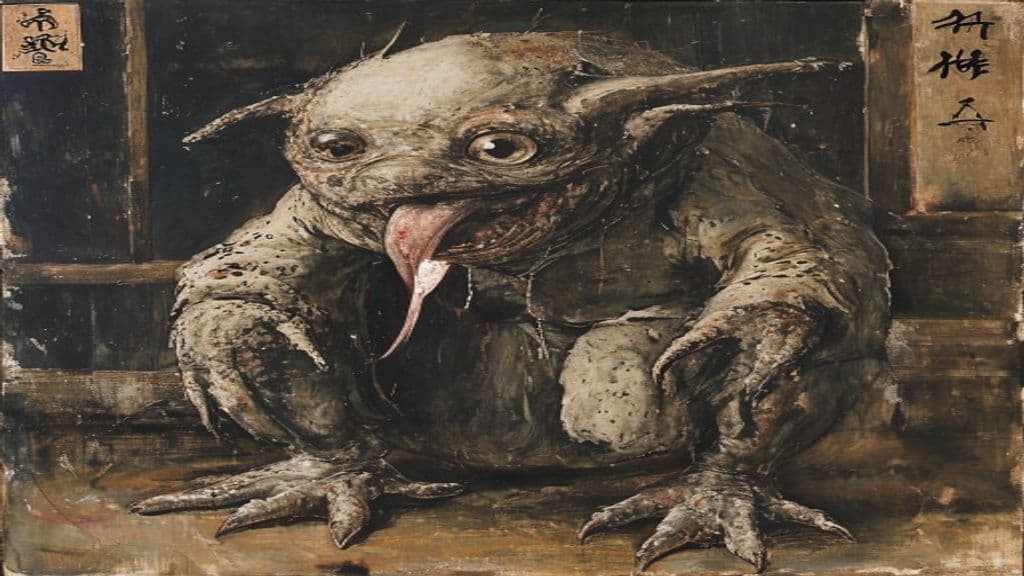
Akaname
Akaname is a Japanese yōkai associated with baths, bathtubs, toilets, and other places where scum and filth accumulate. Traditionally depicted as a child-like creature that licks grime, it functions in folklore as a cautionary figure tied to cleanliness; a few narrative variants cast it as dangerously predatory.

Teke Teke
A Japanese urban-legend onryō of a young woman split in half by a train; she moves by dragging her upper body and produces a scratching 'teke teke' sound while attacking victims, often by slicing them in half to mirror her own injury. A named variant, Kashima Reiko, haunts bathroom stalls and questions occupants about her missing legs.

La Llorona
The Weeping Woman of Mexican folklore — the ghost of a mother who drowned her children and now wanders rivers and lakes, weeping for them and taking other children she finds at night.

Madam Koi Koi
Madam Koi Koi is a Nigerian urban-legend apparition — a vengeful, site-bound female ghost associated with boarding schools, known for the distinctive clicking of red high heels. Tales present her as a punitive presence that haunts dormitories, hallways and toilets at night and as a cultural warning about nocturnal transgressions and unresolved injustice.

Bloody Mary
A mirror-associated apparition invoked by chanting a female name in dim or candlelit conditions. Originating in catoptromantic divination practices, the figure functions in modern youth-lore and urban legend as an ambiguous ghost/witch who may reveal future information or enact violent harm on participants.
Haltija
In Finnish mythology, a Haltija is a supernatural guardian that protects specific locations and species, embodying a spirit of preservation within the natural world. (Note: * Power tier: should be "Lesser" instead of "Greater", as Haltijas are described as solitary creatures protecting specific places or species. * Abilities: added information about Haltijas being able t)
Hamadryad
In Greek myth a hamadryad is a tree-associated nymph whose life is bound to a single tree; if that tree dies, the hamadryad dies. They function as localized rural deities enforcing reciprocal human conduct toward trees and may be propitiated by sacrifice when offended.
Hamadryas baboon (tradition)
The hamadryas baboon (Papio hamadryas) is an Old World primate native to the Horn of Africa and southwestern Arabian Peninsula. In ancient Egyptian religious and archaeological contexts baboons are attested as sacred animals kept in temple precincts and represented in votive statuary and funerary catacombs (the Sacred Animal Necropolis at North Saqqara included baboons among its interments and monuments). The cited materials document the species' biological ecology and its institutional cultic treatment in temple and necropolis contexts but do not supply mythic origin narratives or ritual liturgies specific to the species.
Haman
Haman is the chief antagonist of the Book of Esther: a high Persian court official who secures a royal decree to annihilate the Jews and is ultimately executed on the very gallows he prepared for his enemy. In later rabbinic tradition he is expanded into a symbol of pride, idolatry, divinatory practice, and ancestral enmity linked to Agag/Amalek.
Hamet (Hamut)
The name Hamet (variant Hamut) appears in modern reference sources as a personal name and in several toponyms. The provided sources do not document any folkloric or supernatural entity called Hamet/Hamut, so no reliable ethnographic or mythological description is available from the supplied material.
Hamr (Norse)
In Norse mythology, Hamr is a manifestation of one's mental or spiritual essence that can take shape outside the body, enabling magical transformation and disguise. (Note: 1. Power tier: Downgrade to Lesser (local spirit) - Primordial implies cosmic or universal power, which doesn't match the description. 2. Origin story: Add "According to some interpretations" or rephr)
Hanan (lexical element; as in Hanan Pacha)
Hanan is not attested in the provided sources as an independent goddess. In the Andean/Quechua material within the corpus, hanan functions as a lexical/ontological element meaning the 'upper' or 'higher' realm (as in Hanan Pacha, the Higher World) and appears in compound epithets linking deities (e.g., Inti Hanan Pacha) to that higher world.
Hanbi
A scarcely attested Mesopotamian figure described in modern summaries as the "lord of evil" and as the father of the better-known spirit Pazuzu; preserved mainly in classificatory or genealogical statements rather than narrative myth. Modern commentators sometimes (tentatively) compare him to later Near Eastern concepts of malign shadow-spirits, but primary attestations are fragmentary.
Haneunim / Hananim
Haneunim (하느님) or Hananim (하나님) is the sky god in Korean mythology presented as the supreme heavenly deity. The figure functions as the Lord of Sky in older Korean cosmology, appears in the Dangun foundation myth (via the closely related Hwanin/Hwanung genealogy), and is identified in syncretic religious contexts with high deities such as Indra (Śakra), the Jade Emperor (Okhwang Sangje), and is named in modern Korean religions including Cheondoism and Jeungsanism; the terms have also been used as Korean translations for the Christian concept of God.
Hang Jebat
Hang Jebat is a legendary Malaccan warrior of the early 15th century notable in Malay court literature for his martial prowess and for rebelling against what he perceived as an unjust sultan after the apparent execution of his friend Hang Tuah. The figure embodies a moral tension between loyalty to ruler and opposition to tyranny and is commemorated in modern Malaysian and Singaporean toponyms and institutions.
Hang Tuah
Hang Tuah is a legendary Malay warrior-admiral and court retainer remembered in the Hikayat Hang Tuah and the Sejarah Melayu; he functions as an idealized silat master, diplomat, and exemplar of loyalty associated with 15th‑century Malacca. The figure appears in narrative cycles that mix court historiography and wonder-tale elements (notably an enchanted kris), while his actual historicity remains debated in scholarship.
Haniel
Haniel is an angelic figure in Jewish and later Western angelology, traditionally counted among the seven archangels. The figure is associated with the planet Venus and is described as the governing archangel of the Kabbalistic sephirah Netzach, embodying qualities of grace, charm, and joy and appearing in later Renaissance esoteric apparatus such as John Dee's Sigillum Dei Aemeth.
Community Record
- [1]Hanako-san. Wikipedia: 'Hanako-san' article (summary and quoted passages as cited in research notes)wiki
- [2]Hanako-san (Wikidata). Wikidata entry for Hanako-san (metadata referenced in research notes)other
- [3]CNN / Archive references (metadata provided in research notes). Archive listings included in research notes (no substantive Hanako-san material provided in supplied excerpts)other