
The sources identify Akṣayakumara as the youngest son of Rāvaṇa and the brother of Meghnāda (Indrajit). He appears in the Ramayana narrative during Hanuman's raid in Lanka: when Hanuman begins to damage the Ashoka Vatika after speaking with Sītā, Rāvaṇa sends Akṣayakumara to lead Rakshasa forces against him. The provided excerpts do not supply a separate cosmogonic or supernatural origin for Akṣayakumara beyond his placement as a royal son within Rāvaṇa's Rakshasa household.
The supplied accounts describe him chiefly by age and role: a warrior of about sixteen, the youngest son of Rāvaṇa, who departs for battle in his chariot and employs various weapons against Hanuman. The sources do not give further physical details (height, attire, distinguishing marks) beyond his status as a chariot-riding combatant.
In the episode he demonstrates conventional martial skill and valor: he engages Hanuman in combat, aims and uses various weapons, and fights from his chariot. One summary notes that Hanuman was impressed by the young prince's valor and skills. The provided materials do not attribute supernatural powers, magical abilities, or immortality to Akṣayakumara; he is portrayed as a mortal warrior who is slain in the encounter.
Weaknesses
- conditionmortality (killed by Hanuman)
Wards
None recorded.
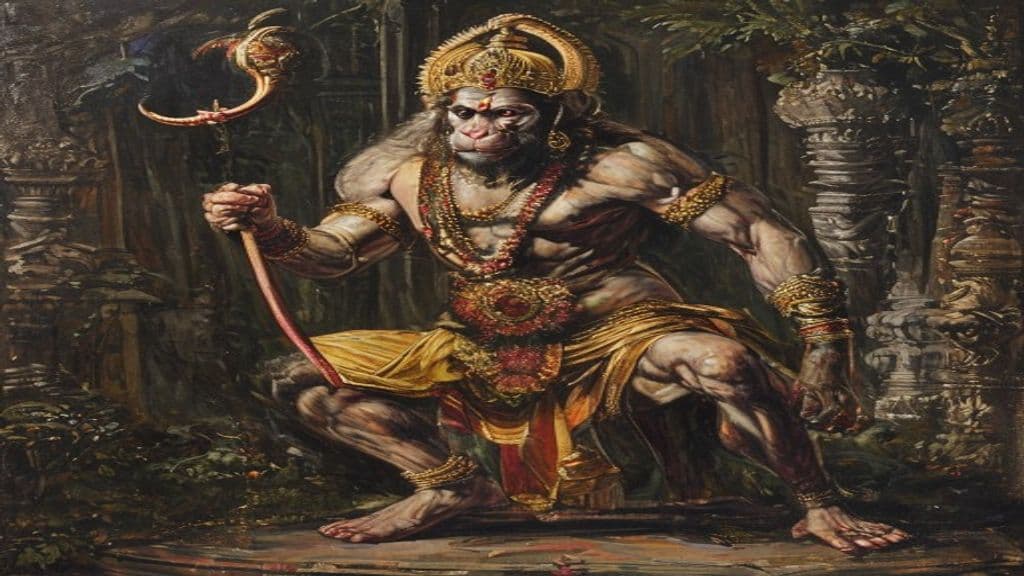
Kausalyā
Kausalyā is a human royal figure in the Ramayana tradition: the senior queen consort of King Daśaratha of Kosala and the mother of Rāma. In the Ayodhyā Kāṇḍa episodes cited she appears as a ritual participant and as a mother whose emotional speech and lamentation shape courtly responses to calamity.
Akuma
Akuma (悪魔/あくま) in Japanese sources is an evil spirit, devil, or demon associated with misfortune and mental disturbance. The term appears in Buddhist texts and Heian-period literature and was later used to translate the Christian figure of Satan, as well as the Buddhist Mara.
Akura-ō
No verifiable folkloric or literary entity named Akura-ō is documented in the supplied sources. The string "akura" appears only as a modern musical credit and as OCR artifacts in archival material; there is no authoritative description of an Akura-ō in the provided documents.
Akuro-ō
Akuro-ō is a fragmentarily attested label appearing in a secondary database gloss as 'Emishi's chief or ogre.' Surviving references are inconsistent and do not supply primary folkloric narratives, descriptions, or rituals; other supplied materials that mention demons or demon-rulers do not refer to Akuro-ō. This entry treats Akuro-ō as a probable secondary/database attestation rather than a well-documented traditional figure.
Akurojin-no-hi
Akurojin-no-hi (悪路神の火, "fire of the god of the bad road") is a flamelike ghost from the folklore of Mie Prefecture, Japan. It is reported to appear on rainy nights; those who encounter it and do not run away are said to become gravely ill. The phenomenon is sparsely documented and is usually compared to will-o'-the-wisp type ghost-lights.
Akvan Div
Akvan Div is a named div (دیو) from the Persian epic Shahnameh who confronts the hero Rostam during the era of Kay Khosrow. In the tale Akvan appears among onager herds, can vanish or assume forms such as a brilliant onager, wind, or storm, and is ultimately snared with a lasso and beheaded by Rostam.
Akycha
Akycha is identified in the supplied sources as a solar goddess in Inuit mythology. The available materials attest the name and classification but provide no further narrative, iconographic, or ritual detail.
Al (Alı)
No folkloric or ethnographic evidence for a supernatural entity named "Al" or "Alı" is present in the supplied source set. The available materials are modern biographical, political, linguistic, and religious texts that do not describe a Turkish spirit, demon, or other supernatural being by this name.
Al (Georgian Tradition)
In Georgian tradition, Al is a supernatural entity that interferes with human reproduction, acting as a demon of childbirth. (Note: - Power tier should be "Ancient" (Al is a demon of childbirth, but not cosmic-level) - Abilities need to specify that Als can cause spontaneous abortions, stillbirths, and infant mortality, as stated )
Al-Abyad
Al-Abyad (Arabic: al‑Abyad, "the White") appears in modern compilations and anecdotal references as a named jinn or epithet within Arabic/Islamic discourse on jinn. The corpus consists mainly of contemporary lists, forum posts, popular articles, and a polemical anecdote; no coherent classical origin myth or primary ritual tradition for Al-Abyad is attested in the supplied materials.
Al-Haddar
Al-Haddar is documented in the provided sources primarily as (a) an impact crater on Saturn's moon Enceladus named after a character from The Book of One Thousand and One Nights, and (b) as a personal or author name appearing on Arabic devotional manuscript titles. The sources do not present Al-Haddar as a supernatural being within any folkloric cosmology.
Al-Jann
Al-Jann (Jann) is a primordial, pre‑Adamite class of beings in Islamic/Arab folkloric tradition presented as the ancestor or earlier population from which the jinn derive. They are said to have inhabited the earth before Adam and in at least one account were ruled by a king named Jann ibn Jann; some folkloric variants describe them as punished and turned into the weakest class of jinn.
Community Record
- [1]Akshayakumara - Wikipedia. Wikipedia, 'Akshayakumara'wiki
- [2]Akshayakumara (Wikidata). Wikidata entry Q2587152 for Akshayakumaraother
- [3]Sri Sundara Kanda is nothing but Kundalini yoga : Seshendra Sharma (archive). Archive.org copy of Seshendra Sharma, commentary on Sundara Kandaother
- [4]VAHINI.ORG: RAMAKATHA RASAVAHINI-2 CHAPTER7b. Vahini.org, Ramakatha Rasavahini-2 Chapter 7bother
- [5]VAHINI.ORG: RAMAKATHA RASAVAHINI-2 CHAPTER6a. Vahini.org, Ramakatha Rasavahini-2 Chapter 6aother