
Greek poetic tradition portrays Alala as a personified force of warfare. Pindar is reported to present her as a daughter of Polemos (the personification of war), a formulation that situates her within the family and entourage of martial personifications rather than as an independent cult-figure. The surviving testimony is poetic and descriptive rather than narrative: Alala exists as the cry itself rendered into a named presence associated with battle.
Ancient sources and modern summaries treat Alala functionally and poetically rather than providing a physical description. She is listed among Ares' attendants on the battlefield, but no surviving source included in the supplied material gives bodily features, clothing, or iconographic detail; her depiction in the literature is primarily as the audible war-cry incarnate.
Alala's 'power' is the embodiment of the battle-cry: the sound soldiers raise to terrify enemies and rally comrades. Poetic testimony (notably Pindar as summarized) characterizes her as a 'prelude to spears' and associates her with the sacrificial imagery of death offered for the city, linking the cry with the ritual and civic dimensions of martial killing. She functions alongside other personified wartime forces (fear, dread, discord, manslaughter) as part of Ares' entourage.
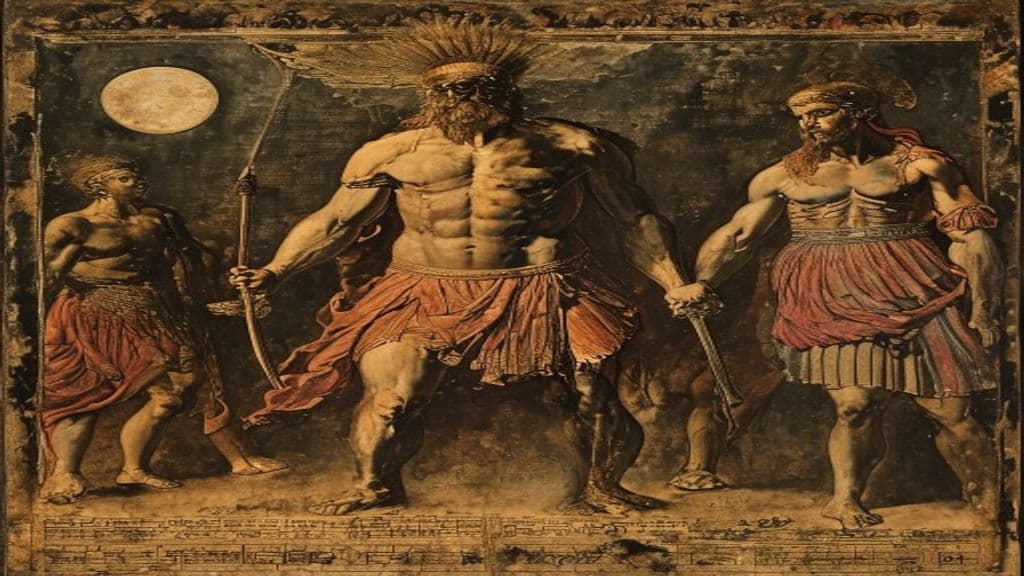
Androktasiai
Androktasiai (Ἀνδροκτασίαι, sing. Androktasia) are plural personifications in ancient Greek poetry that embody manslaughters or the slayings of men in battle. They appear chiefly as named offspring of Eris in Hesiod's Theogony and as elements in Homeric/Hesiodic ekphrasis (the Shield of Heracles), functioning as poetic embodiments of wartime slaughter rather than individualized cult-deities.

Keres
In Greek myth the Keres (Κῆρες; singular Κήρ) are night-born, malevolent death-spirits associated with violent death, pestilence, and the ravaging aspects of mortality; they are often portrayed as a swarm of blood‑thirsty female spirits that hover over battlefields and seize the dead and dying.
Aladdin
Aladdin is the human protagonist of a Middle Eastern folktale (ATU 561) who rises from poverty to wealth after acquiring a magical ring and a magical lamp that house spirit-agents. Although widely associated with The Thousand and One Nights, the tale entered that corpus via Antoine Galland from a story told by the Syrian storyteller Hanna Diyab rather than from the earliest Arabic Nights manuscripts.
Alaisiagae
A group of Germanic female deities attested in Roman Britain, worshipped by continental auxiliary troops at a shrine near Vercovicium (Housesteads) on Hadrian's Wall. Epigraphic evidence records dedications to named members (Beda, Fimmilena, and in other lists Baudihillia and Friagabis) alongside Mars Thincsus and the numen of the emperor; modern scholarship interprets them variously as war/victory goddesses, as goddesses associated with assembly/justice, or as part of Matronae‑type fertility/ancestor cults.
Alaka (Hindu tradition)
Mythical city in Hindu cosmology, dwelling place of Kubera and ruler of the yakshas. (Note: - Power tier: Primordial (Alaka's splendor rivals Amaravati, which is a capital of a cosmic deity; thus, it should be categorized as Primordial) - Abilities: The text states Alaka has grandeur and maj)
Alakh Niranjan
A doctrinal and devotional formula in the Nath-yogi tradition denoting the unseen, unblemished ultimate reality (Nirguna Brahman/Atman). Used as a salutational invocation, theological name, and signifier of realised Self rather than a personified supernatural being.
Alaksandu
Alaksandu is attested in Hittite diplomatic texts as a historical king of Wilusa (commonly identified with Late Bronze Age Troy) who concluded a treaty with the Hittite king Muwatalli II ca. 1280 BCE. The name appears non-Anatolian and has been plausibly identified as a Hittite transcription of Greek Alexandros, a point used in scholarship to link a historical ruler with later Homeric Alexandros/Paris.
Alakshmi
Alakshmi is an inauspicious female supernatural figure in Hindu tradition, presented as the negation or shadow-counterpart of the prosperity-goddess Lakshmi. She personifies poverty, grief, jealousy and social discord and is managed in domestic ritual and festival practice.
Alalcomenes
Alalcomenes (also Alalcomeneus) is an eponymous autochthonous figure from ancient Greek tradition associated with Boeotia, cited as the name-giver of the town Alalcomenae. Sources treat him as a local foundational or etiological figure rather than as an active mythic agent with narrated deeds.
Alalu
Alalu (also Alala/Alal) is a primordial, ancestral god attested in Mesopotamian, Hurrian and Hittite sources. He appears in genealogical lists as an early progenitor of later sky-gods and in Hurrian myth (the Kumarbi Cycle) as a former 'king in heaven' overthrown and forced to flee to the underworld.
Alamelu
Alamelu (also Alamelu Manga / Alarmel Mangai) is a South Indian devotional name for the goddess Padmavati, identified in sources as an avatar of Lakshmi and the consort of Venkateswara; the name is also used widely as a female personal name and in titles of cultural works in Tamil and Telugu contexts.
Alammuš
Alammuš is a Mesopotamian deity who functioned as the sukkal (attendant or court-official deity) of the moon god Nanna (Akkadian Sin). He is attested in offering lists, god-lists, oath formulas, legal and seal texts, and in Mesopotamian astronomical lists where he is paired with Ningublaga as the 'Little Twins.'
Alan
A class of non‑human spirit-beings in Tinguian (Philipine) folklore associated with reproductive wastes and springs; said to transform discarded menstrual blood, afterbirth, or miscarried tissue into human children whom they rear, and to dwell in fine houses near springs. Key described features include wings and backward-pointing fingers and toes.
Alan Scott
Alan Scott is a fictional American comic-book superhero, the original bearer of the Green Lantern name, created by Martin Nodell and Bill Finger and debuting in All-American Comics #16 (July 10, 1940). He is a Golden Age costumed crimefighter who uses a mystical ring recharged from a green lantern and served as a founding member and early leader of the Justice Society of America.
Community Record
- [1]Alala. Wikipedia, 'Alala' (entry summarising ancient Greek personification and citing Pindar and other literary attestations).wiki
- [2]Alala (Wikidata). Wikidata entry for Alala, linked data record corresponding to the personification of the war-cry.other