
In Mesopotamian god-lists Alalu (Alala) occurs among remote ancestral gods and is paired with figures such as Belili; these lists present him as part of a predecessor generation to major sky-gods like Anu. In Hurrian reception (as preserved in Hittite transmission) the Kumarbi Cycle names Alalu as an early king of the gods who ruled 'in heaven' until, in the ninth year of his reign, his cup-bearer Anu overthrew him; Alalu then fled to the Dark Earth (the underworld). After this overthrow Alalu has no sustained narrative role in the surviving account. Scholarship treats him as a primeval ancestral figure whose precise origin and etymology are uncertain.
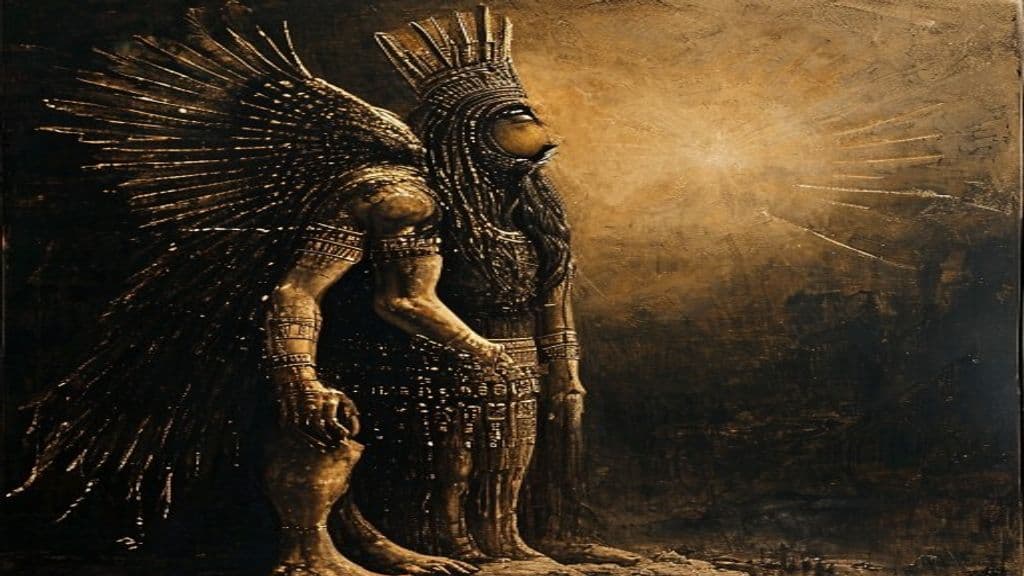
No consistent iconographic description of Alalu is preserved in the cited sources. He is counted among the group of primeval gods depicted collectively on the Yazılıkaya reliefs in the Hurrian/Hittite context, but surviving imagery does not provide individually labeled visual features for him. Mesopotamian textual excerpts in the provided material likewise do not supply a vivid physical description.
Attestations present Alalu primarily in genealogical and ritual terms rather than as an active magician or combatant. He functions as a primordial king and ancestor—an early sovereign whose authority predates the familiar pantheon—and is invoked in texts as a marker of deep antiquity. In Hurrian/Hittite ritual contexts he appears among the enna turena ('primeval gods') who could be listed as divine witnesses in treaties and ritual formulas; in these roles he serves as an authoritative ancestral witness rather than an active juridical agent. The sources do not enumerate specific magical powers.
Weaknesses
- otherNo specific weaknesses recorded in the cited sources
Wards
- otherNo specific protective wards or anti‑Alalu rites are recorded in the provided material
Anu
Anu (Sumerian An; Akkadian Anu/Anum) is the divine personification of the sky in ancient Mesopotamian religion, traditionally ranked at the top of god‑lists as the source of heavenly authority (anûtu/anuti) and the fount of legitimate rule for gods and kings. Though supreme in genealogies and astronomical schema, many periods portray him as a relatively passive or figurehead deity whose active cultic role is limited until a late Seleucid reinvention in Uruk.

Enmesharra
Enmesharra is a Mesopotamian theogonic and ancestral deity, presented in texts as a member of an older generation of gods associated with the underworld and with earlier or superseded divine prerogatives summed up by the Sumerian term me.
'Ain Samiya Goblet
Silver cup from the Middle Bronze Age I, discovered in a tomb at Ain Samiya. (Note: 1. Power tier should be "None", but add a note explaining that historical artifacts don't fit into the typical power tier classification. 2. Add a description of its appearance based on it being a sil)
Adamma
Adamma is an ancient north‑Syrian goddess attested in Eblaite palace records ca. 2400 BCE and later incorporated into Hurrian and Emar contexts. She functioned as a named cultic deity with an institutional priesthood, a month and festival bearing her name, and documented offerings from the royal palace.
Allani
Allani is a Hurrian goddess who rules the land of the dead and participates in determining mortal fates. She appears in Hurrian ritual life and was incorporated into neighboring Mesopotamian and Anatolian religious corpora under Akkadian forms such as Allatum/Allatu.
Allanzu
Allanzu is a Hurrian youthful goddess, daughter of Ḫepat and Teshub, attested in Hurrian ritual lists and later worshiped by Hittites and Luwians (as Alasuwa). She functions primarily as a cultic daughter-figure within the household of Ḫepat and appears alongside family members in offerings and temple contexts.
Allatum (Allani / Allatu)
Allani (Hurrian) or Allatu/Allatum (Akkadian/Mesopotamian) is a Near Eastern underworld goddess associated with rulership of the land of the dead and with determination of fate. She appears across Hurrian, Mesopotamian and Hittite/Anatolian contexts and is closely linked with other chthonic deities such as Išḫara and Ereshkigal.
Ammarik
Ammarik (also Ammarig, Hammarigu; later Armaruk/‘lord of Armaruk’) is an ancient Eblaite deity most likely representing a deified mountain attested in third-millennium BCE Eblaite texts and later Hurrian and Hittite sources. He appears in Eblaite offering lists and an incantation context allied with weather cults and apotropaic ritual action.
Appu (Hurrian)
Appu is the central figure of a fragmentary myth preserved in Hittite archives as CTH 360 and conventionally regarded by scholars as reflecting a Hurrian tale. The text survives in Hittite-language form, is incomplete, and provides few concrete details about the character beyond its role as the story's protagonist.
Apsu (Abzu)
Apsu (Sumerian Abzû; Akkadian Apsu) is the primeval freshwater principle in Mesopotamian cosmology, conceived both as the subterranean freshwater ocean/aquifer and as a hypostatic divine presence. Paired with the saltwater Tiamat, Apsu is a progenitor of earlier divine generations and the source of lakes, springs, rivers, rain and floodwaters; in Enūma Eliš he is slain by the younger god Ea and his domain becomes Ea's dwelling.
Ara
Ara (Sumerian: A) is a minor Mesopotamian goddess attested as a servant or attendant of the god Enki. Earlier scholarship sometimes conflated her theonym with the attendant deity Isimud, but modern treatments distinguish Ara as a separate divine household figure.
Aranzaḫ
Aranzaḫ is the Hurrian divine personification of the river Tigris, treated in Hurrian religion as a numen and river-god who appears in the Kumarbi Cycle and as an ally-protector in the tale of Gurparanzaḫ. The figure is attested in Hurrian theophoric names and is discussed in scholarship in relation to later regional cultic references to the Tigris source.
Aya
Aya is a Mesopotamian goddess associated with the dawn and worshiped as the consort of the sun god Shamash. She is principally attested in the city of Sippar, appears in royal inscriptions there, and was incorporated into Hurrian religion as the wife of the Hurrian sun Šimige.
Aštabi
Aštabi is an ancient Near Eastern deity attested in Eblaite, Hurrian, Ugaritic, and Hittite contexts. In later Hurrian and Hittite sources he functions as a war god and participant in divine assemblies and mythic combat; in the earliest Eblaite documents his precise original character is unresolved though he had named cult centers and cultic statues.
Community Record
- [1]Alalu (Wikipedia). Wikipedia entry 'Alalu'wiki
- [2]Wikidata: Alalu. Wikidata entry for Alaluother