No fully elaborated indigenous origin myth for Algol is preserved in the supplied materials. The sources state that in some Greek commentary Algol was associated with a Gorgon and that in Arabic tradition it was likened to a ghoul-like creature; these associations imply that its conspicuous and varying brightness was interpreted as ominous in those cultural discourses. Historical astronomical record shows progressively empirical attention: disputed claims of very early (Egyptian calendar) recognition, silence or neutrality in some medieval star catalogues (al‑Sufi), observational notation of variability in the 17th century (Geminiano Montanari) and the identification of an eclipsing mechanism by John Goodricke (1783). The supplied sources therefore present Algol's 'origin' as a convergence of ancient omen-bearing labels and later scientific explanation rather than a single, preserved mythic narrative.
Astronomically, Algol is a bright naked-eye star in Perseus (Beta Persei). It is a three-star system (components Aa1, Aa2, Ab): the close eclipsing pair consists of a hot luminous primary (Aa1, B8 main-sequence) and a cooler, larger fainter secondary (Aa2, K0 subgiant) whose mutual orbit produces regular eclipses as seen from Earth; the system's apparent magnitude typically about 2.1 and drops to about 3.4 during the roughly ten-hour-long eclipse every ~2.86 days. A third star (Ab) orbits more distantly. In folkloric terms the supplied materials record only generalized monstrous associations (Gorgon, ghoul) and do not preserve a consistent humanoid or detailed physical description beyond those labels.
Observable astrophysical behaviors (well documented): Algol displays periodic brightness variability caused by eclipses (period ≈ 2.86 days, eclipse duration ~10 hours), X-ray and radio flares tied to magnetic and chromospheric activity, mass transfer between the close pair (accounting for the so-called "Algol paradox" in stellar evolution) and spectroscopic signatures used in Doppler studies. Cultural attributions recorded in the sources are limited to its reputation as ominous or demon-like (association with Gorgon imagery in Greek commentary and ghoul-like imagery in Arabic tradition); the sources do not record agentive supernatural acts, rituals, or direct interpersonal interactions by Algol as an entity.
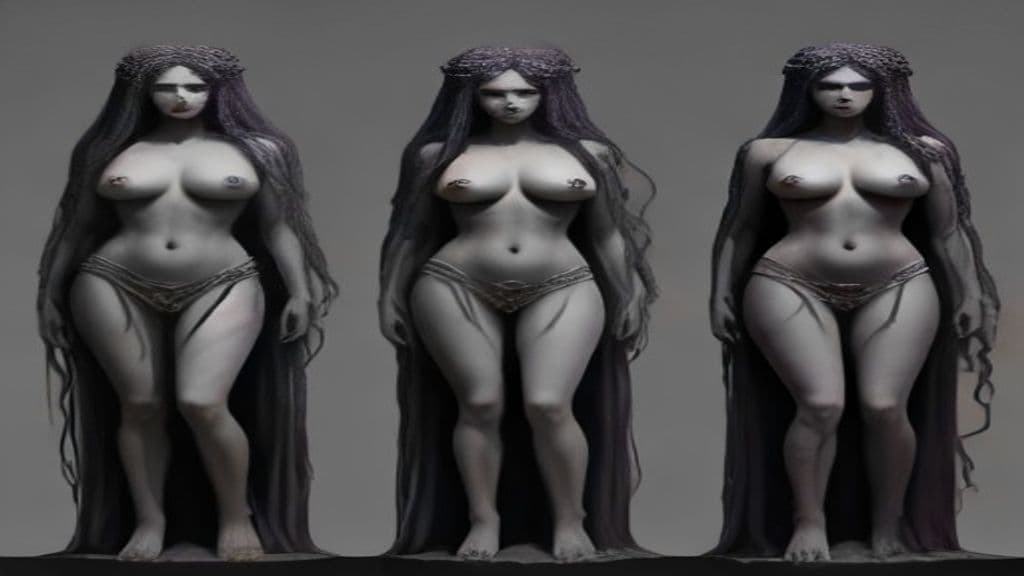
Gorgons
In classical Greek myth a trio of monstrous sisters—Stheno, Euryale, and Medusa—daughters of Phorcys and Ceto, famed for a petrifying gaze; Medusa is mortal and slain by Perseus while her sisters are described as immortal. The name has been widely reused in modern culture for characters, bands, and projects.

Ghoul
A ghoul is a demon-like or monstrous humanoid originating in pre-Islamic Arabian religion, traditionally associated with graveyards and the consumption of human flesh. The concept later entered broader folklore and has been widely reused and transformed in modern fiction and popular culture.
*Péh₂usōn (reconstructed)
Péh₂usōn is a hypothetical Proto‑Indo‑European pastoral guardian reconstructed by comparative scholars from parallels in Greek and Vedic traditions. Proposed as a Graeco‑Aryan ancestor‑figure, the reconstruction describes a protector of flocks, roads, and travellers rather than an attested historical cultic personality.
3-D Man
3-D Man is a Marvel Comics superhero identity associated with a 1950s-era origin in which the body of Chuck Chandler can materialize in three-dimensional existence when activated by his brother Hal via a pair of glasses. The mantle was later assumed by Delroy Garrett (formerly Triathlon) in modern continuity.
5 Ronin
5 Ronin is a 2011 Marvel Comics five-issue limited series that reimagines five Marvel superhero archetypes as rōnin (masterless samurai) in a fictionalized post‑Sekigahara feudal Japan. The work places Wolverine, Hulk, Punisher, Psylocke, and Deadpool analogues into period roles to explore displacement, revenge, and identity in an era of political upheaval.
58 Concordia
58 Concordia is a fairly large main-belt asteroid orbiting the Sun, discovered in 1860 and named after the Roman goddess Concordia. Astronomical sources classify it as a C-type (carbonaceous) body with a multi-year orbital period and measurable rotation and pole orientations.
9MOTHER9HORSE9EYES9
An anonymous Reddit screen name and online persona used by the author of the Interface series, a multipart speculative-horror narrative posted in short installments across Reddit in 2016. The name functions as the signature of an authorial identity and as a focal label for a fandom that created archives, a subreddit, and a wiki documenting the story and its fictional phenomena (notably entities called "flesh interfaces").
A.R.G.U.S.
A.R.G.U.S. is a fictional clandestine United States government agency in the DC Comics universe that investigates, contains, and manages superhuman, meta-human, and supernatural incidents and assets. Introduced in The New 52 continuity, it functions as an institutional actor providing intelligence, logistical support, covert task forces (notably Task Force X / the Suicide Squad), and a dedicated magic division across comics and media adaptations.
Aba (disambiguation / name-form)
Aba is a polyvalent name-form attested across many unrelated contexts (place names, personal names, animal names, and brief mythological listings). The provided sources do not support a single, coherent supernatural entity called "Aba" and offer no descriptive or ritual material for such a being.
Ababil
Ababil (Arabic: أبابيل, romanized abābīl) are miraculous birds mentioned in the Qur'anic account of Surah Al‑Fil. In Islamic tradition they appear as a divinely sent avian host that defended the Kaaba by pelting an invading army with small clay stones; tradition places the event in the year traditionally given as 570 CE.
Abadir
Abadir is a polysemous name attested in distinct cultural contexts: a legendary founding saint and clan ancestor in eastern Ethiopia (Sheikh Abadir Umar Al‑Rida / Aw Abadir), a term applied to cone‑shaped cult stones in Phoenician religious description, and a personal name of a martyr (Abadir/Apater) in the Coptic Synaxarium. The attestations are independent usages of the same name rather than a single supernatural being.
Abarbarea
Abarbarea is a name attested in classical Greek and Roman sources for freshwater nymphs (naiads). The name appears for at least two individual mythic figures — a naiad wife of Bucolion and a naiad counted among ancestors of the Tyrians — and Hesychius records plural forms that may indicate the name was also used as a class-name (Abarbareai / Abarbalaiai).
Abas
Abas (Ancient Greek: Ἄβας, gen.: Ἄβαντος) is not a single mythic being but a recurring personal name borne by multiple mortals and minor mythic figures in Greek epic and genealogical traditions — kings, founders, seers, warriors, attendants, a centaur, and a youth transformed by a goddess. The name is glossed in the sources as 'guileless' or 'good-hearted' and appears across Argive, Theban, Trojan, Euboean, and other local cycles.
Abderus
Abderus (Ancient Greek: Ἄβδηρος, romanized Ábdēros) is a mortal heroic figure in Greek myth closely associated with Heracles, remembered as the youth left in charge of the Mares of Diomedes who was killed by them. He functions as an eponymous local/divine-hero ancestor for the city of Abdera and received funerary commemoration and athletic agones at his tomb.
Community Record
- [1]Algol. Wikipedia: Algol — article summarising astronomical properties and historical/cultural associations (Gorgon, ghoul); notes observational history (Montanari, Goodricke) and physical description of the triple system.wiki
- [2]Algol - Beta Persei. Astropixels: Algol (Beta Persei) — summary of magnitude, variability, and system ranking (apparent magnitude ≈ 2.09; eclipse behavior; brightness ranking).other