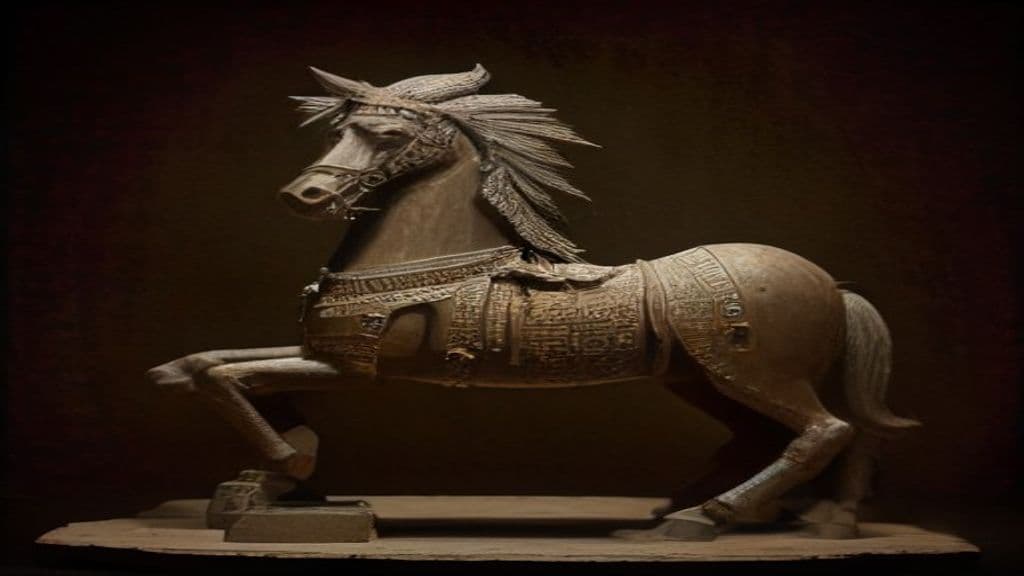
Anticlus appears in the Homeric and post-Homeric tradition as one of the Greek warriors selected to conceal themselves inside the wooden horse used in the stratagem to take Troy. Sources in the epic cycle identify him as a member of the contingent within the horse; some secondary catalogues of Trojan War participants give genealogical notes (sources vary), but the supplied materials treat him primarily as a named combatant within the Trojan Horse episode.
No physical description of Anticlus (height, armor, facial features) is provided in the supplied sources. Descriptively, he is recorded only as one of the Greeks hidden inside the crowded wooden horse brought into Troy, i.e., concealed within the craft alongside other warriors.
The sources attribute no supernatural powers to Anticlus; he is a mortal warrior. His notable behavior in the narrative is a moment of human vulnerability: when Helen circled the horse and imitated the voices of the warriors' wives, Anticlus attempted to answer on hearing the voice of his wife Laodamia. Odysseus prevented him from replying by shutting his mouth with his hands; some accounts say the restraint was so forceful that Anticlus was strangled (variant traditions differ on this detail).
Weaknesses
- conditionemotional susceptibility to hearing a loved one's voice
- conditionbeing physically restrained by a comrade
Wards
- otherphysical restraint by companions (e.g., shutting the mouth)
Achilles
A legendary Greek heroic figure of epic poetry, son of the sea‑nymph Thetis and the mortal Peleus, celebrated as the greatest of the Greek warriors at Troy whose anger and fate shape events in the Trojan War cycle.
Aeneas, Anchises, and Ascanius
Aeneas is a legendary Trojan nobleman, son of the goddess Aphrodite (Venus) and the mortal Anchises; he is portrayed in Greek epic and Roman literary tradition as a divinely favored warrior and a founder-ancestor whose destiny links Troy to the eventual Roman line represented by Romulus and Remus. Anchises is Aeneas' mortal father and a Trojan prince; Ascanius (also called Iulus in Roman tradition) is his son and the next link in the genealogical chain. Together they function in the sources as a familial triad that embodies divine intervention, pietas, and sacred genealogy.
Agenor of Troy
Agenor (Ancient Greek: Ἀγήνώρ) is a mortal Trojan heroic figure in the Greek epic tradition notable for confronting Achilles during a rout in Iliad Book 21; Apollo carries Agenor away in a veil of mist and then impersonates him to distract Achilles, allowing the Trojans to reach safety. Later authors vary about his battlefield kills and his eventual death.
Areilycus (Archilycus)
Areilycus (Ancient Greek Ἀρηίλυκος; also attested Archilycus/Areilykos) is a personal name in Greek epic and later mythography. It appears in two distinct Homeric-era attestations: as a genealogical father of Boeotian leaders (Arcesilaus/Archesilaus and Prothoenor) and as a mortal warrior, son of Menoetius, wounded in the thigh by Patroclus in Iliad Book XVI.
Arizelus
Arizelus (also attested Arizelos, Latinized Arizela) is attested in Greek literary and onomastic sources as a personal name borne by mortal figures. In epic genealogy he is known only as the father (patronym) of the warrior Harpalion; in later literature the name appears as the father of an orator Timarchus. No supernatural attributes are recorded.
Balius and Xanthos
Balius and Xanthos are two named immortal horses in Greek epic associated with Achilles and his charioteer Automedon. Treated as semi-divine companions, they display autonomous behavior in battle and, in one Homeric reference, Xanthus is said to be granted the power of utterance to prophesy Achilles' death.
Briseus
Briseus (Ancient Greek: Βρισεύς or Βρίσης) is a mortal figure in the Trojan War tradition, known primarily as the father of Briseis, a woman taken captive by the Greeks. He appears in Homeric tradition and later commentators, who variably place him in Pedasus or identify him as a priest of Lyrnessus; a later pseudo-historical source (Dictys Cretensis) reports that he hanged himself after losing his daughter.
Clytemnestra
Clytemnestra is a mortal queen of Mycenae in Greek epic and tragic drama, best known for her role in the murder of her husband Agamemnon and for precipitating the cycle of familial vengeance that follows. She appears across Homer and the tragedians (Aeschylus, Sophocles, Euripides) as a politically capable, scheming royal whose actions raise questions of justice, revenge, and social order.
Deiphobos
Deiphobos is a Trojan prince in Greek epic tradition, a son of Priam and Hecuba who fought in the Trojan War. Later epic and post-epic poets (Virgil, Chaucer in allusion) treat his household and fate among the episodes of Troy's sack; classical summaries also record him as a notable warrior who killed several named opponents.
Deiphobus
Deiphobus (Ancient Greek Δηΐφοβος) is a Trojan prince, son of King Priam and Hecuba, attested across Homeric epic and later Greek and Roman narratives as a warrior of the Trojan War. He appears in the Iliad among Trojan leaders, is given expanded roles in post‑Homeric sources (notably Euripides, Dares, Dictys, Malalas) and in Vergil’s Aeneid is depicted posthumously as a horribly mutilated corpse who recounts his death.
Elephenor
Elephenor (Ancient Greek: Ἐλεφήνωρ) is a mortal king of the Abantes of Euboea in Greek mythic-historical tradition, known as a captain of a contingent to the Trojan War, a purifying figure in one homicide episode, and as the subject of variant local foundation or exile traditions after the war.
Eusorus
Eusorus (Ancient Greek Εύσωρος, Eusōros/Eusorus) is an otherwise-unknown named ancestor attested in Greek epic and mythographic genealogies. He functions as a paternal or grandpaternal figure used to anchor the origins of better-known figures such as Aenete, Cyzicus, and Acamas; no myths, deeds, cult, or physical descriptions are recorded for him in the cited sources.
Community Record
- [1]Anticlus — Wikipedia. Wikipedia, entry 'Anticlus' (summary citing Homer, Apollodorus, Tryphiodorus).wiki
- [2]Tryphiodorus fragments (translations). Tryphiodorus fragments as presented on elfinspell.com (voice-imitation motif around the Trojan Horse episode).literary
- [3]Anticlus — Myths of UVic. Mythological catalogue entry summarizing Anticlus as one of the Greeks in the Trojan Horse.other