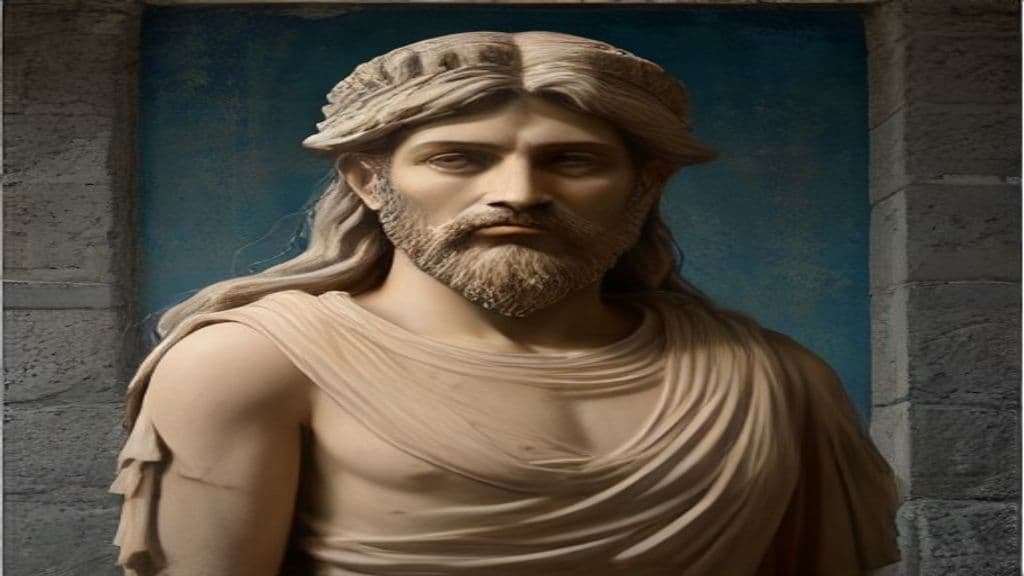
Deiphobus is presented in the literary tradition as a son of Priam and Hecuba, a member of Troy’s royal household and one of Priam’s many sons. In Homer (Iliad) he is enumerated among Trojan leaders and fights in the defense of the city (e.g., leading men with Helenus, engaging near the Argive wall). Later authors expand his role: Dares the Phrygian and Malalas provide descriptive portraits; Dictys Cretensis and other post‑Homeric chroniclers assign him varying parts in episodes such as the death of Achilles; Euripides’ The Trojan Women portrays him as husband to Helen after Paris’ death; Vergil’s Aeneid gives a postmortem account in which the mutilated Deiphobus recounts his death during the sack of Troy. These attestations together trace his literary development from Homeric catalog and battlefield presence into more elaborate tragic and epic characterizations.
Homeric epic itself offers only catalogic naming rather than an extended portrait; later chroniclers provide differing descriptions. Malalas (as cited in summaries) calls him "above average stature, keen‑eyed, somewhat snub‑nosed, dark‑skinned, flat‑faced, brave, good beard." Dares the Phrygian (per later summaries) portrays him as resembling his father with a "handsome face" and as a man of forceful action. Vergil’s Aeneid presents a posthumous image of Deiphobus "horribly mutilated" following the sack of Troy. These portrayals are variant and derive from distinct, largely post‑Homeric traditions.
Deiphobus is consistently attested as a mortal warrior and military leader among the Trojan princes: in the Iliad he fights alongside other leaders (at times with his brother Helenus), takes part in assaults on the Greek wall, and is named among those who wound or engage Achaean heroes. He is not depicted as possessing supernatural powers in the cited sources; his literary function includes serving as the identity Athena mimics in Iliad Book XXII to deceive Hector, and in later narratives he is variously involved in episodes concerning Helen, Achilles’ death (a contested, later attribution), and the sack of Troy.
Weaknesses
- conditionmortality (vulnerable in battle)
Wards
None recorded.
Achaemenides
Achaemenides is a literary mortal figure introduced into Virgil's Aeneid as a marooned member of Odysseus' crew whom Aeneas rescues on Sicily. In Roman epic he functions as a chance survivor and eyewitness who helps link the Homeric tradition to the Trojan refugees and to illustrate Aeneas' magnanimity.
Achates
Achates is the faithful human companion and attendant of Aeneas in Virgil's Aeneid, conventionally known by the epithet 'fidus Achates' and used in Latin literature as the by-word for an intimate, loyal companion.
Achilles
A legendary Greek heroic figure of epic poetry, son of the sea‑nymph Thetis and the mortal Peleus, celebrated as the greatest of the Greek warriors at Troy whose anger and fate shape events in the Trojan War cycle.
Adrastus
Adrastus (Ancient Greek: Ἄδραστος or Ἄδρηστος) is a legendary king of Argos in the Greek mythic-historical tradition, best known as the leader of the expedition of the Seven against Thebes and as a figure tied to oracular counsel, dynastic marriages, and local hero cults.
Aegisthus
Aegisthus (Greek Αἴγισθος, Aigisthos) is a mortal member of the House of Atreus in Greek myth who, born of incestuous circumstances and raised by shepherds and a goat, participates in dynastic murder and usurpation — notably the slaying of Atreus in some accounts and the conspiracy (with Clytemnestra) that results in Agamemnon's death — and is later killed by Orestes, an episode that figures in narratives about inherited guilt, vengeance, and the transition from private retribution to public justice.
Aeneas, Anchises, and Ascanius
Aeneas is a legendary Trojan nobleman, son of the goddess Aphrodite (Venus) and the mortal Anchises; he is portrayed in Greek epic and Roman literary tradition as a divinely favored warrior and a founder-ancestor whose destiny links Troy to the eventual Roman line represented by Romulus and Remus. Anchises is Aeneas' mortal father and a Trojan prince; Ascanius (also called Iulus in Roman tradition) is his son and the next link in the genealogical chain. Together they function in the sources as a familial triad that embodies divine intervention, pietas, and sacred genealogy.
Agamemnon
Agamemnon is the legendary king of Mycenae (or Argos), head of the House of Atreus, and commander of the Achaean forces at Troy in Greek epic and tragedy. His story links dynastic guilt, ritual obligation, and political authority, culminating in the sacrifice-at-Aulis episode and his murder on return from Troy followed by juridical atonement in the Oresteia.
Agenor of Troy
Agenor (Ancient Greek: Ἀγήνώρ) is a mortal Trojan heroic figure in the Greek epic tradition notable for confronting Achilles during a rout in Iliad Book 21; Apollo carries Agenor away in a veil of mist and then impersonates him to distract Achilles, allowing the Trojans to reach safety. Later authors vary about his battlefield kills and his eventual death.
Alcander (Alcandrus)
Alcander or Alcandrus is a personal name borne by several distinct mythic humans in Greek and Roman epic traditions: a Molossian seer who was transformed by Zeus into a wren, a Lycian warrior slain at Troy, and a companion of Aeneas killed in Italy. The entries are separate narrative figures rather than a single recurrent supernatural species.
Anchises
Anchises is a mortal Trojan noble of myth, famed as the father of Aeneas and as a lover of the goddess Aphrodite/Venus; he appears in Greek and Roman epic traditions as a living elder rescued from Troy and later as an advising shade in the Roman underworld vision.
Androgeus
Androgeus is a mythic human name borne by at least two distinct figures in Classical Greek and Roman tradition: a Cretan prince, son of Minos and Pasiphaë, famed for athletic victories and whose death in some accounts is linked to the Marathonian/Cretan bull; and Androgeos, a Greek soldier named by Virgil in the Aeneid who, during the sack of Troy, mistakes Aeneas and his companions for fellow Greeks. Both are mortal figures woven into larger heroic and epic cycles rather than supernatural beings.
Anticlus
Anticlus (Ancient Greek: Ἄντικλος) is a named mortal Greek warrior of the epic Trojan cycle who hid inside the wooden horse at Troy. He is chiefly remembered for nearly revealing the concealed Greeks when Helen imitated the voice of his wife, and for being physically restrained by Odysseus to prevent detection.
Community Record
- [1]Deiphobus — Wikipedia. Wikipedia, article "Deiphobus" (summary of classical accounts and later depictions)wiki
- [2]Wikidata: Deiphobus (Q736813). Wikidata entry Q736813other
- [3]The Iliad, Book XIII. Homer, Iliad, Book XIII (translation available at monadnock.net) — mentions Deiphobus among Trojan leadersliterary
- [4]The Iliad, Book XXII. Homer, Iliad, Book XXII (translation available at monadnock.net) — Athena appears in the shape of Deiphobus to deceive Hector; Hector calls for Deiphobus and finds him absentliterary
- [5]The Fall of Troy (Quintus Smyrnaeus) — selected passages. Quintus Smyrnaeus, Fall of Troy (post‑Homeric epic traditions concerning sack and aftermath)literary
- [6]Virgil, Aeneid — Deiphobus' appearance in the underworld (summary). Vergil’s Aeneid summarized in secondary source (Wikipedia): Deiphobus appears to Aeneas in the underworld, mutilated, and recounts his death during the sack of Troyliterary
- [7]Euripides, The Trojan Women (summary). Euripides’ The Trojan Women (as summarized): Deiphobus is assigned Helen as a wife after Paris’ death; Euripides portrays the marriage as coerced and Helen as "bitterly enslaved"literary
- [8]Malalas and Dares (descriptive traditions, summarized). Malalas (Chronography) and Dares the Phrygian summarized in secondary source: provide later physical descriptions of Deiphobusliterary
- [9]Radio and stage retellings (archival listings). Archive.org listings of dramatic retellings (e.g., radio adaptation of Trojan Horse, stage Troilus and Cressida) confirming modern performances include Deiphobus as a characterother