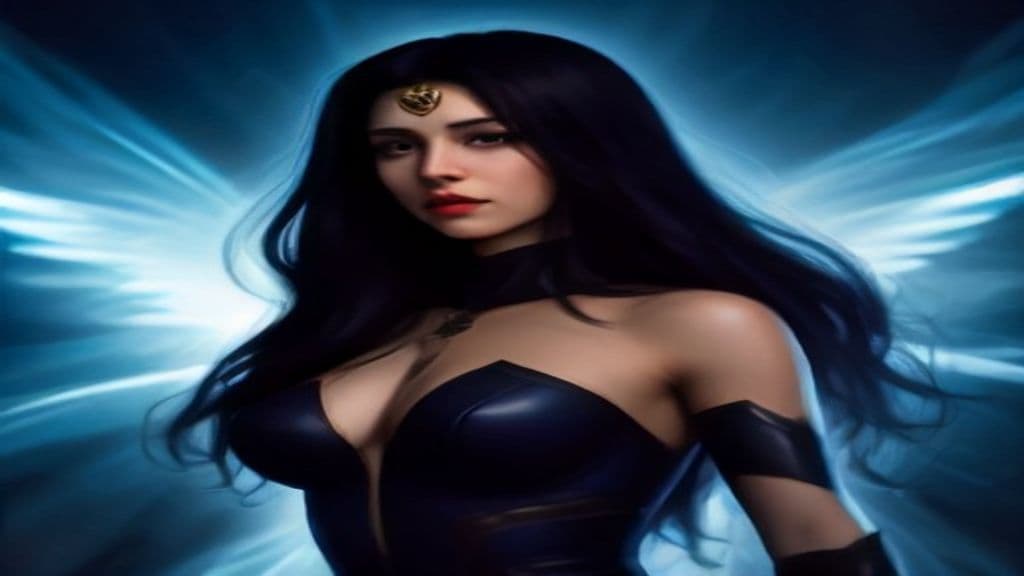
Born Angela Roth in Gotham City, she ran away from home and became involved with a cult that enacted a secret ritual to appeal to the interdimensional being Trigon; she was assaulted/impregnated by Trigon (in human guise) and later attempted suicide. Instead of dying she was taken to the interdimensional temple of Azarath, where she changed her name to Arella (described in-universe as meaning 'Messenger Angel'), gave up her maternal care to the priestess Azar and joined the Azarath community. In later narratives she takes over guardianship of her daughter Raven after Azar's death, establishes a sanctuary ranch for troubled women on Earth, and in at least one storyline sacrifices herself (with Danny Chase) to stop Raven, merging with the souls of Azarath into the composite entity Phantasm (all plot elements summarized from DC Comics sources as recorded in secondary summaries).
Sources do not provide a single, detailed canonical physical description. Summaries describe Arella as a human woman (Angela Roth turned Arella) portrayed across comic-book issues and adaptations in varied visual incarnations; the provided sources note biography and roles rather than consistent physical traits or costume details. Canonical portrayals across media depict her as a mortal female caregiver figure, but the sources supplied lack a definitive, detailed visual specification.
The available sources do not attribute innate supernatural powers to Arella herself; she is consistently characterized as a pacifist, spiritual caregiver, and leader/member of Azarath's community. Her notable narrative acts include giving up direct maternal custody to Azar, later assuming guardianship of Raven, establishing a refuge for troubled women, and participating in a sacrificial merging with the souls of Azarath to form Phantasm in a specific storyline. These events are described as plot developments rather than a catalogue of personal supernatural abilities driven by Arella's inherent powers.
Weaknesses
- conditionHuman vulnerability (trauma, physical harm, victimization by antagonists)
Wards
None recorded.
Ardina
Ardina is a Marvel Comics fictional cosmic/magical construct described in comic-book continuities as a female being formed from the Silver Surfer's energies (Power Cosmic) and appearing in storylines involving the Defenders, the Order, and related Marvel mythic figures.
Arduinna
Arduinna is a local Gallo-Roman tutelary goddess of the Ardennes (Arduenna) — a divine personification of wooded heights — attested in two inscriptions and later equated with the Roman Diana. Iconography associating her with a boar-riding huntress exists in modern literature but the identification is uncertain.
Aredvi Sura Anahita
Aredvi Sura Anahita is the Avestan Yazata of waters and fertility in ancient Iranian religion and Zoroastrianism, praised in the Aban (Aban Yasht) as the mighty, undefiled river and invoked in liturgical offerings to waters.
Aregonis
Aregonis (Ancient Greek: Ἀρηγονίς) is a mythological maternal figure in Greek genealogies, named as the wife of the seer Ampyx and mother of the Argonautic seer Mopsus in the Orphic Argonautica. In other traditions the maternal role is given to a woman called Chloris, reflecting variant naming in transmission.
Areilycus (Archilycus)
Areilycus (Ancient Greek Ἀρηίλυκος; also attested Archilycus/Areilykos) is a personal name in Greek epic and later mythography. It appears in two distinct Homeric-era attestations: as a genealogical father of Boeotian leaders (Arcesilaus/Archesilaus and Prothoenor) and as a mortal warrior, son of Menoetius, wounded in the thigh by Patroclus in Iliad Book XVI.
Areius
Areius (Ancient Greek: Ἀρεῖος) is primarily an epithet used in Greek and Roman cultic and literary contexts, most notably applied to Zeus to denote a warlike or propitiatory/atoning aspect; it also appears as a personal or mythic proper name in classical onomastic and historiographic sources.
Arensnuphis
Arensnuphis (Egyptian Iryhemesnefer, 'the good companion') is a deity originating in the Kingdom of Kush who was incorporated into Egyptian temple contexts in the Ptolemaic Period. He is attested at Musawwarat el-Sufra (3rd century BC) and later worshipped at Philae and Dendur, where he is described as a companion of Isis and syncretized with the Egyptian gods Anhur and Shu.
Ares
Ares (Ancient Greek: Ἄρης) is the ancient Greek Olympian god of war who personifies the physical violence, valor, and bloodlust of combat. Worshiped irregularly across Greece and Asia Minor, he was both honored and ritually restrained by communities that sought to direct his martial power toward protection rather than wanton destruction.
Arestor
Arestor (Ancient Greek: Ἀρέστωρ) is an Argive princely figure in Greek mythic genealogies, known primarily as a forefather and eponymic node connecting the foundation myths of Argos/Mycenae and several heroic-age figures (notably as father of one or more figures named Argus). He functions as a mortal genealogical ancestor in the literary tradition rather than as an independently acting supernatural being.
Arete
Arete is the queen of the Phaeacians (Scheria) in Greek epic tradition, wife of Alcinous and a leading household and civic figure noted for intelligence, hospitality, and influential mediation in matters of sanctuary, marriage, and domestic dispute. Though the people regard her with near-sacral reverence — they 'look upon her as upon a goddess' — the sources present her as an honored human ruler whose authority operates within social and political frameworks of the community.
Arethusa
Arethusa is a freshwater nymph of Greek myth who, pursued by the river-god Alpheus while serving as a chaste attendant of Artemis/Diana, transforms into a spring and emerges on the island of Ortygia (Syracuse). Her myth explains a subterranean link between distant waters and serves as a civic emblem of Syracuse.
Arethusa (Boeotia)
Arethusa (Ἀρέθουσα) in the Boeotian–Chalcidian tradition is a mythic woman whose liaison with a sea-deity (the damaged text is usually restored as Poseidon) and subsequent transformation by Hera form an aetiology for the Arethusa spring at Chalcis. The fragmentary evidence presents her primarily as a toponymic and genealogical figure connecting local cult, landscape, and regional identity.
Community Record
- [1]Arella - Wikipedia. Wikipedia contributors, 'Arella,' Wikipedia, The Free Encyclopedia.wiki
- [2]Arella - Wikidata. Wikidata entry Q1767692, 'Arella'.wiki
- [3]Telangana Government Order (uses of 'Arella' as personal name). Archive: Telangana Government Order, 2016-03-15 (contains unrelated real-world personal names 'Arella').other
- [4]Rainbowarriors (archive reference including name 'Arella'). Archive entry 'Rainbowarriors' (contains unrelated uses of the name 'Arella').other
- [5]Arella Louise Johnson (court docket reference). Archive court docket referencing 'Arella' as a personal name.other