
The surviving sources do not preserve a mythic origin story for Arensnuphis. He is first attested archaeologically at Musawwarat el-Sufra in the 3rd century BC and thereafter appears within Egyptian-controlled cult sites during the Ptolemaic Period; modern descriptions thus emphasize his historical and cultic emergence from Kushite religion into Egyptian temple practice rather than a recorded narrative origin.
Sources describe two principal iconographies: a leonine depiction (described simply as a lion) and an anthropomorphic form often shown wearing a crown of feathers or plumes and sometimes carrying a spear. Henadology notes he is almost always depicted anthropomorphically wearing a crown of plumes, while encyclopedic summaries record both the human-with-feathers and lion depictions.
The sources explicitly state that Arensnuphis's mythological role is unknown and do not provide a catalogue of powers or deeds. From his epithet ('the good companion') and his designation at Philae as the companion of Isis, the surviving evidence presents him functionally as a companion or attendant deity within temple contexts. The sources also report that Egyptians syncretized him with Anhur and Shu, but they do not record specific shared actions or concrete powers drawn from those gods.

Anhur (Onuris)
Anhur, also called Onuris, is an Ancient Egyptian war god worshipped especially at Abydos and Thinis. His name is glossed as "(one who) leads back the distant one," reflecting a myth in which he brings his consort Mehit from Nubia; he appears in Egyptian inscriptional and decorative programs such as polychrome inlays from Ashmunein (Hermopolis).
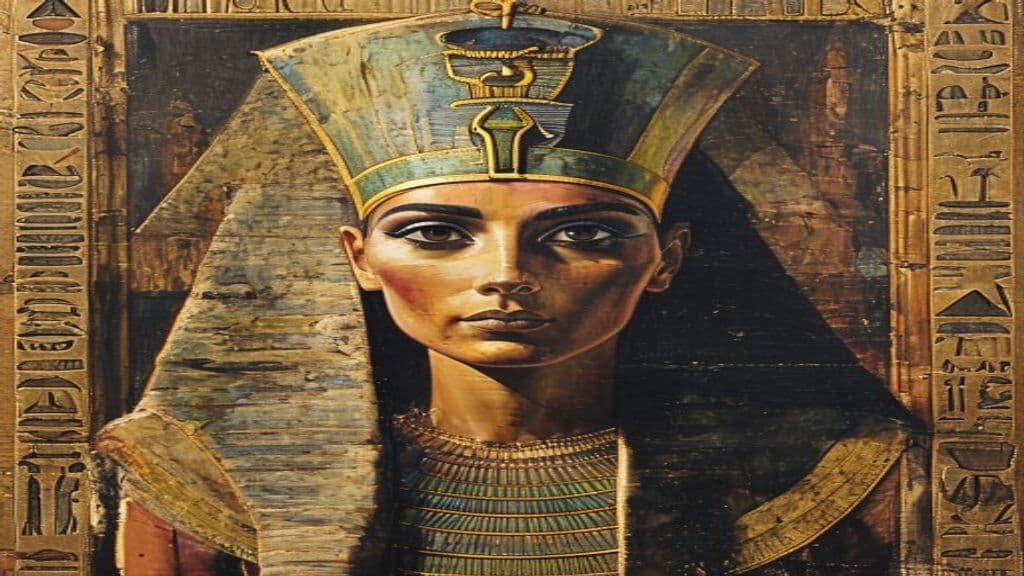
Isis
Isis is a major goddess of ancient Egyptian religion, a member of the Heliopolitan Ennead who functions as sister and consort of Osiris, mother and protector of Horus, a funerary and royal protector, and a locus of potent magic whose cult spread through the Hellenistic and Roman Mediterranean.

Shu
Shu is a primordial deity of the Heliopolitan Ennead in ancient Egyptian religion, commonly identified with the atmosphere, air, and the space that separates sky and earth. He is portrayed in sources as spouse and brother of the goddess Tefnut and is credited in summaries with roles including separating Nut (sky) from Geb (earth), generating wind, and associations with light, dryness/heat, peace, and lions.
Arduinna
Arduinna is a local Gallo-Roman tutelary goddess of the Ardennes (Arduenna) — a divine personification of wooded heights — attested in two inscriptions and later equated with the Roman Diana. Iconography associating her with a boar-riding huntress exists in modern literature but the identification is uncertain.
Aredvi Sura Anahita
Aredvi Sura Anahita is the Avestan Yazata of waters and fertility in ancient Iranian religion and Zoroastrianism, praised in the Aban (Aban Yasht) as the mighty, undefiled river and invoked in liturgical offerings to waters.
Aregonis
Aregonis (Ancient Greek: Ἀρηγονίς) is a mythological maternal figure in Greek genealogies, named as the wife of the seer Ampyx and mother of the Argonautic seer Mopsus in the Orphic Argonautica. In other traditions the maternal role is given to a woman called Chloris, reflecting variant naming in transmission.
Areilycus (Archilycus)
Areilycus (Ancient Greek Ἀρηίλυκος; also attested Archilycus/Areilykos) is a personal name in Greek epic and later mythography. It appears in two distinct Homeric-era attestations: as a genealogical father of Boeotian leaders (Arcesilaus/Archesilaus and Prothoenor) and as a mortal warrior, son of Menoetius, wounded in the thigh by Patroclus in Iliad Book XVI.
Areius
Areius (Ancient Greek: Ἀρεῖος) is primarily an epithet used in Greek and Roman cultic and literary contexts, most notably applied to Zeus to denote a warlike or propitiatory/atoning aspect; it also appears as a personal or mythic proper name in classical onomastic and historiographic sources.
Arella
Arella (born Angela Roth) is a fictional human character from DC Comics, best known as the pacifist mother of the superheroine Raven and a member of the interdimensional spiritual community of Azarath. In-universe she is a mortal woman who assumes a spiritual caregiver role and, in certain storylines, participates in sacrificial events that merge her with collective souls of Azarath (Phantasm).
Ares
Ares (Ancient Greek: Ἄρης) is the ancient Greek Olympian god of war who personifies the physical violence, valor, and bloodlust of combat. Worshiped irregularly across Greece and Asia Minor, he was both honored and ritually restrained by communities that sought to direct his martial power toward protection rather than wanton destruction.
Arestor
Arestor (Ancient Greek: Ἀρέστωρ) is an Argive princely figure in Greek mythic genealogies, known primarily as a forefather and eponymic node connecting the foundation myths of Argos/Mycenae and several heroic-age figures (notably as father of one or more figures named Argus). He functions as a mortal genealogical ancestor in the literary tradition rather than as an independently acting supernatural being.
Arete
Arete is the queen of the Phaeacians (Scheria) in Greek epic tradition, wife of Alcinous and a leading household and civic figure noted for intelligence, hospitality, and influential mediation in matters of sanctuary, marriage, and domestic dispute. Though the people regard her with near-sacral reverence — they 'look upon her as upon a goddess' — the sources present her as an honored human ruler whose authority operates within social and political frameworks of the community.
Arethusa
Arethusa is a freshwater nymph of Greek myth who, pursued by the river-god Alpheus while serving as a chaste attendant of Artemis/Diana, transforms into a spring and emerges on the island of Ortygia (Syracuse). Her myth explains a subterranean link between distant waters and serves as a civic emblem of Syracuse.
Arethusa (Boeotia)
Arethusa (Ἀρέθουσα) in the Boeotian–Chalcidian tradition is a mythic woman whose liaison with a sea-deity (the damaged text is usually restored as Poseidon) and subsequent transformation by Hera form an aetiology for the Arethusa spring at Chalcis. The fragmentary evidence presents her primarily as a toponymic and genealogical figure connecting local cult, landscape, and regional identity.
Aretos
Aretos is an ancient Greek anthroponym borne by several distinct mortal figures in epic and mythographic traditions (princes, warriors, and a king). The name does not denote a unified supernatural being; rather, multiple individuals named Aretos appear across disparate episodes such as the Trojan War, the Argonautic/Bebrycian episode, and Dionysus’ Indian campaign.
Community Record
- [1]Arensnuphis - Wikipedia. Wikipedia, 'Arensnuphis' (accessed via provided research notes)wiki
- [2]Arensnuphis | Henadology. Henadology, 'Arensnuphis' (noting anthropomorphic depictions wearing a crown of plumes)other
- [3]Sebiumeker - Wikipedia (contextual source). Wikipedia, 'Sebiumeker' (cited in research notes as a related Nubian deity in the same cultural space)wiki
- [4]Arensnuphis : God of Companionship - Mythlok. Mythlok, 'Arensnuphis' (summary/encyclopedic webpage repeating key attestations and iconography)other
- [5]ARENSNUPHIS - the Egyptian Tutelary God (Godchecker). Godchecker entry on Arensnuphis (providing summary information cited in research notes)other
- [6]Philae – following hadrian photography. Following Hadrian photography page on Philae (contextual site-photography cited in research notes)other