
The supplied sources do not preserve a detailed origin narrative for Arnapkapfaaluk. What is attested is her functional placement within local cosmology: she occupies the position equivalent to other Arctic 'sea-mother' figures (for example Sedna or Arnakuagsak) for the Coronation Gulf Copper Inuit. Rather than a preserved myth of her birth, marriage, or descent, the literature emphasizes her social role — a principal sea-power whose stance toward humans (fear-inspiring and punitive) regulates access to marine resources. Because explicit cosmogonic or etiological tales for this named figure are not given in the provided material, reconstruction of an origin story is not possible from these sources.
The provided sources give no direct physical description of Arnapkapfaaluk. They do not record specific morphology, clothing, or animal attributes for her. While other regional sea-mother figures (such as Sedna in some traditions) are elsewhere described with partial human/marine form, those descriptions are not attributed to Arnapkapfaaluk in the supplied material and therefore cannot be asserted here. The sources limit themselves to describing her character and powers rather than bodily form.
Sources consistently attribute to Arnapkapfaaluk the power to determine the availability of seals and other marine mammals to Copper Inuit hunters. Her primary mode of action is withholding animals — hunts become unsuccessful when she is angered. This withholding functions as a social and moral sanction: the breaking of a taboo or other indiscretion is reported to result in failed hunts. The literature frames her as fear-inspiring rather than overtly beneficent, and her influence is exercised through control of crucial subsistence resources rather than, for example, direct physical assault or possession narratives in the provided texts.
Weaknesses
None recorded.
Wards
- conditionadherence to cultural taboos and avoidance of indiscretions

Arnakuagsak
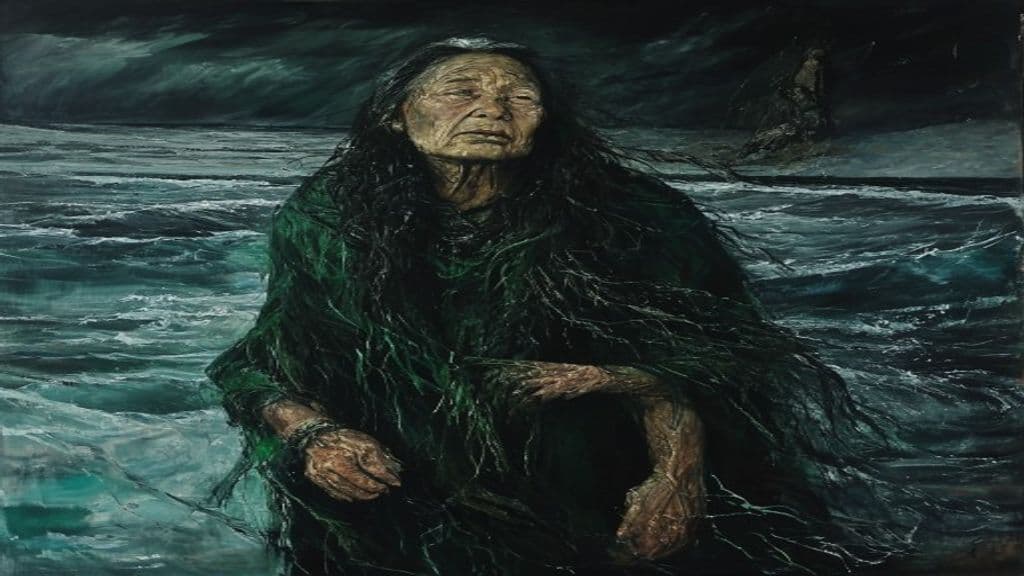
Arnakuagsak is an Inuit sea-mother deity worshipped primarily in Greenland, described as an 'old woman from the sea' who is responsible for ensuring hunters' success and the health and strength of the people. She is treated in sources as essentially equivalent to related sea-mother figures in Canadian and Alaskan Inuit traditions.
Nerrivik
Nerrivik (also Nerivik) is an Inuit sea-mother figure—an elder female supernatural who is the owner/provider of sea creatures and the patron of fishermen and hunters. She appears in Greenlandic and Canadian Inuit traditions as a principal sea goddess (regional equivalents include Sedna, Arnapkapfaaluk, and Arnakuagsak). Her origin myths explain her residence at the bottom of the sea and a mutilated condition (one-handed) resulting from being cast off a boat.
Adlet
A category of non-human peoples in Inuit narrative tradition (also rendered Erqigdlet/Irqigdlit) that functions both as a mythic ancestor-race and as dog‑legged antagonists; the term can denote inland native American peoples or half‑canine humanoids depending on regional usage.
Aipaloovik
Aipaloovik is an Inuit sea-associated supernatural being described in available sources as an evil or dangerous water deity linked to death and hazard for fishermen. The figure is described as the opposite of the being Anguta; beyond this brief characterization the cited sources provide no detailed myths, appearance, or ritual corpus.
Akhlut
An Inuit composite, shape‑changing animal‑spirit described in early ethnographic accounts as an orca that can become a wolf on land (and sometimes depicted in later popular media as a wolf‑orca hybrid). Associated with the seashore and ice edge along the Bering Sea, it is portrayed as powerful and dangerous in the cited sources.
Alignak
Alignak is named in modern reference works as an Inuit deity associated with the moon and with dynamic natural phenomena such as weather, water, tides, eclipses, and earthquakes. The available sources provide only terse domain associations and do not supply narrative, iconographic, or ritual detail.
Amarok
In Greenlandic Inuit tradition the Amarok (also Amaroq) is a singular, gigantic wolf-like spirit said to hunt alone and to interact powerfully with humans: stalking and devouring lone nocturnal hunters, wresting with humans to bestow strength in Rink's tales, and — in another tale — dragging a humanoid from the water and taking a mourner's soul. The term in some dialects is reserved for this legendary wolf, while other Arctic peoples may use the word for ordinary wolves.
Amautalik
Amautalik is a child‑stealing ogress from Inuit folktale collections and modern retellings. Presented in story collections, illustrated books, graphic novels, and short films, she functions as a monstrous threat who carries away children and haunts communities, and whom protagonists overcome through luck, courage, and ancestral knowledge.
Anguta
Anguta is an ancestral/parent figure in Inuit cosmology associated with the sea-goddess Sedna and the underworld Adlivun. Different traditions variously portray him as a creator or supreme being (especially in some Greenlandic accounts), a mortal ancestor, and most consistently as a psychopomp or lord of the dead who ferries souls and supervises part of the afterlife journey.
Apanuugak
Apanuugak is an Inuit legendary figure presented in modern summaries as a culture-hero who is narratively ambivalent: sometimes an error-prone or long-lived warrior and elsewhere depicted as a dastardly villain or cunning trickster.
Aulanerk
Aulanerk is an Inuit sea spirit attested in several short ethnographic and reference summaries as a benevolent sea-being who lives in the ocean and is responsible for producing waves and surf; he is also described as helping hunters by working with other sea powers to lead them to seals.
Caribou Mother
An Inuit deity described as the maternal source and protector of caribou herds and, in some texts, the owner of all land animals. She is depicted as ancient and gigantic and is implicated in regulating human behaviour toward animals, especially in the context of hunting.
Eeyeekalduk
Eeyeekalduk is identified in multiple compiled references as an Inuit supernatural figure associated with medicine, healing, and good health. The available sources list the name among Inuit deities or pantheons but provide no primary ethnographic detail about myths, rituals, or iconography.
Goose Wife
A bird‑woman figure from Inuit and other Arctic oral traditions who alternates between human and avian form by removing or donning a feathered skin; she may become a human wife when her skin is taken and later return to the bird realm by reclaiming or fashioning feathers.
Community Record
- [1]Arnapkapfaaluk. Wikipedia: Arnapkapfaalukwiki
- [2]Wikidata: Arnapkapfaaluk. Wikidata entry for Arnapkapfaalukwiki
- [3]Arnakuagsak. Wikipedia: Arnakuagsak (comparative material on regional sea-mother figures)wiki
- [4]Beautiful Sedna (discussion of continuing relevance of sea-mother figures). Order White Moon: Beautiful Sedna (notes on ongoing petitions to sea-mother figures)other